


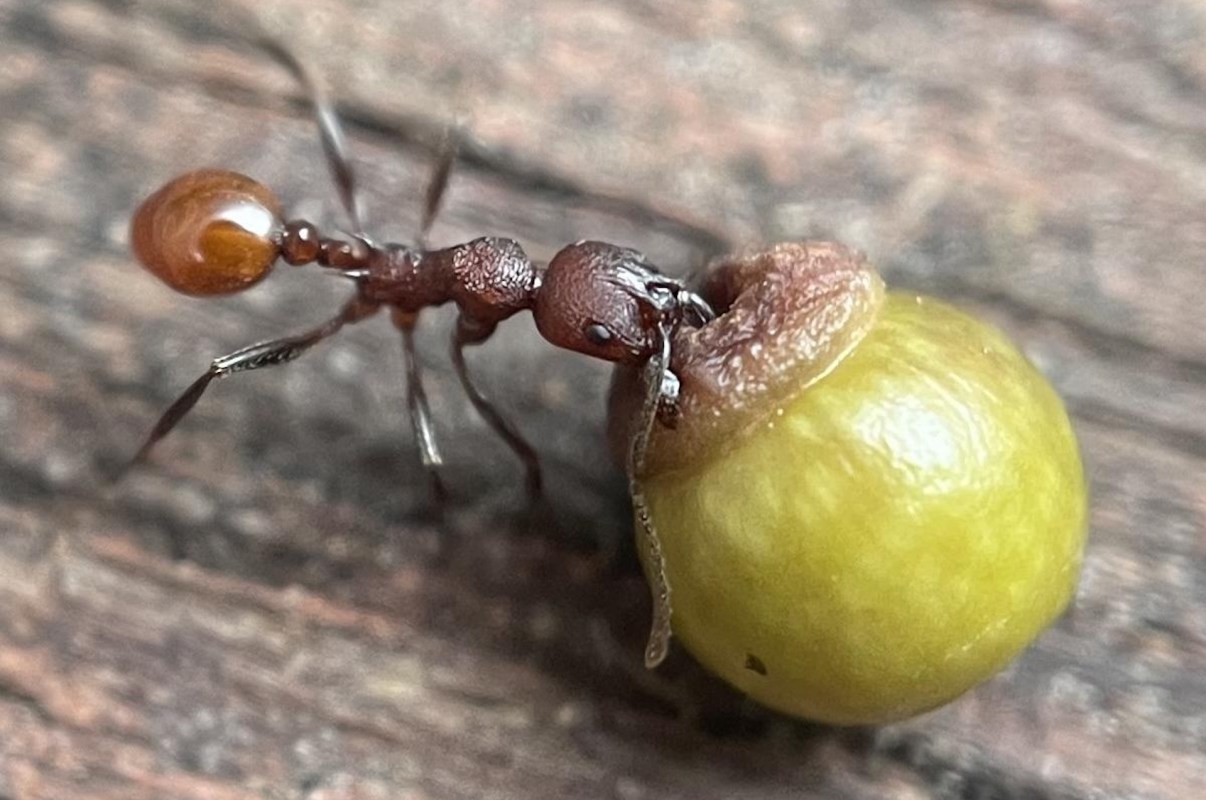
What looked like a cluster of tiny seeds near an ant nest in 8-year-old Hugo Deans' backyard turned out to be something far stranger.
The boy's sharp-eyed discovery helped reveal that ants may be eating and dispersing oak galls, not just seeds, challenging a century-old biological assumption, according to Earth.com.
Oak galls are plant growths caused by insects; they are small, circular "rooms" that act as a microhabitat for larvae. In this case, gall wasps created the galls that Hugo observed in his backyard.
Fortunately, Hugo's dad, Andrew Deans, is an entomology professor at Penn State and took notice of the proximity of the galls to the ant nest.
Subsequently, researchers at Penn State University and SUNY reported a three-way interaction among ants, oak trees, and gall-forming wasps previously unknown to science. Their study suggests ants may be responding to chemical cues on the galls that resemble the signals known to attract them to certain seeds, broadening scientists' understanding of how species interact in forest ecosystems.
The researchers examined galls produced by two cynipid wasp species, Kokkocynips rileyi and Kokkocynips decidua, which develop on red oak leaves and have a pale cap that the team called the "kapéllo," from the Greek word for "cap," according to the original report. When leaves fall in late summer and autumn, ants appear to collect those capped galls and carry them away.
TCD Picks » Quince Spotlight
💡These best-sellers from Quince deliver affordable, sustainable luxury for all




To test whether ants treated the galls like ant-dispersed seeds, the team conducted field experiments in a New York forest using dishes containing bloodroot seeds and K. rileyi galls. The ants — especially Aphaenogaster picea, a species already known for seed dispersal — removed the galls at about the same pace as the seeds over roughly 90 minutes.
Laboratory observations helped explain the behavior. Ants showed similar levels of interest in both items and frequently grasped the galls by the kapéllo, much as they handle the fatty seed attachment known as an elaiosome, which is often eaten for nutrients.
Deans explains, "Ants get a little bit of nutrition when they eat the elaiosomes, and the plants get their seeds dispersed to an enemy-free space."
In another experiment, ants mostly ignored gall bodies after the kapéllo had been removed, while showing strong interest in both isolated kapéllos and intact galls. That result indicated the cap itself was the main attractant.
Chemical analysis provided a key clue. Researchers found that the kapéllo contained free fatty acids also present in elaiosomes, compounds known to trigger ants' carrying behavior.
The findings matter beyond one unusual forest interaction. They suggest that small chemical cues can influence how insects, nutrients, microbes, and predators move through ecosystems, highlighting how much biodiversity may depend on these overlooked relationships.

Get TCD's free newsletters for easy tips, smart advice, and a chance to earn $5,000 toward home upgrades. To see more stories like this one, change your Google preferences here.







