


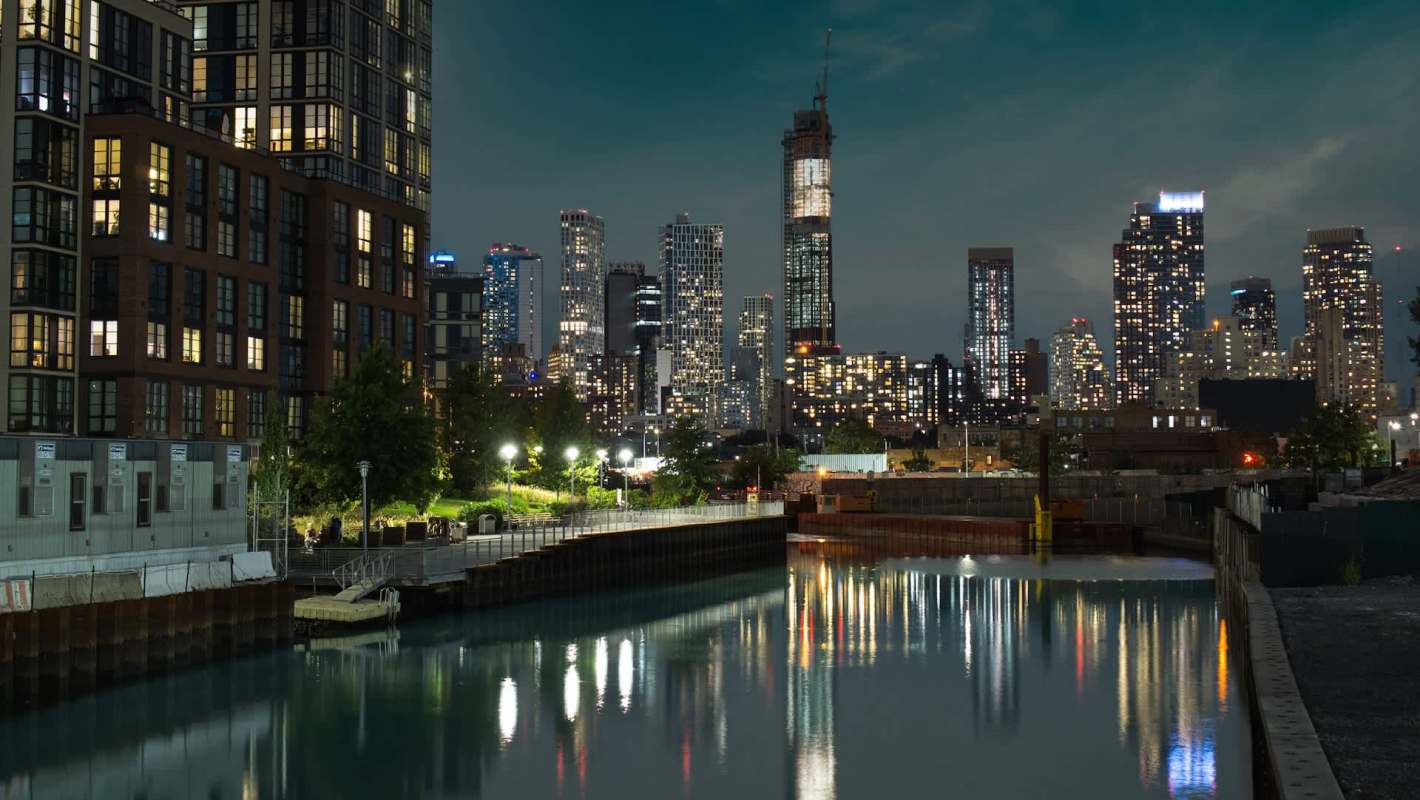
When looking for an apartment in New York City, it's always helpful to ask existing residents to get a better sense of where to look. What's the neighborhood like? Any good coffee shops? Does the area smell like a mix of sulfur, rotten eggs, and sewage?
The answer to that last question can be yes, particularly in areas along the Gowanus Canal in Brooklyn, a two-mile-long, 100-foot-wide artificial stream of water that connects directly to the New York Harbor.
And while some may think it's a luxury to live by a body of water, current and former residents say the canal has held toxic waste for decades. It's one of the city's most polluted waterways and was declared a Superfund site by the Environmental Protection Agency in 2010.
"The closest thing I can relate the smell to is — my garbage can is out front right now and is very easily accessible from the sidewalk, so people will just lean over the gate and throw their loose garbage into the can. So the bottom of our trash can is like rainwater, old dog poop bags, melted cups of ice cream, and old coffee cups. I'd say that is the smell of the Gowanus Canal," a former Park Slope resident told The Cool Down. "It only really smelled when you were walking over the bridge, though, like the surrounding streets and blocks didn't smell that atrocious."
"It smells like a rug that's been left outside rolled up for an entire winter," another Park Slope neighbor told The Cool Down. "The smell kind of wrapped you up."
But the smell could be the least of the neighborhood's problems. One environmental medicine group through New York University is speculating that there could be another alarming issue for the city to consider: Whether the Gowanus Canal is negatively impacting residents' health.
"A lot of people have had direct experiences of like, 'Oh, when I opened my window, my head hurts,' and that's not a normal thing," Aramis Valverde, a graduate student and researcher at NYU, told The Cool Down. "The concerns are not so much about littering, but these sorts of long-term effects."
Valverde launched a survey for Gowanus area residents under his former environmental medicine professor, Dr. Judith Zelikoff, a few weeks ago. The area has undergone a "real estate boom" in the last few years, according to The New York Times, despite the canal not being fixed, and some members have been questioning whether the toxicology could be linked to certain health issues, Valverde told The Cool Down.
While the area has already undergone toxicological testing under New York State, most of the tests focused on whether the canal was impacting apartment buildings, which fell under landlord jurisdiction, Valverde said. Gowanus residents had requested that the Department of Health conduct a health effects study in 2012, but it did not materialize.
In 2023, Toxics Targeting called out the "extraordinarily high levels" of trichloroethylene that were detected around the Gowanus Canal two years prior, and the public wasn't properly alerted. Trichloroethylene is a colorless, nonflammable liquid that is linked to cancers and developmental issues, and it was widely used in several household products throughout the 20th century.
TCD Picks » Quince Spotlight
💡These best-sellers from Quince deliver affordable, sustainable luxury for all




|
Which of these savings plans for rooftop solar panels would be most appealing for you?
Click your choice to see results and earn rewards to spend on home upgrades. |
 Save $1,000 this year 💸
 While the DOH warns against anyone swimming, scuba diving, or eating fish and crabs from the canal, residents still question whether just breathing the air is a problem.
"We're in the low hundreds now," Valverde said about the responses. "If we can get to the high hundreds, maybe even to the thousands, that will give us enough robust data to really sort of definitively answer some of these regulatory questions that people are concerned about."
What is wrong with the Gowanus Canal?
The problems with the Gowanus Canal started when it served as a major shipping platform in the mid-1800s. Over the years, as more facilities like gas and chemical plants moved in along the water, the nearby businesses started dumping their contaminants and waste into the canal. Industrial toxic waste dumping began to stop in the 1960s, but then raw sewage overflow became the problem.
The toxins aren't necessarily limited to the body of water, either. The neighborhood is a major flood zone, expected to expand significantly by the 2050s as sea levels rise, according to a 2016 report from the New York City Panel on Climate Change. Every time it rains heavily or storms, the canal overflows into the neighborhood — spreading the toxins and sewage.
While the New York City Department of Environmental Protection built and implemented two combined sewer overflow tanks to help remediate the Gowanus Canal from overflowing, residents argue it's still not enough to prevent flooding and stop the black mayonnaise from spreading. The tanks have a combined capacity of 12 million gallons, but the canal is estimated to receive 363 million gallons of overflow annually.
In addition to causing chronic neighborhood floods, the sewage overflow sediment then evolves into what the EPA and residents refer to as "black mayonnaise," a sludgy mix of coal tar waste, heavy metals, sewage, and petrol waste, along with toxicants like lead, benzene, mercury, arsenic, and naphthalene, Valverde told The Cool Down.
"Even some people who work at the EPA are just not sufficient to clean things up properly," Valverde said, referring to the EPA's overall resources and efforts, including its multiyear $1.6 billion cleanup effort for Gowanus. "There's not exactly a clear end game for cleaning up the canal."
There's not a straightforward way to clean up the Gowanus Canal, either.
"The rule of thumb with contaminated groundwater, you have to get rid of the source of contamination," Timothy Eaton, a professor of hydrology and geophysics at Queens College, told City & State in January. "Getting rid of the source means excavating tons of material under the water table and nobody wants to pay for that. This has to be in perpetuity; this is how bad it is."
Have other communities dealt with this before?
The Gowanus Canal is not a standalone problem in the U.S., and some communities have been successfully remediated, Valverde said.
The Thea Foss Waterway, which separates downtown Tacoma, Washington, from the Port of Tacoma, was also a large industrial hub up until the 1980s, which then dealt with similar toxic pollution, according to Valverde. The EPA declared it a Superfund site in 1983 and warned that the waterway was contaminating sediment in the region, which could impact human health, and creating tar pits in the area, which contaminated the groundwater. The city underwent a 20-year process to address the problem.
But Gowanus seems to have a unique problem that could challenge whether it can be fixed.
"Most Superfund sites, with some exceptions, are remediated without relocation," Valverde said. "But few are remediated while experiencing a surge in residents, which seems to be why Gowanus has seen an effort to put development before remediation in a counterproductive manner."
Despite the area's increased risk of flooding — and the smell — since 2021, the city has implemented rezoning plans that have added thousands of residential units to the area, welcoming 20,000 new residents. As more buildings are constructed and families move in, the city still hasn't been able to contain or address the Gowanus Canal's growing contamination issue, let alone look into whether it's impacting locals. This is what Valverde hopes his survey can help get to the bottom of.
"There needs to be an initial indication of there's a problem here, or there's something that needs to be investigated," he said. "We already have the robust data to say that there's something there, and we just have to see what [it's doing]."

Get TCD's free newsletters for easy tips to save more, waste less, and make smarter choices — and earn up to $5,000 toward clean upgrades in TCD's exclusive Rewards Club.
Cool Picks




