


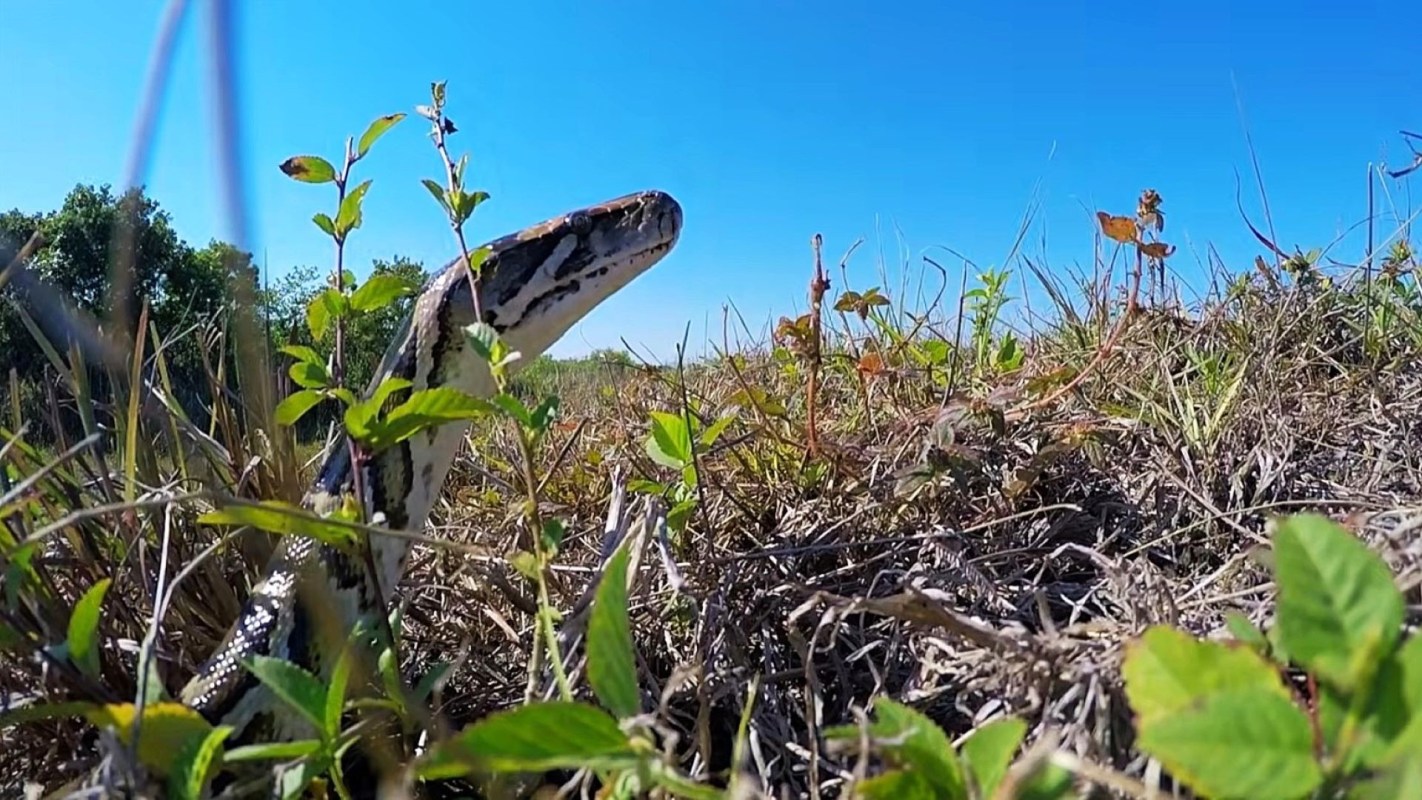
Florida is warning would-be hunters that Burmese pythons, one of the Everglades' most destructive invasive species, are easier to detect on land than in the water.
A new state PSA tells searchers to check levee banks and trees, and to avoid confronting the huge snakes in waterways where the reptiles have the advantage.
What's happening?
As Popular Science noted, the Florida Fish and Wildlife Conservation Commission has put out a safety-focused video for people trying to track and remove Burmese pythons from the Everglades. The message arrives ahead of the state's annual Florida Python Challenge, a summer campaign meant to slow the spread of one of the region's most disruptive predators.
Even with estimates placing the Everglades population at roughly 100,000 to 300,000 Burmese pythons, most people are unlikely to notice one. Their camouflage is so effective in the subtropical environment that conservationists believe fewer than 5% are visible to the average person.
For the best odds, the commission says to look along dry edges and around vegetation rather than in the canals: during warmer months, pythons often bask on levee banks or stay near trees. Hunters are also advised to identify the species by the arrow-shaped mark on the head, the dark spots around the eyes, and the giraffe-like pattern on the body, while avoiding snakes in the water.
Why does it matter?
Burmese pythons are an invasive species that can severely disrupt native ecosystems by preying on local mammals, birds, and reptiles.
TCD Picks » Quince Spotlight
💡These best-sellers from Quince deliver affordable, sustainable luxury for all




In a place as ecologically important as the Everglades, that disruption can ripple outward, affecting biodiversity, habitat stability, and the health of a landscape that supports communities, recreation, and tourism across South Florida.
The issue also raises a direct human safety concern. Florida is encouraging ordinary people to help, but only if they understand the risks involved. These snakes can grow to around 13 feet long, and the commission's video stresses that proper clothing, gloves, and a snake-handling tool are essential, even in punishing summer heat.
Limiting invasive species can support a healthier Everglades while also reducing the likelihood of dangerous encounters for residents and visitors alike.
What's being done?
Florida's current strategy combines public education, organized removal efforts, and reporting tools. Hunters who successfully capture a python are instructed to kill it humanely under state guidelines, record the location using latitude and longitude, and take multiple photos that can help conservationists monitor the reptiles' spread.
For people who want to help but do not want to physically capture a snake, the state says sightings can still be reported through the Exotic Species Hotline at 888-IveGot1 or, as Popular Science reported, through www.IveGot1.org or the IveGot1 smartphone app.
Managing invasive species often depends on a combination of professional expertise and public participation. In this case, even knowing when not to engage — especially in the water — can make the response safer and more effective.
As the video puts it, hunters should "prepare [themselves] by envisioning large snakes over six feet in length that are outstretched or coiled up," and ask, "Do I really want to do this, or should I leave it to the professionals?"

Get TCD's free newsletters for easy tips, smart advice, and a chance to earn $5,000 toward home upgrades. To see more stories like this one, change your Google preferences here.







