


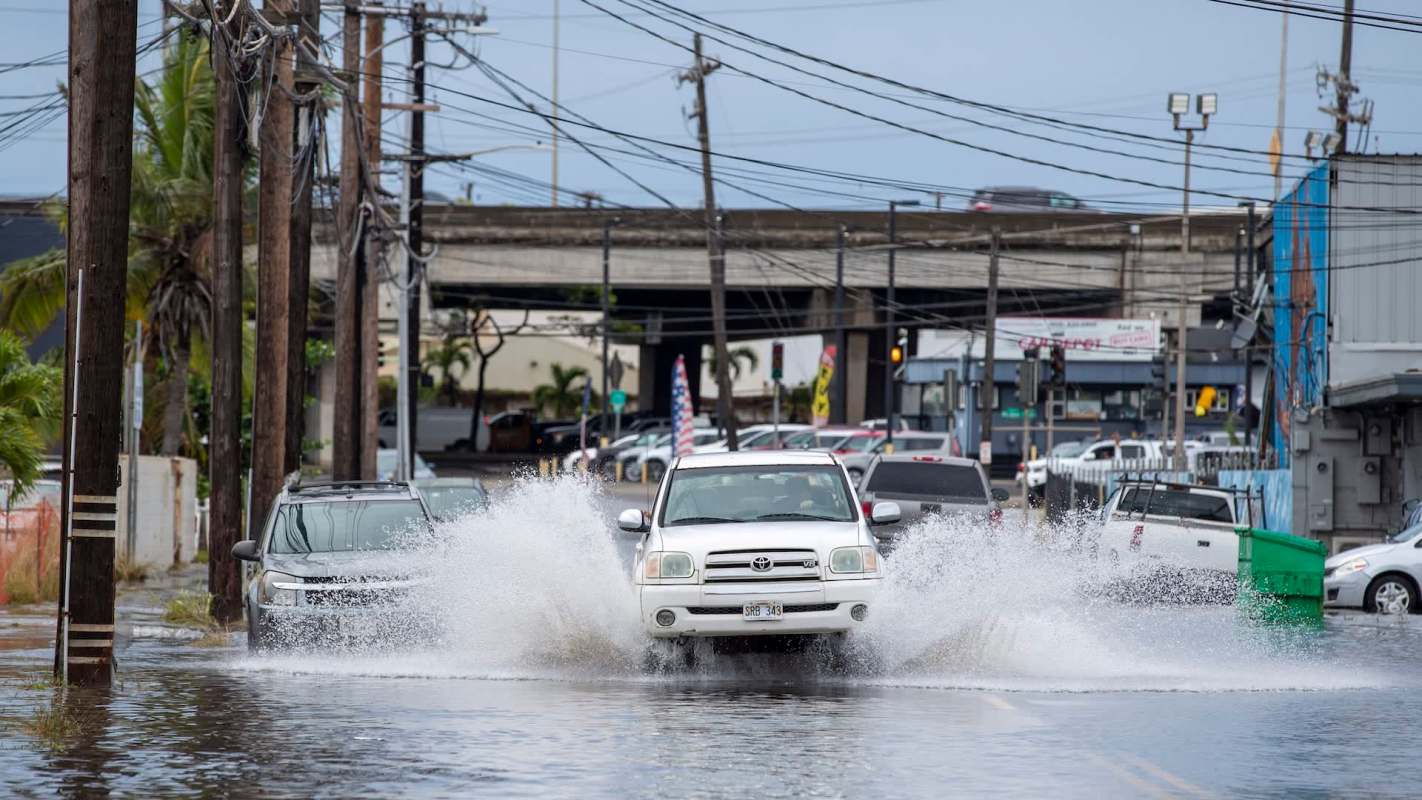
Officials in Hawaiʻi are assessing the immense damage wrought after back-to-back heavy rain systems caused the worst flooding seen in the state in 20 years, Hawaii News Now reported.
What's happening?
On March 15, Surfer covered a then-ongoing Kona low storm that had been "pummeling the Hawaiian Islands" for days.
A Kona low is a system common in Hawaiʻi from the late fall through early spring, "associated with a southward plunge of cold air over the central Pacific Ocean," per AccuWeather.
Heavy rains battered the islands from March 13-16, with a second, stronger Kona low storm striking Thursday, prompting the National Weather Service to issue a flood watch for the weekend.
Although evacuation orders were lifted at 2:41 p.m. local time Saturday, more than 2,000 households were left without power as of Sunday, according to CNBC.
As the outlet noted, many power outages were Public Safety Power Shutoffs, instances in which utility providers such as Hawaiian Electric proactively cut power to limit public risk, typically during active wildfires.
Areas like Oahu were hit with "30 and 40 inches" of rain between the two Kona low systems, Hawaii News Now reported.
At a press conference Saturday, Honolulu Mayor Rick Blangiardi acknowledged that the rain and subsequent flooding outstripped forecasts, plunging the state into chaos.
"What was supposed to be 2 to 3 inches of rain, it became 10 in a matter of only three hours. And that is what's really created a lot of tension and, quite honestly, damage over the last 48 hours," he stated.
Why is this concerning?
According to Blangiardi, the storm systems were unlike any he'd seen before.
TCD Picks » Quince Spotlight
💡These best-sellers from Quince deliver affordable, sustainable luxury for all




|
Which of these savings plans for rooftop solar panels would be most appealing for you?
Click your choice to see results and earn rewards to spend on home upgrades. |
 Save $1,000 this year 💸
 "I've lived in Hawaiʻi for 61 years. I've seen post-storm stuff. I've never seen the ocean as brown as we saw today," he remarked.
The catastrophic rains and flooding in Hawaiʻi are part of a phenomenon known as extreme weather, which, as CNBC noted, is linked to rising temperatures caused by human activity.
Sustained warmer weather and hotter seas increase atmospheric evaporation, which supercharges volatile weather patterns, making them costlier, more frequent, and deadlier.
Early estimates indicate that the costs of this event could top $1 billion, though the damage is still being assessed.
No fatalities have been reported, but 233 rescues were carried out in the raging floodwaters.
What's being done about it?
On Sunday, Hawaii News Now and KHON published articles with links to organizations providing on-the-ground assistance to Hawaiians affected by the storm.
Honolulu Civil Beat also provided details on how to volunteer or donate to support recovery in Hawaiʻi, and Hawaiian Electric updated customers with instructions on safely restoring power after a PSPS.

Get TCD's free newsletters for easy tips to save more, waste less, and make smarter choices — and earn up to $5,000 toward clean upgrades in TCD's exclusive Rewards Club.
Cool Picks






