


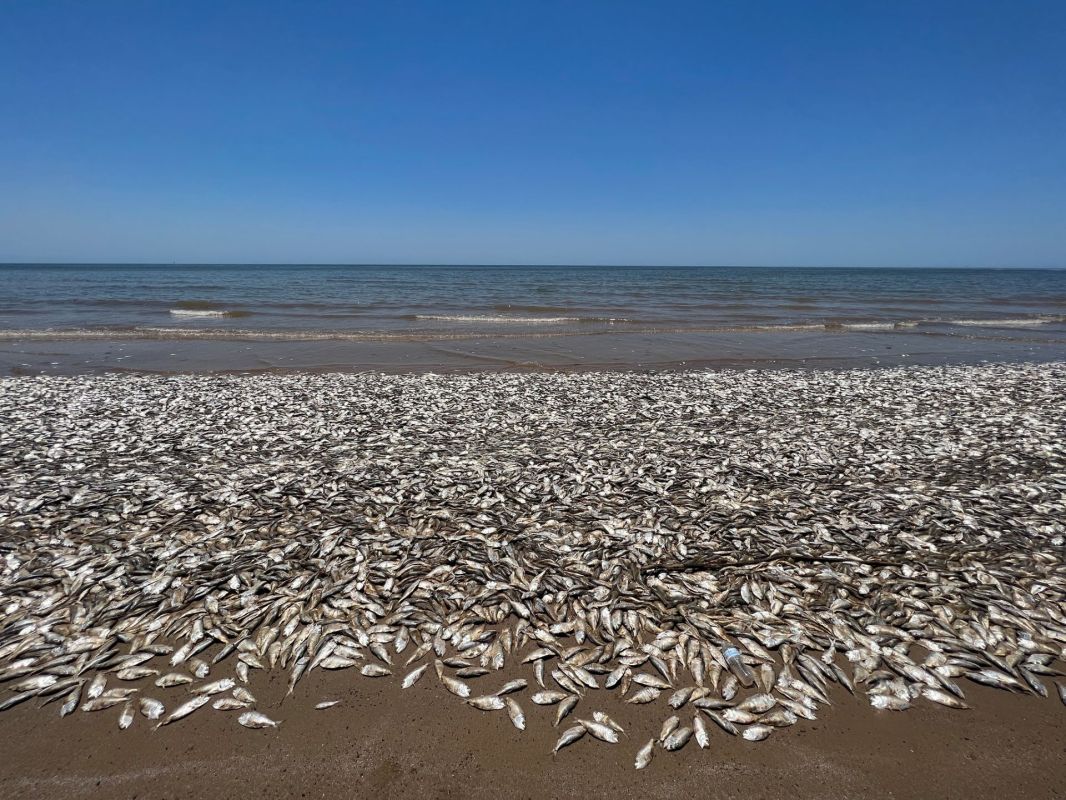
Beachgoers on a Texas shoreline near Houston were left floundering when thousands of dead fish washed up on the beach, Insider reported.
What's happening?
The fish, most of which were Gulf menhaden, were killed by low oxygen levels in the surrounding water and blanketed shores near Quintana Beach for miles.
A Facebook post by Quintana Beach County Park explained that "when water temperature rises above 70 degrees Fahrenheit, it becomes hard for menhaden to receive enough oxygen to survive." And it's worse in shallow water.
The world's oceans have lost around 2% of their oxygen since the 1950s and, if we continue at the rate we're going, are expected to lose up to 4% by the year 2100.
"Water can only hold so much oxygen at certain temperatures, and certainly we know that seawater temperatures are rising," Katie St. Clair, the manager of the sea life facility at Texas A&M University at Galveston, told NPR. "It is concerning and something that needs to be monitored."
Julia Wellner, a glacial marine geoscientist at the University of Houston and one of a team of scientists who were there to study beach sediment, tweeted a harrowing video of the scene.
"Yesterday I took a dozen international visiting sedimentologists to Quintana Beach, TX," she wrote. "I might be an expert on some things on the beach but this fish kill baffled all of us. Went for miles. Low oxygen sure but why here and now? Why this dramatic? Scary future."
Yesterday I took a dozen international visiting sedimentologists to Quintana Beach, TX. I might be an expert on some things on the beach but this fish kill baffled all of us. Went for miles. Low oxygen sure but why here and now? Why this dramatic? Scary future. @TPWDnews pic.twitter.com/TVBdJEJL7v
— @wellner@mastodon.green (@houston_wellner) June 11, 2023
Why is this event concerning?
Wellner may have said it best because this mass kill points to a "scary future," indeed. Oceans comprise 97% of the liveable space on Earth and are pivotal to sustaining life.
Oxygen in the ocean is just as important as it is on land because the plants and animals that live in the ocean need it to survive. If deoxygenation continues to worsen, it will have devastating effects on marine ecosystems as well as life on land.
Deoxygenation in deeper ocean waters also produces toxic planet-warming gases that could make their way to the surface and be released into the atmosphere and contribute to further warming.
TCD Picks » Quince Spotlight
💡These best-sellers from Quince deliver affordable, sustainable luxury for all




According to a report by the International Union for Conservation of Nature quoted by Copernicus Marine Service, "Ocean deoxygenation is one of the most pernicious, yet under-reported side-effects of human-induced climate change."
The burning of dirty energy, like coal, gas, and oil, along with deforestation, agriculture, and other human activities, has sent an abundance of heat-trapping gases into our atmosphere, and the ocean absorbs more than 93% of the Earth's warming from our changing climate.
What can be done to slow ocean deoxygenation?
Reducing our creation of planet-warming gases and ocean nutrient pollution is the best way to slow ocean deoxygenation.
We can do this by speeding up the switch from dirty energy sources, like gas, coal, and oil, to clean energy sources, like wind and solar power, in addition to reducing our usage of single-use plastic, which is created using oil and typically ends up polluting the ocean even further.

Join our free newsletter for cool news and cool tips that make it easy to help yourself while helping the planet.
Cool Picks






