


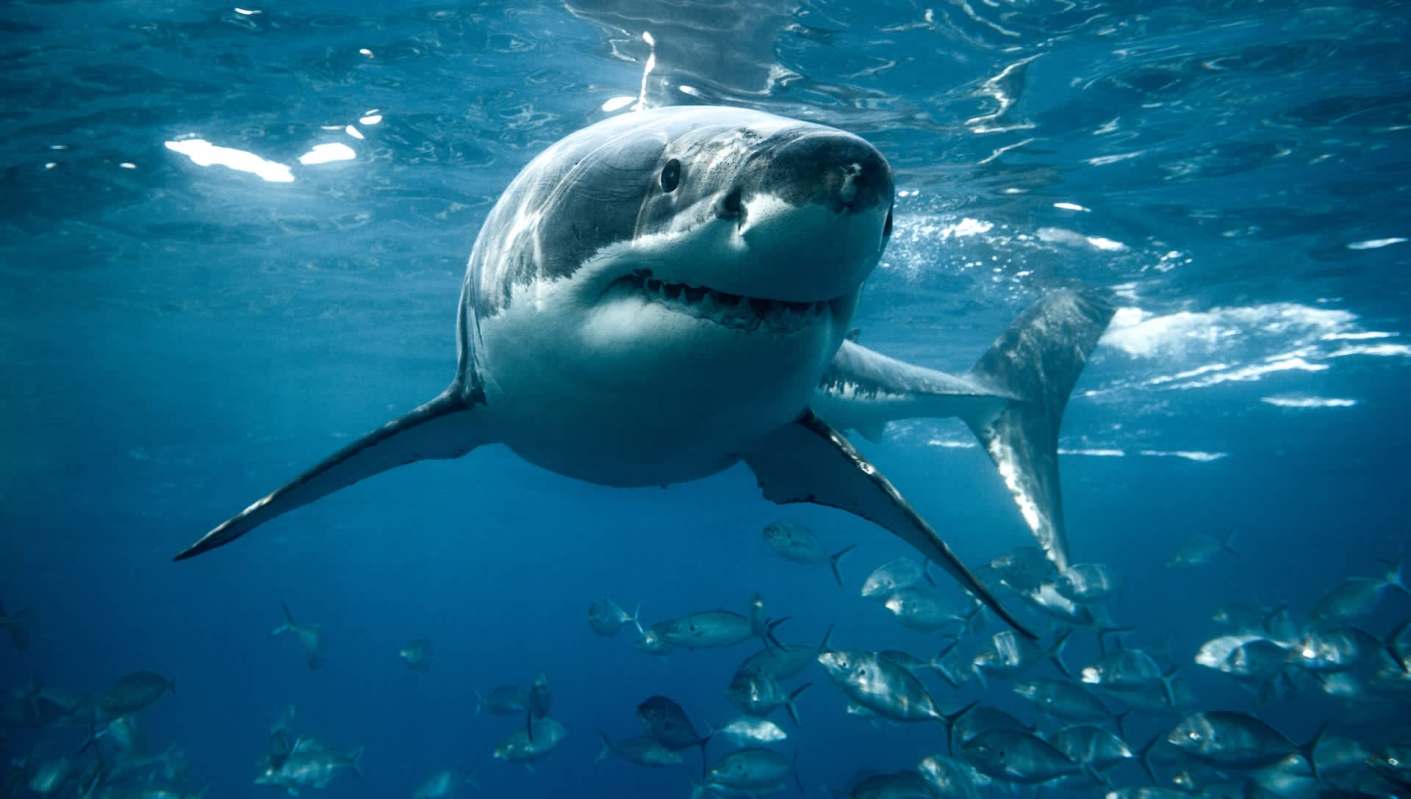
A long-lost great white shark tag has revealed one shark's stunning journey from South Africa to Southeast Asia, giving new insight into the apex predator's migratory behavior.
In 2012, researchers with the marine conservation organization OCEARCH tagged a young female great white shark named Alisha off the coast of South Africa. The goal was to study her movements within the southern African region. But over the next four years, Alisha — and her satellite tag — would go on an unexpected journey.
Alisha resurfaced in Indonesia in 2016, some 23,000 miles from where she was originally tagged. Her journey is the first confirmed link between great white shark populations in South Africa and Southeast Asia, according to a Mongabay report. Before Alisha's data surfaced, scientists assumed that South African great white sharks were completely isolated from shark populations in Asian and Australian waters.
For years, however, scientists didn't know what became of Alisha. Her tag stopped transmitting, suggesting she had either died or the tag had been damaged. It wasn't until 2024 that her tag was finally returned to scientists by an Indonesian fisherman, providing "rare evidence of transoceanic connectivity," according to a Mongabay report.
Alisha's journey unfortunately ended when she became entangled in the fisherman's longline gear in November 2016. Mistaking her for a mako shark, the fisherman kept the tag hidden for nearly a decade, fearing repercussions for the bycatch. It was only after the Indonesian non-profit Project Hiu, which works with local shark fishers, offered a reward for returning research equipment that the tag finally made its way back to scientists in 2024.
In June, Alisha's journey — and its scientific significance — was recorded in a peer-reviewed study, becoming the first documented movement of a great white shark between South Africa and Southeast Asia.
TCD Picks » Quince Spotlight
💡These best-sellers from Quince deliver affordable, sustainable luxury for all




"You've never really seen a shark displaced so far," Dylan Irion, the paper's lead author and co-founder of diving and research organization Cape RADD, told Mongabay.
Irion added that Alisha's journey was remarkable not only for its distance, but also because she passed through vastly different habitats — from the cold-temperate waters off South Africa to the warm tropical waters in Indonesia.
The study notes that sightings of great white sharks in Southeast Asia — particularly in Indonesia — have been extremely rare. Yet, Alisha's misidentification as a longfin mako by the local fisherman suggests that other white sharks may have been similarly overlooked.
Great white sharks are considered a vulnerable species with decreasing populations by the International Union for Conservation of Nature. A lack of data, however, makes estimating great white populations nearly impossible.
|
Who should be paying for space exploration? Click your choice to see results and speak your mind. |
 The government 🏛️
 The National Oceanic and Atmospheric Administration reports that the biggest threats to great white sharks worldwide are bycatch, overfishing, and habitat impacts. In South Africa, shark-control programs and longline fishing continue to kill dozens of white sharks annually. In Indonesia, shark fishing is a vital source of income, with fishers selling both fins and meat.
"Sharks generally take a long time to reach maturity," Irion told Mongabay. "If females are not surviving, then their lifetime reproductive output is low. Couple that with a low population, and it doesn't take much to severely limit the potential for population growth."
Alisha's story is more than a remarkable account of one shark's globe-trotting journey. It highlights the urgent need for international conservation work and a shared responsibility toward wildlife protection, especially for sharks facing so many avoidable threats.
Irion told Mongabay, "The reason for publishing [the study] is to show how important it is to work across borders and collaborate internationally, as well as to build relationships with the local communities … to find new ways of coexisting."

Join our free newsletter for good news and useful tips, and don't miss this cool list of easy ways to help yourself while helping the planet.







