


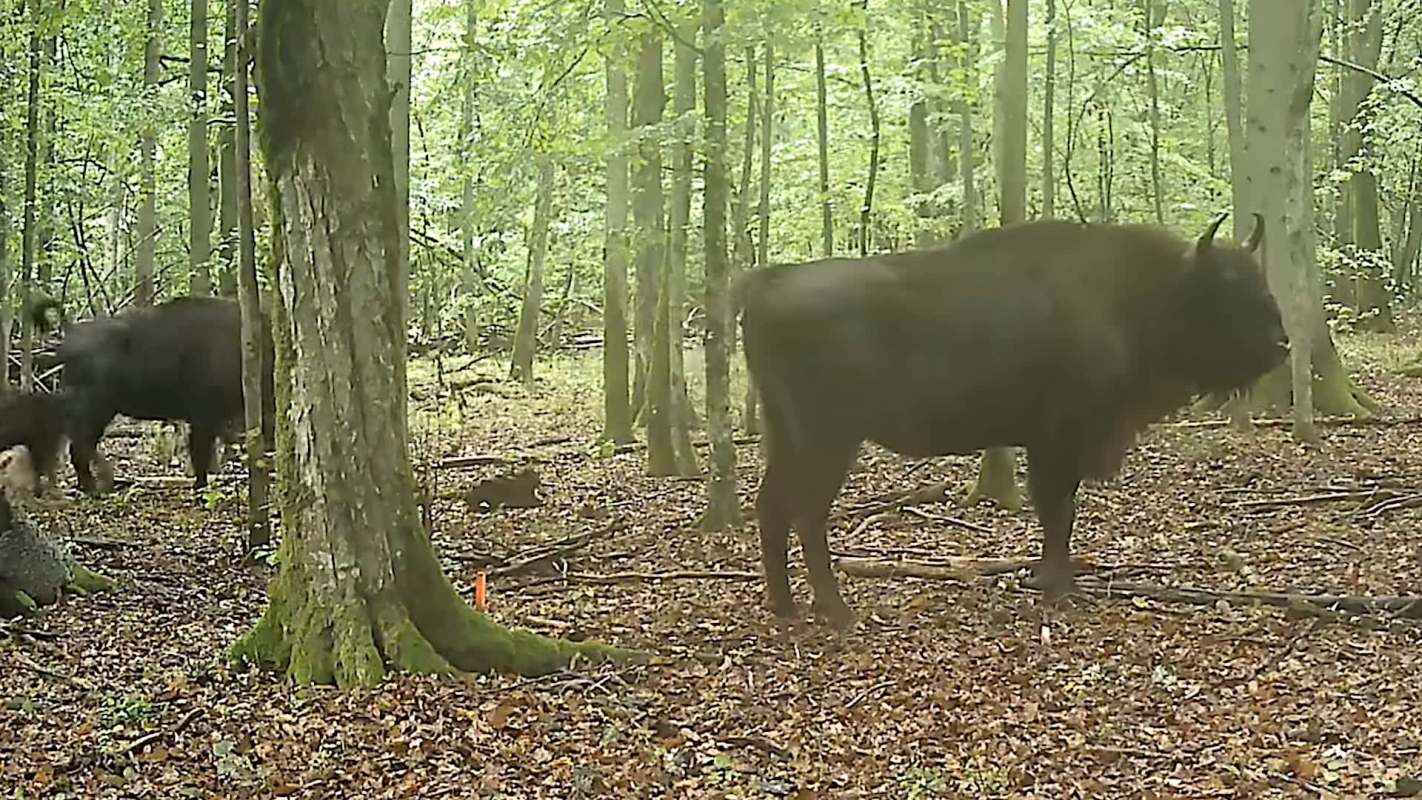
A camera trap in Poland's Białowieża Primeval Forest, one of Europe's last ancient forests, has captured wolves attacking a herd of European bison for the first time in the area.
As IFLScience detailed, scientists recorded the footage on September 15, 2025, giving them a rare view of a meeting between a recovering predator and an animal that once vanished from the wild.
What happened?
The footage accompanies new research, published in the journal Ecology and Evolution, and shows a pack of seven wolves pursuing 11 bison, including a newborn calf.
A clip of the encounter was shared on the publication's YouTube account (@IFLScienceOfficial).
In the footage, the wolves bite the calf and begin pulling it away before two adult female bison charge in and drive them off. The pack then comes back for a second try, but the herd tightens around the calf, and the encounter eventually ends, as IFL Science recounted.
"To our knowledge, we present the first video-recorded evidence of wolves attacking a European bison herd in the Białowieża Primeval Forest, focusing on a newborn calf," the study's authors wrote in its abstract.
TCD Picks » Quince Spotlight
💡These best-sellers from Quince deliver affordable, sustainable luxury for all




Wolves are known to hunt American bison in North America, but verified wolf-bison encounters in Europe remain exceptionally rare, IFL Science said. In this case, the wolves did not make a kill on camera, but they clearly targeted the herd's most vulnerable member.
Why does it matter?
By 1919, the European bison, the continent's largest land mammal, had disappeared from the wild. The species was returned to Białowieża in 1952 through reintroduction efforts, and IFLScience reported that Poland now has the world's largest population of European bison.
The camera traps gave researchers a window into predator-prey relationships that may be re-emerging as the ecosystem recovers. IFL Science noted that the researchers aren't concerned that the wolves' predation threatens bison conservation efforts.
Healthier ecosystems tend to be more resilient, and when large herbivores and predators both have room to survive, forests can function in a more natural way.
These observations can also help scientists make better decisions about habitat protection, land use, and reducing conflict between wildlife and nearby communities.
What are people saying?
The researchers took a careful tone in describing what they observed.
"If predation on European bison, specifically young animals, occurs more frequently than previously assumed, wolves could play a small but potentially important role in the natural regulation of bison numbers," they wrote in the research paper.
They pointed out that wolves could help ensure that bison wouldn't overrun the area and cause conflicts with nearby humans. As conservationists weigh adding European bison to other areas with predators, it's worth bearing in mind.
"Our finding may have implications for the conservation and future reintroductions of European bison in areas where they co-exist with large predators," the researchers said.

Get TCD's free newsletters for easy tips, smart advice, and a chance to earn $5,000 toward home upgrades. To see more stories like this one, change your Google preferences here.






