


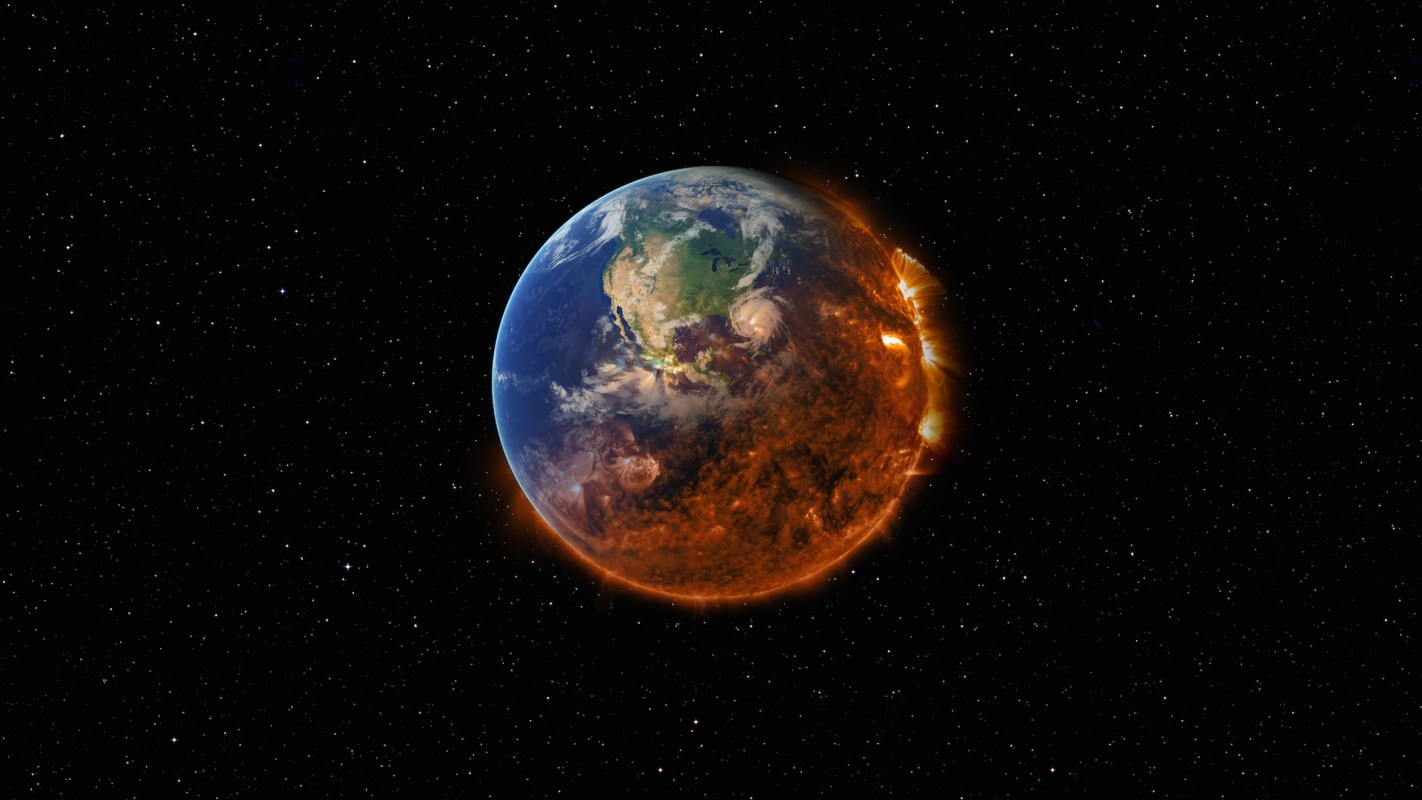
New research suggests Earth can experience climate shocks, even with little or no ice at the poles, at a surprisingly fast pace.
What's happening?
Professor Chengshan Wang of the China University of Geosciences led an international research team examining sediment cores from China's Songliao Basin from about 83 million years ago in the Late Cretaceous, ScienceDaily reported.
At the time, the planet had very high carbon dioxide levels and almost no polar ice.
Many researchers had tied abrupt climate swings mainly to large ice sheets growing and melting. That view fit the last Ice Age. Greenland warmed by up to 16 degrees Celsius within decades, and repeated pulses of icebergs disrupted circulation in the North Atlantic.
But the new study points to a different mechanism of slow changes in Earth's orbit and axial wobble.
The team linked precession-related changes in sunlight, especially in the tropics, to recurring wet-dry shifts at roughly 4,000- to 5,000-year intervals. Longer 100,000-year orbital rhythms shape their intensity.
TCD Picks » Quince Spotlight
💡These best-sellers from Quince deliver affordable, sustainable luxury for all




Researchers combined geochemical evidence and other data to compare patterns in the cores with predictions for how tropical solar radiation changed over time, according to ScienceDaily.
Why do these findings about climate shock matter?
They challenge the idea that ice sheets are necessary for sudden climate disruptions, suggesting that even an ice-free planet may not be as stable as scientists once assumed.
The Late Cretaceous may offer one of the best natural comparisons for a much warmer world.
"During the Late Cretaceous, atmospheric CO2 levels reached about 1,000 parts per million — comparable to projections for the end of this century," said Michael Wagreich, a paleoclimatologist at the University of Vienna, as reported by ScienceDaily.
If global temperatures continue rising, understanding how climate systems behaved under those conditions before could help scientists better anticipate risks.
That understanding could help people adapt to shifting rainfall and longer droughts, which can affect things like crop yields and wildfire risk.
The study also suggests that some high-frequency climate oscillations may be more predictable than previously thought, since Earth's orbital patterns are stable and well understood.
What's being done?
The researchers used cores from the Cretaceous Continental Scientific Drilling Project, a global drilling initiative that began in 2006. They paired the cores with newer analytical and modeling tools to detect subtle climate rhythms hidden in the rock record.
That kind of paleoclimate work can improve modern forecasting by showing how a hotter Earth responds over long timescales. Better forecasts can help governments and farmers prepare for changes in precipitation and heat before they become more disruptive.
"High-frequency climate oscillations, like those seen in the Cretaceous, could also emerge in a warmer future -- potentially in ways that are more predictable than previously thought," the study's first author, Zhifeng Zhang, said in the release.

Get TCD's free newsletters for easy tips, smart advice, and a chance to earn $5,000 toward home upgrades. To see more stories like this one, change your Google preferences here.






