


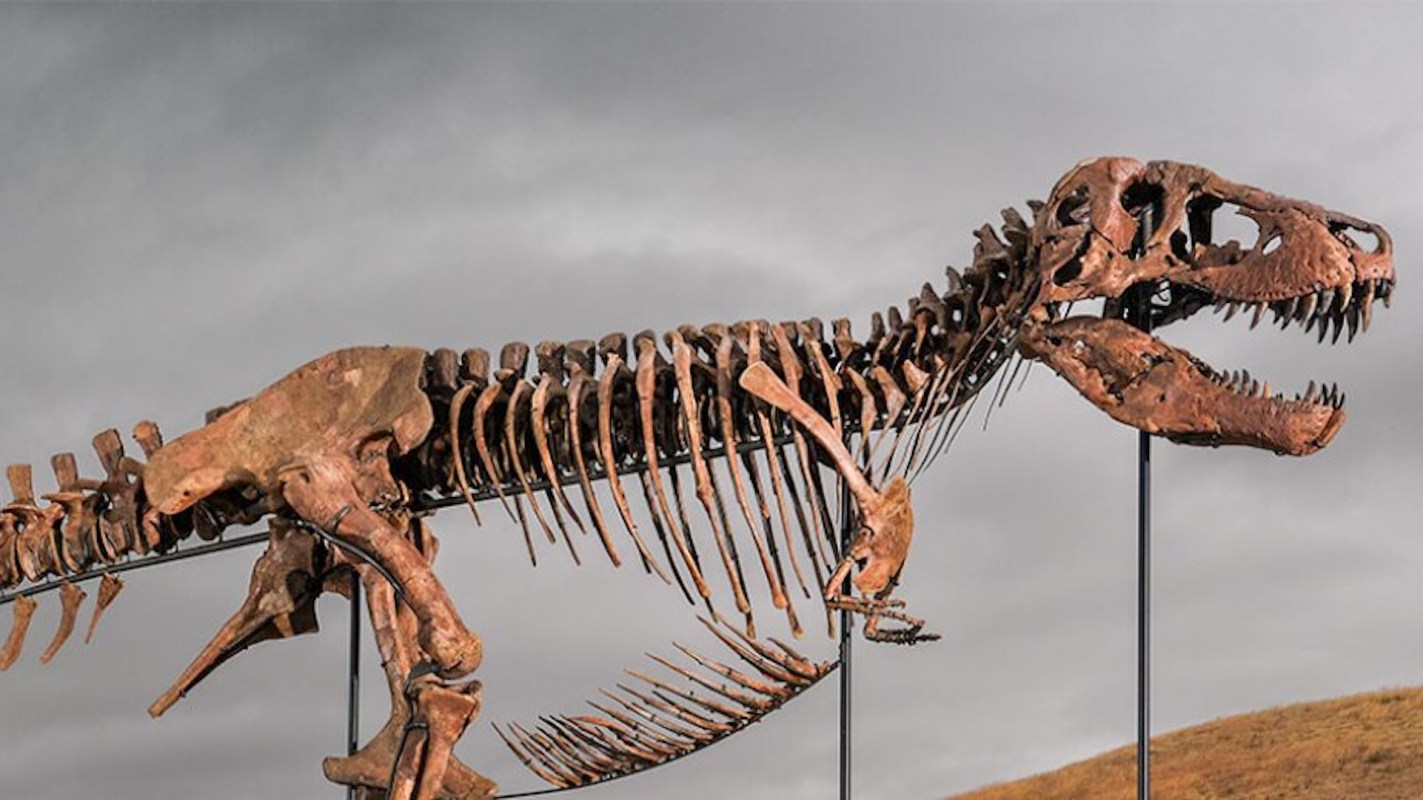
A giant Tyrannosaurus rex fossil brought a record-setting auction price, highlighting both the appetite for top-tier dinosaur specimens and scientists' unease about where discoveries like this ultimately end up.
The Guardian reported that the prehistoric predator was effectively sold in New York as a luxury collectible, with bids rising far above the expected range.
What happened?
At Sotheby's on Tuesday, "Gus," the nicknamed T. rex skeleton unearthed in South Dakota, sold for $50.1 million including fees, as the outlet detailed. The steep price was the highest amount ever paid at auction for a dinosaur fossil, per the Guardian.
The publication noted it was also well above the projected $20 million to $30 million range, thereby surpassing the previous dinosaur auction record set by Apex, a stegosaurus that sold for $44.6 million in 2024.
Sotheby's said Gus is among the largest T. rex fossils on record, standing about 12.5 feet tall, stretching roughly 38 feet long, and measuring 61% complete by bone count, The Guardian said.
The outlet added that the specimen was found on private land in Harding County, South Dakota, excavated by Theropoda Expeditions from 2021 to 2023, and named for landowner Gary "Gus" Licking.
TCD Picks » Quince Spotlight
💡These best-sellers from Quince deliver affordable, sustainable luxury for all




"This result has been years in the making," Cassandra Hatton, Sotheby's vice-chairman and global head of science and natural history, told the Guardian. "Gus is not only an exceptional find, but a specimen that's been excavated, documented, prepared and cared for with real excellence."
Why does it matter?
Beyond the record price, the auction revives a broader debate about where scientifically important fossils should end up.
Researchers' main concern is access. When a major specimen goes into private ownership, scientists may have little or no chance to examine it, limiting what can be learned about extinct animals, ancient ecosystems, injuries, growth patterns, and evolution.
That concern is sharper in Gus's case because the fossil appears to preserve signs of the dinosaur's life, as the Guardian noted. Sotheby's said the skull and jaw show bite marks, while ribs and belly ribs contain healed fractures, details that could shed light on combat, scavenging, and survival, per the outlet.
"The current trend towards dinosaur fossils being marketed and sold like rare artworks at vast prices by auction houses is very concerning," Professor Richard Butler, a vertebrate paleontologist at the University of Birmingham, warned the Guardian.
Butler further expressed concern to the outlet that they are becoming a "status symbol" or a "commodity."
What's being done?
The dispute over Gus is not mainly about whether the sale was legal. As the Guardian noted, fossils found on private land in the U.S. can often be sold lawfully by landowners, unlike in some countries where such finds automatically belong to the state.
Instead, the outlet says scientists are making a public-interest case that exceptional fossils should remain in museum collections, where they can be studied, displayed, and shared more broadly.
Gus shows how a sale can follow the law and still be viewed by researchers as a scientific loss.
Auction houses can ensure exceptional upkeep of the fossils, but their role as middlemen extracting high prices can potentially cut out future study.
"Fossils have been bought and sold for hundreds of years, but prices are increasingly out of the reach of museums, much to the detriment of science," Butler concluded to the Guardian.

Get TCD's free newsletters for easy tips, smart advice, and a chance to earn $5,000 toward home upgrades. To see more stories like this one, change your Google preferences here.






