


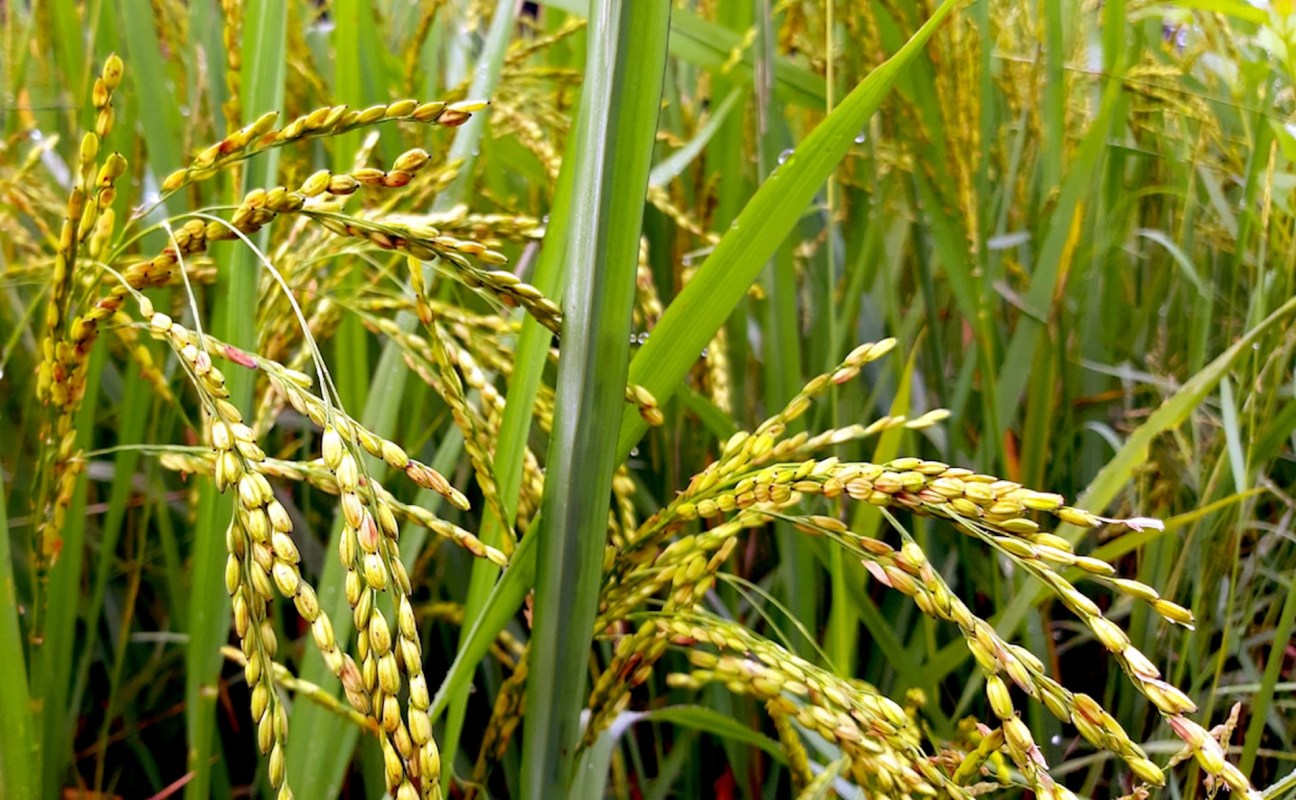
Researchers are working on a way to give plants a shot in the arm against diseases.
Interestingly, it's not an immunity-boosting vaccine, a spray, or a fertilizer that's being developed but rather an entirely new immune system. If they find scalable success, it could be transformative for our food supply.
Plants have a general immune system, though it's not adaptive like the kind in animals. In a scenario that could be pulled from the pages of a botany-based version of "The Island of Dr. Moreau," experts fused parts of the animal immune system with that of a plant. They used a rice plant as a model, and the new system proved to provide protection from a pathogen, all per an abstract published by the journal Science.
And unlike Moreau's fictional test subjects, the rice shouldn't turn violent on the scientists. In fact, the findings could hold great promise for farming.
"Made-to-order synthetic plant immune receptors provide an opportunity to tailor resistance to pathogen genotypes present in the field," the experts said in the journal.
The innovation gives plants a boost in the battle against pathogens that has been ongoing for millions of years. Plants have internal "security cameras," as Big Think described it, that identify pathogens and diseases as they infiltrate crops. But the menaces have evolved over time to get past the plant's sentinels.
The rice plant's generic immune system was studied by a team led by Jiorgos Kourelis, from the United Kingdom's University of East Anglia. It can naturally detect hundreds of infiltrators. By comparison, adaptive human antibodies can recognize a quintillion (that's a lot) "highly precise molecular patterns," according to Big Think.
To prove the concept, the team modified a protein immunity receptor in the rice plant, helping it to bind to fluorescent proteins and work more like our antibodies.
Then, they exposed the plant to a pathogen made to "express fluorescent proteins," as Big Think's Peter Rogers summarized the research.
The findings were highlighted by less luminescence, a result of the plant's immune system functioning more like an animal's germ-fighting ability.
TCD Picks » Quince Spotlight
💡These best-sellers from Quince deliver affordable, sustainable luxury for all




"The bioengineered plants showed significantly less fluorescence, suggesting that the … antibody hybrid molecules produced by the plants successfully blocked the virus from replicating," Rogers wrote.
Researchers have already been giving plants adaptation boosts as our planet overheats. A team at the University of Maryland has developed heat-resistant apples, for example.
Annual crop loss from pathogens and pests in the United States is estimated to cost $220 billion, according to the journal Nature.
Big Think reported that there's a fungal pathogen that is "responsible for 30% of rice production loss globally." That volume could provide meals for 60 million people, per the story.
With the global population expected to continue growing — the U.S. Census Bureau expects it to hit 10.2 billion by 2060 — there will be more strain on the food system.
By making crops more adaptive to disease, the immunity research could help to strengthen food security around the world.
"That would be a welcome development for the world's farmers and the people they feed," Rogers wrote.

Join our free newsletter for weekly updates on the coolest innovations improving our lives and saving our planet.
Cool Picks





