


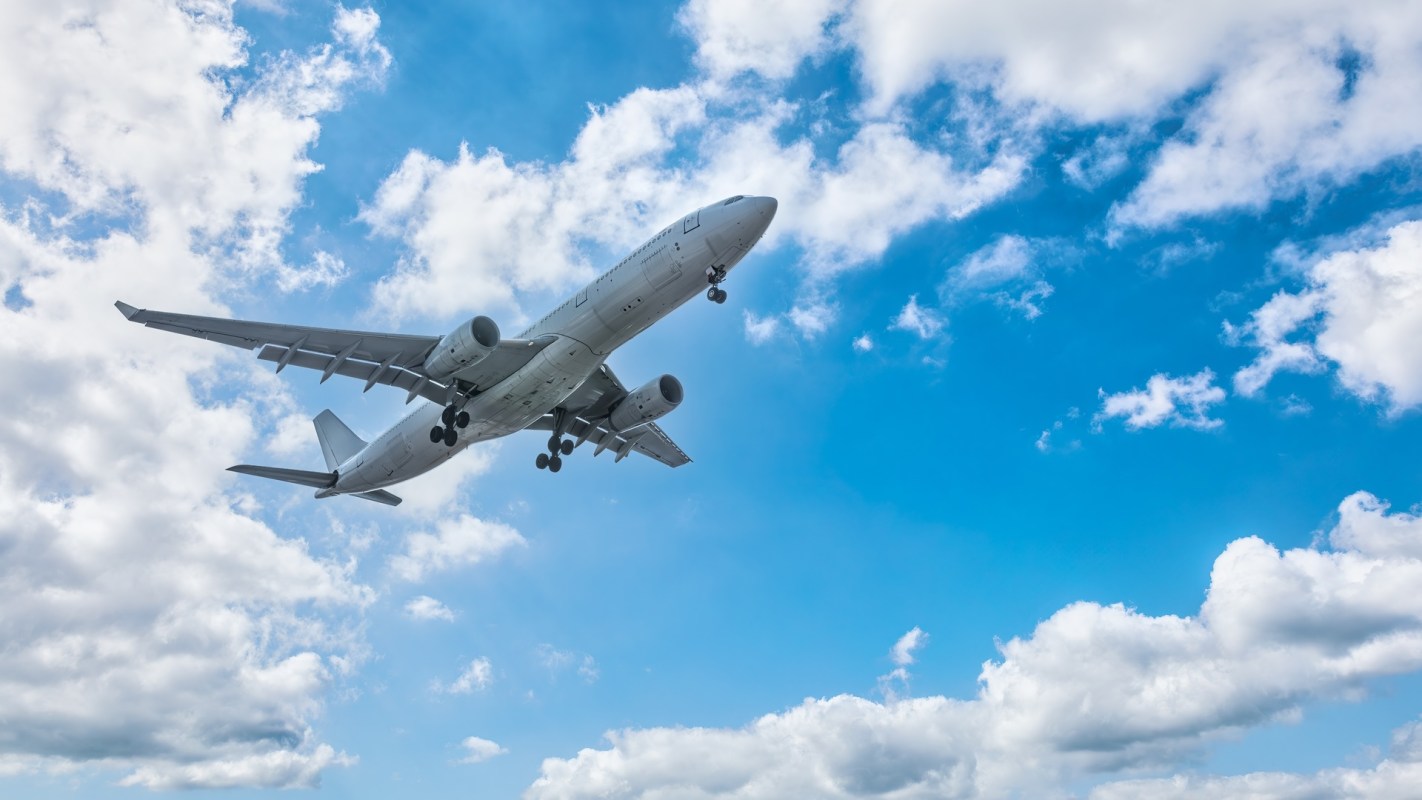
An innovative research group is turning food scraps into air miles.
That's because the University of Illinois Urbana-Champaign team's process can convert the waste into sustainable aviation fuel, or SAF, that meets industry performance standards without adding petroleum, according to a news release.
"This has huge potential for business opportunities and economic development," corresponding author Professor Yuanhui Zhang said.
It also helps limit pollution from two sources: food waste and plane exhaust.
The World Food Program reported that about 20% of food is wasted, or about a billion meals a day. Those scraps create harmful air pollution when they are dumped in a landfill to decompose.
For its part, aviation accounts for about 2% of worldwide carbon dioxide emissions, according to U.S. government data.
But the industry is working to operate more cleanly, and Illinois' circularly made SAF "could help it meet its ambitious goal of net-zero carbon emissions by 2050," the experts stated. Net zero means that more air pollution is prevented, or removed through better processes, than is generated, according to the University of Oxford.
The Illinois method uses hydrothermal liquefaction — involving water, medium temperatures, and high pressure — to turn food waste into biocrude oil. Impurities like nitrogen, oxygen, and sulfur are removed, leaving crucial hydrocarbons (compounds of hydrogen and carbon).
Hydrogen and other catalysts are used to refine it into plane fuel. The team needed to test dozens of mixtures to find the right one.
Amazingly, the researchers said their technique mimics the natural creation of crude oil deep in the Earth without dinosaur bones.
TCD Picks » Quince Spotlight
💡These best-sellers from Quince deliver affordable, sustainable luxury for all




|
What's the most you'd pay per month to put solar panels on your roof if there was no down payment?
Click your choice to see results and speak your mind. |
 $200 or more 💰
 "It uses high heat and pressure," lead author Sabrina Summers added. "The goal of this work is to upgrade that biocrude oil into transportation fuels that can go directly into existing energy infrastructure."
The researchers gathered scraps for their experiments from a nearby processing plant. They estimated that 30% of food is wasted worldwide at some point from farms to plates. The method can use other feedstock such as biowaste, manure, algal blooms, and sewage.
Other experts are pursuing cleaner flights as well. Hydrogen-powered and even electric planes are in development.
Battery power is already effective on the ground — electric vehicles prevent thousands of pounds of air pollution annually compared to gas-powered cars, per the U.S. Department of Energy. Air pollution creates smog that's harmful to human health. Eye irritation and cancer risks are concerns listed by the National Library of Medicine that worsen with longer exposure.
Drivers typically save about $1,500 a year in gas and service costs, thanks in part to nixing oil and other fluid changes. Those advantages could be realized for air travel, too, and Joby Aviation is among the companies bringing electric flight to fruition.
On the ground, Kelley Blue Book has a list of incentives for buying and charging EVs by state to get you started on making the switch.
At the University of Illinois, the researchers see their work as bending the traditional linear mindset when it comes to product use. And the process could also be leveraged to create petroleum-free compounds for other things, including plastic.
"We just produce something, use it, and throw it away. In this project, we take the waste and recover the energy and materials to make a usable product," Zhang said.
The fuel has passed industry and government testing and has "potential" to be scaled for commercialization, per the release.

Get TCD's free newsletters for easy tips to save more, waste less, and make smarter choices — and earn up to $5,000 toward clean upgrades in TCD's exclusive Rewards Club.
Cool Picks





