


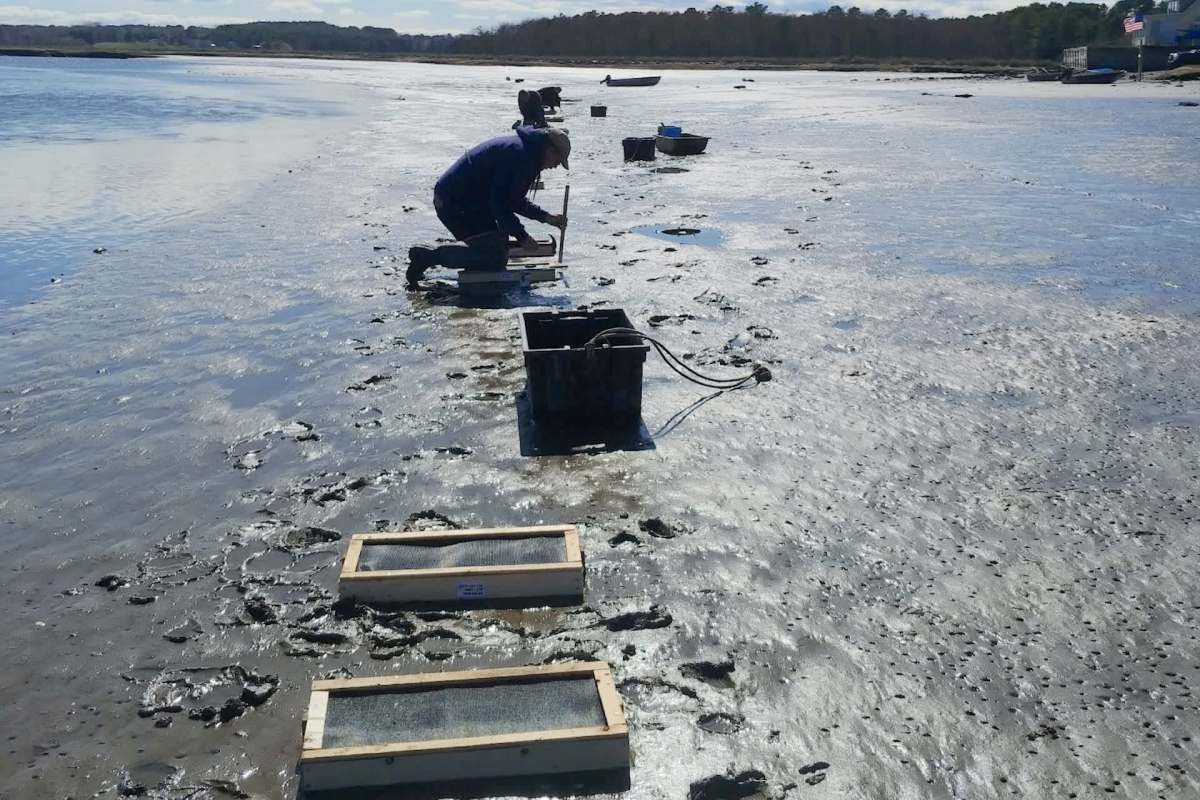
Generations of people on Massachusetts' North Shore have relied on the region's shellfish flats, but a steep decline in soft-shell clams is making that livelihood increasingly difficult, and scientists and clammers are teaming up to pinpoint the cause of the drop.
In Plum Island Sound, researchers are testing one possible theory by setting mesh-covered boxes into the mud and tracking whether young clams fare better when predators are kept away, according to WGBH.
Here's what to know
The study is part of a two-year collaboration connecting ecologists with shellfishers on Massachusetts' North Shore.
During one sampling round, Northeastern University marine science professor David Kimbro and his team retrieved 45 PVC boxes filled with mud from the flats and examined them for soft-shell clams at a nearby research station.
NOAA Fisheries data cited by WGBH shows New England's commercial soft-shell clam harvest fell from 8.9 million pounds in 1950 to 1.75 million in 2024 — roughly an 80% decline.
Runoff and sewage spills have also forced closures that further squeeze shellfishers' incomes.
TCD Picks » Quince Spotlight
💡These best-sellers from Quince deliver affordable, sustainable luxury for all




Patrick Saunders, whose family has been digging clams in Rowley for at least six generations, explained that financial strain has already changed what families in the trade can reasonably expect from the work.
"It's just not possible to support a family," Saunders admitted.
Shellfishers involved with the Plum Island Ecosystems research program told scientists they think green crabs may be a major driver of the decline.
The invasive species has been present in New England waters since the late 1800s, and the study is meant to test that idea more directly.
More background
Soft-shell clams support local employment, regional seafood businesses, and a North Shore food tradition that stretches back generations.
As clam beds decline, communities lose money and part of their connection to the land.
Kimbro described the project as aiming to replace guesswork with evidence.
"We're all hemming and hawing and saying it's this or it's that. But you can't come up with a solution that's going to work unless you know it's exactly happening because of X, Y, and Z," he acknowledged.
Since the 1980s, Downeast Institute marine ecologist Brian Beal has been studying clams and green crabs in Maine.
"They smash things and they just … crunch. There's nothing left of the clam after a green crab is done with it," Beal began. "There's clams settling to the mudflat, but there's not enough to swamp out the effects of predators," he added.
Beal said mild winters often lead to higher green crab numbers, while colder winters can reduce those populations.
What's being done?
The main device in the Massachusetts research is the "recruitment box," a protective tool adapted from Beal's design.
Its mesh top lets tiny clam larvae settle into the mud but blocks larger predators. That gives researchers a way to compare survival inside the protected boxes with survival in nearby, unprotected mudflat areas.
Beal noted that the difference can be dramatic, with open mud holding only two or three clams per square foot and protected boxes reaching as many as 450 clams per square foot.
That comparison could help researchers determine whether too few larvae are arriving or whether predators create a survival bottleneck after the clams settle.
Samples from the boxes in Rowley suggested the mud still held plenty of life, including soft-shell clams and razor clams.
Grace Abe, a Northeastern University graduate student working on Kimbro's team, believed those results may offer a key clue.
"And if there's clams in our boxes, that shows us that there are larvae out there and that they are dying, but our boxes are protecting them from that," Abe remarked.
"I don't want to get, like, woo-woo," Saunders told WGBH. "But I hope that my kids can go out and eat from the same shellfish beds that my great-grandfather did."
Where can I learn more?
The North Shore's clam troubles are part of a bigger coastal picture, including both restoration work and mounting environmental strain. These stories look at that broader landscape, from oyster gardening in Chesapeake Bay to erosion and sinking land affecting other U.S. shorelines.
• In Chesapeake Bay, volunteers are tending oyster gardens with the potential to profoundly improve local water quality.
• Along Washington's coast, towns face a looming danger threatening to consume homes as erosion advances.
• Across the eastern US, slow and insidious land sinking is exacerbating long-term coastal flood risk.
Together, they show the kinds of pressures coastal communities face — and how people are trying to respond. That broader view helps put the North Shore mudflat research in perspective, showing why the fate of one clam fishery carried bigger stakes.

Get TCD's free newsletters for easy tips, smart advice, and a chance to earn $5,000 toward home upgrades. To see more stories like this one, change your Google preferences here.






