


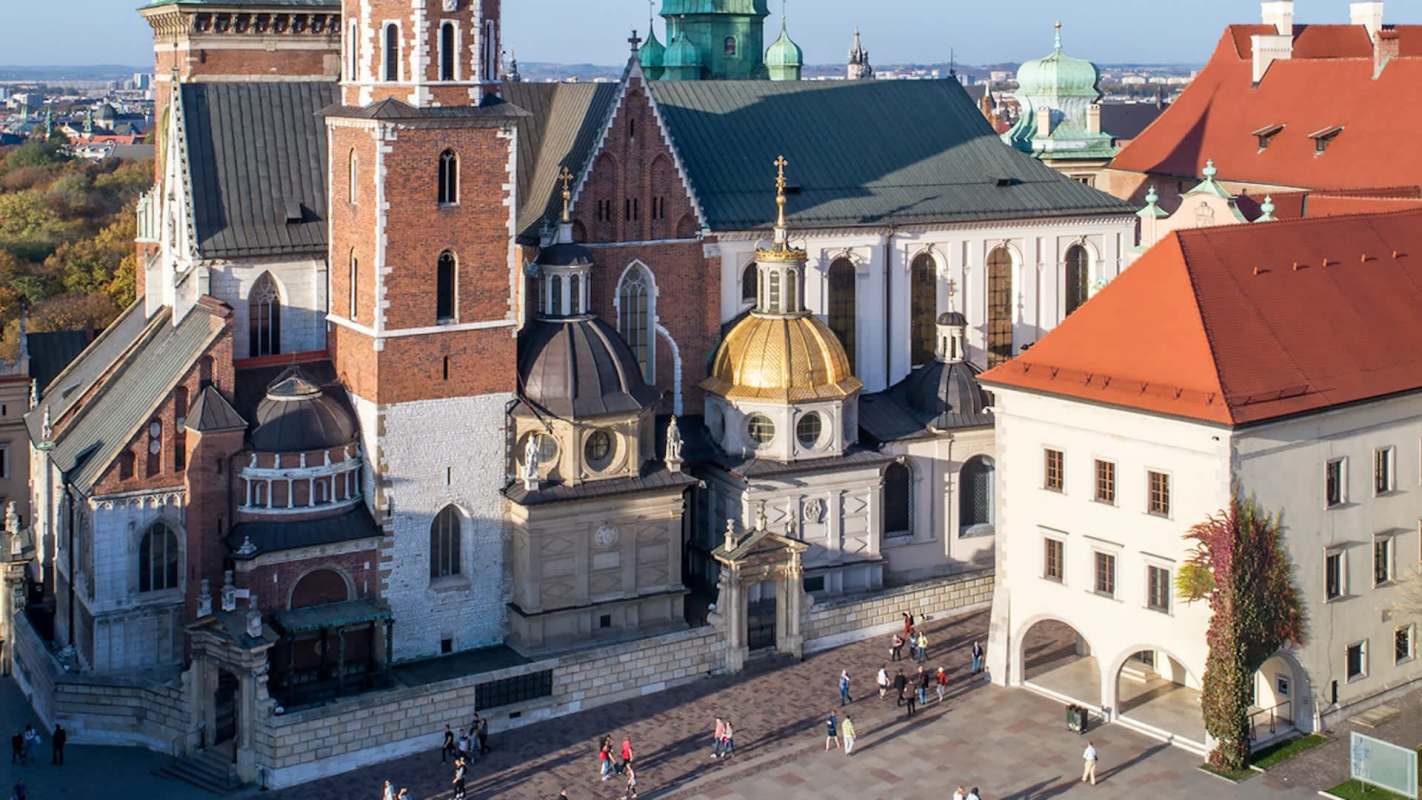
For decades, one of Poland's oldest stone churches posed a deceptively simple question: If the 10th-century rotunda had no entrance, how was anyone supposed to get inside? A new study suggests the answer may be far less complicated than generations of scholars assumed. The building may never have needed an exterior door at all.
What happened?
Researchers may have finally explained the mystery of the Rotunda of the Holy Virgin Mary, a small stone church on Wawel Hill in Kraków that dates to the 10th century, The Economic Times reported.
The circular structure, about 32 feet across, is among the oldest stone churches in the country. For years, though, archaeologists were left with a basic problem: No doorway could be identified.
In a recent study published in the International Journal of Conservation Science, Klaudia Stala, an archaeologist and associate professor at Kraków University of Technology, argued that the rotunda was likely never intended to function as a standalone public church. Instead, she says, it probably served as a private chapel attached directly to a nearby royal residence.
Because the site is protected and can't be excavated, Stala used non-invasive techniques, including ground-penetrating radar, thermal imaging, and architectural analysis. Those scans revealed subsurface shapes consistent with a large rectangular building beside the rotunda, resembling early medieval palace complexes already identified elsewhere in Poland.
The findings also push back against an older theory that visitors entered by an elevated exterior staircase while the lower level served as a crypt. Stala found no evidence of a crypt beneath the floor and no sign that an outside staircase had ever been attached to the remaining walls.
TCD Picks » Quince Spotlight
💡These best-sellers from Quince deliver affordable, sustainable luxury for all




Why is this important?
The study shows how quickly long-accepted theories can shift when new tools are applied to old questions. A structure once considered incomplete may actually have been part of a larger royal complex.
That matters well beyond this structure. Non-invasive methods allow researchers to investigate fragile heritage locations without disturbing them, an important advantage when excavation is legally restricted or could damage what remains.
It's also another example of how modern imaging technology is changing the way history is studied while helping preserve irreplaceable places for future generations, museum visitors, students, and tourists.
What's the bigger picture?
Archaeologists are increasingly relying on tools such as radar and thermal imaging to explore buried structures without excavation. Those methods can reduce the risk of harming sensitive sites while still revealing walls, adjoining buildings, and hidden underground layouts.
At Wawel Hill, that approach made it possible to test a long-standing theory at a site where digging was not an option.
The same strategy could prove useful at other sites where excavation is limited by law, cost, or conservation concerns. As scanning technology improves, researchers may be able to return to old mysteries and solve them with far less disruption.

Get TCD's free newsletters for easy tips, smart advice, and a chance to earn $5,000 toward home upgrades. To see more stories like this one, change your Google preferences here.






