


While some online users may call on AI chatbots to win an argument, this source is not nearly as reliable as many assume — and that's when it's being quoted correctly.
AFP Fact Check reported on one of these instances in which a user tried to use ChatGPT to support a conspiracy theory, ignoring valuable context and potentially even misrepresenting its statements.
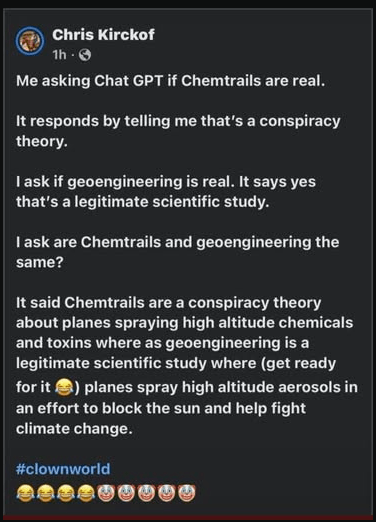
The user posted their interaction with ChatGPT to Facebook in an apparent bid to liken the debunked chemtrails conspiracy theory to geoengineering.
Contrails — cloudlike lines of condensation — have been left behind by jets for decades. "Chemtrails" refers to the notion that aircraft are secretly dispersing harmful substances designed to manipulate the weather through these trails. As AFP Fact Check noted, scientists widely reject that theory. So did ChatGPT, for what it's worth.
Where the user tried to play "gotcha" was in claiming that, according to them, ChatGPT didn't reject the existence of geoengineering. They claimed that ChatGPT described a similar process for both activities and that "proved" they were the same.
That conclusion misses the point. Scientists are exploring geoengineering, as the Environmental Protection Agency reported, but these efforts to mitigate climate change and remove greenhouse gases are mostly local and theoretical, focusing on climate modeling and scenario analysis.
TCD Picks » Quince Spotlight
💡These best-sellers from Quince deliver affordable, sustainable luxury for all




For example, a 2025 scientific paper introduced a plan in which commercial aircraft could aid in cooling the planet with solar radiation management tech, as explained here by the National Academies. Other projects test different experiments in small areas in the lab or the environment.
That doesn't translate to a vast ploy by the government spanning decades with the public left unawares.
"The chemtrails narrative describes something that isn't happening: a secret, large-scale atmospheric spraying," explained Michael Thompson at the Alliance for Just Deliberation on Solar Geoengineering, per AFP Fact Check. "These clouds are not part of a global conspiracy."
Another flaw with the argument is granting AI chatbots heaps of credibility, or taking user-shared conversations at face value.
|
Which of these savings plans for rooftop solar panels would be most appealing for you?
Click your choice to see results and earn rewards to spend on home upgrades. |
 Save $1,000 this year 💸
 AFP Fact Check couldn't reproduce the Facebook user's conversation. Even if it could, ChatGPT and other AI chatbots aren't some ironclad source, as the Lancet explained.
"In many cases, [they] present claims with high confidence, but when asked for sources, they may hallucinate them, misrepresent them, or rely on material that lacks proper verification," revealed Tal Hagin, an information-warfare analyst and media-literacy lecturer, per AFP Fact Check.

Get TCD's free newsletters for easy tips, smart advice, and a chance to earn $5,000 toward home upgrades. To see more stories like this one, change your Google preferences here.






