


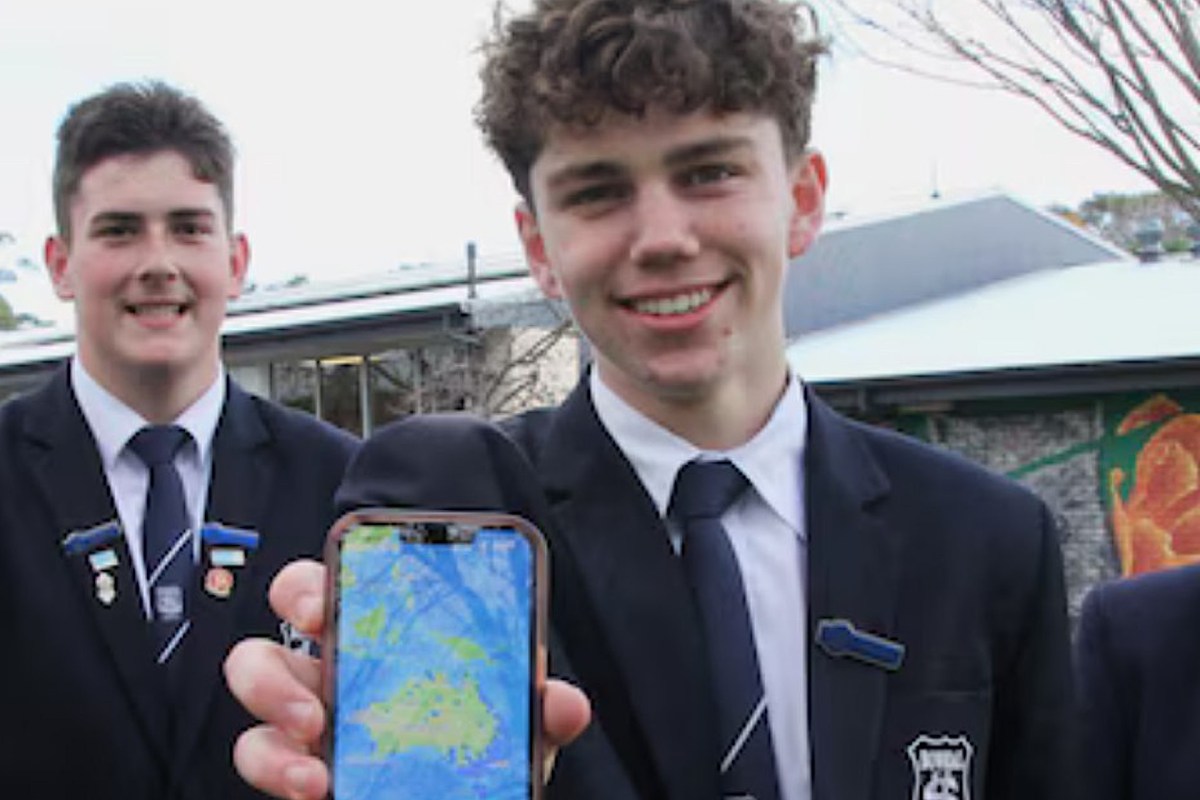
A group of high school students has developed an app that could help consumers avoid exposure to PFAS, a worrying group of long-lasting chemicals that can accumulate in the body — earning them the nickname "forever chemicals" — and used in many everyday essentials.
As detailed by the Australian Broadcasting Corporation, the five students from Bowral High School were inspired to develop their app after learning their local river had elevated levels of PFAS, or perfluoroalkyl and polyfluoroalkyl substances.
These chemicals are often found in items like nonstick cookware, stain-resistant clothing, and cosmetics. While PFAS do have useful properties, researchers have linked them to impaired organ function, cancer, immune system dysfunction, higher levels of cholesterol, and other health complications, as Australia's Environmental Health Standing Committee explained.
Meg Paviour, Tukker Lewin, Henry Rees, Chloe Ward, and Michael Tonkinson — who developed the app — were also alarmed after the Australian Bureau of Statistics detected PFAS in more than 85% of the country's population.
"The scariest part is not just that it's in everyone, but no one knows about it," Tukker told ABC. "We've been on our own journey to try and educate ourselves, but we're on the path now where we're trying to get everyone else to open their eyes and really pay attention."
The group's app works by scanning a product's barcode to determine a product's PFAS levels, incorporating existing data about PFAS hotspots into the analysis. The prototype does have a key limitation, though: It only works on two products.
Sparse data about PFAS is the obstacle to overcome. Dr. Denis O'Carroll, a PFAS researcher from the University of NSW, told ABC that similar apps are more successful in places with robust PFAS labeling rules, like California or the European Union.
"It is challenging because it depends on where the source data comes from. If you were to buy beer or a soda drink from different places, the amount of PFAS in that drink would be a function of where the water used to make it came from, and that could change with time," O'Carroll said.
To overcome this, the high school students have launched a parliamentary petition asking Australia to require PFAS-level labeling on all products in the country.
"If people start moving away from products with PFAS because they understand the health concerns, that then pushes companies to move away from PFAS," Chloe told ABC, highlighting how consumers can use their purchasing power to push for change.
TCD Picks » Quince Spotlight
💡These best-sellers from Quince deliver affordable, sustainable luxury for all




|
Do you worry about having toxic forever chemicals in your home?
Click your choice to see results and speak your mind. |
 Majorly 😥
 The team has also connected with Cate Faehrmann, chair of the Select Committee on PFAS Contamination in NSW Waterways, as well as UNICEF and Apple representatives as they work to make their prototype into a publicly available app.
"By empowering people with information, we can give them the choice to avoid products with avoidable PFAS levels and protect themselves and their families," the students said in their petition on Change.org. "Labelling is not just about transparency — it's about accountability."

Join our free newsletter for weekly updates on the latest innovations improving our lives and shaping our future, and don't miss this cool list of easy ways to help yourself while helping the planet.
Cool Picks





