


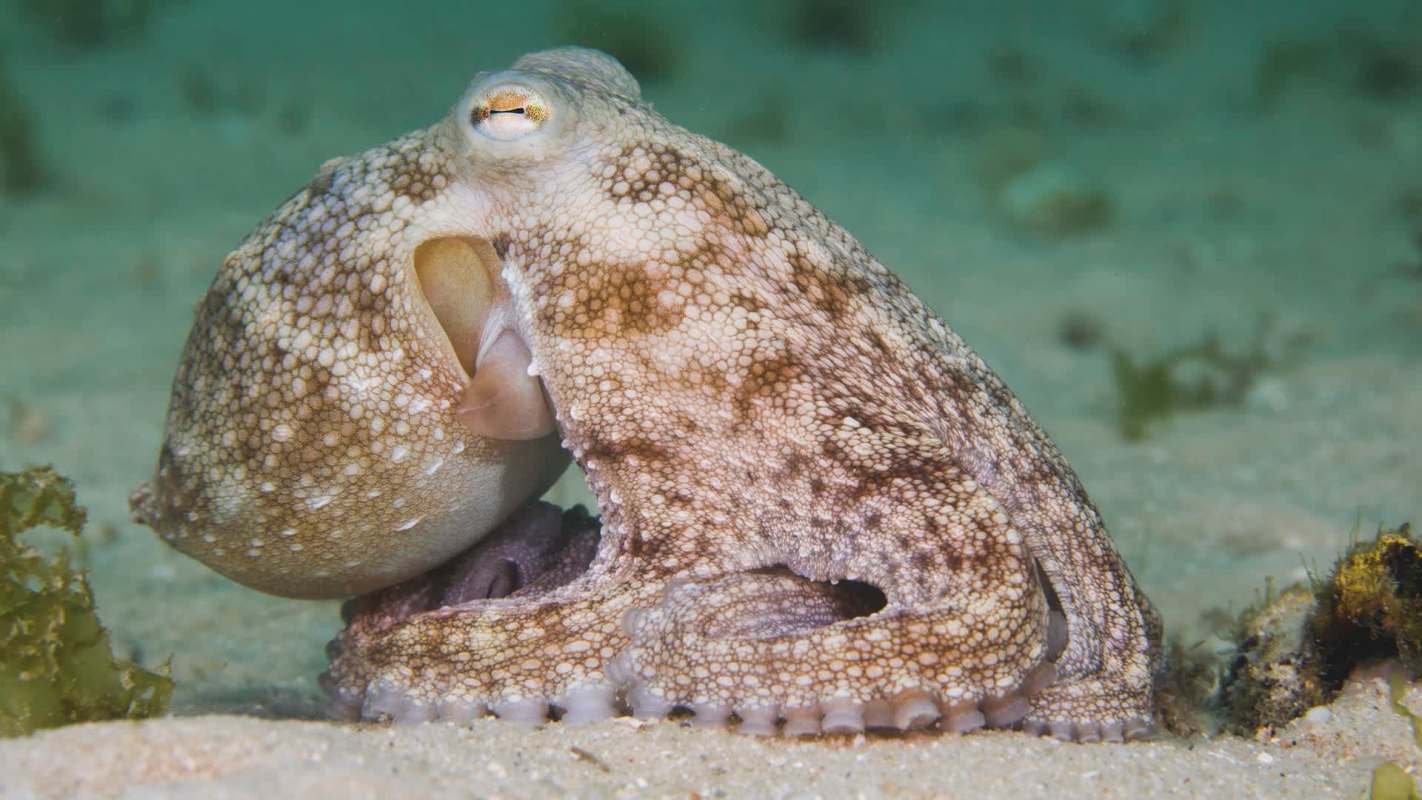
Scientists have now shown that octopuses can learn to use mirror reflections to find food hidden from direct view.
The resulting study suggests octopuses possess a more advanced level of spatial reasoning than researchers previously thought.
What happened?
The Dartmouth study was published in Current Biology and summarized in a university press release. It found that octopuses can use mirrors to determine where prey is located even when it is out of sight.
The team worked with three California two-spot octopuses in Dartmouth's Octopus Lab. It allowed the animals to get used to mirrors in their environment and then trained them to connect a reflected image with an object's real position.
One training task used a live crab inside a glass jar placed so the octopus could detect it only in the mirror. To reach the reward, the animal had to turn 90 degrees and move around a corner instead of going after the reflection.
The researchers later tested the skill under more controlled conditions. Each octopus began in a box facing a mirror. A virtual crab image appeared behind it and was visible only in the reflection. The animals picked the correct side about 73% of the time.
TCD Picks » Quince Spotlight
💡These best-sellers from Quince deliver affordable, sustainable luxury for all




"Our findings are the first to demonstrate that invertebrates can use mirrors to understand their environment to find prey," lead author Mary Kieseler said in the press release.
Why does it matter?
The study adds to a growing body of evidence of octopuses' intelligence. Mirror use is not the same as self-recognition, but it does require an animal to understand that reflected information can help it navigate the world.
The finding expands scientists' understanding of how intelligence can evolve across very different branches of life.
Kieseler also spoke about possible "convergent evolution" in the press release. That happens when living organisms evolve separately but develop similar features.
Octopuses are so evolutionarily distant from humans and other familiar intelligent animals. If an animal with such a different nervous system can learn this skill, it suggests that complex problem-solving may arise in multiple ways across nature.
Scientists have a lot to learn about how octopuses exist in and contribute to ecosystems as well. By studying them further, they can better understand how to support octopuses and keep ecosystems for as long as possible.
What's next?
Speculations from the study's senior author, Peter Tse, suggest that there's a clear research path forward.
"Hunters are very effective when they have a mental map of their territory, so that they know where they are in relation to their environments," Tse said in the press release. "Our work suggests that octopuses might also have internal maps, an internal representation of space."
The co-authors stated that more research is necessary to determine if that's actually true.

Get TCD's free newsletters for easy tips, smart advice, and a chance to earn $5,000 toward home upgrades. To see more stories like this one, change your Google preferences here.






