


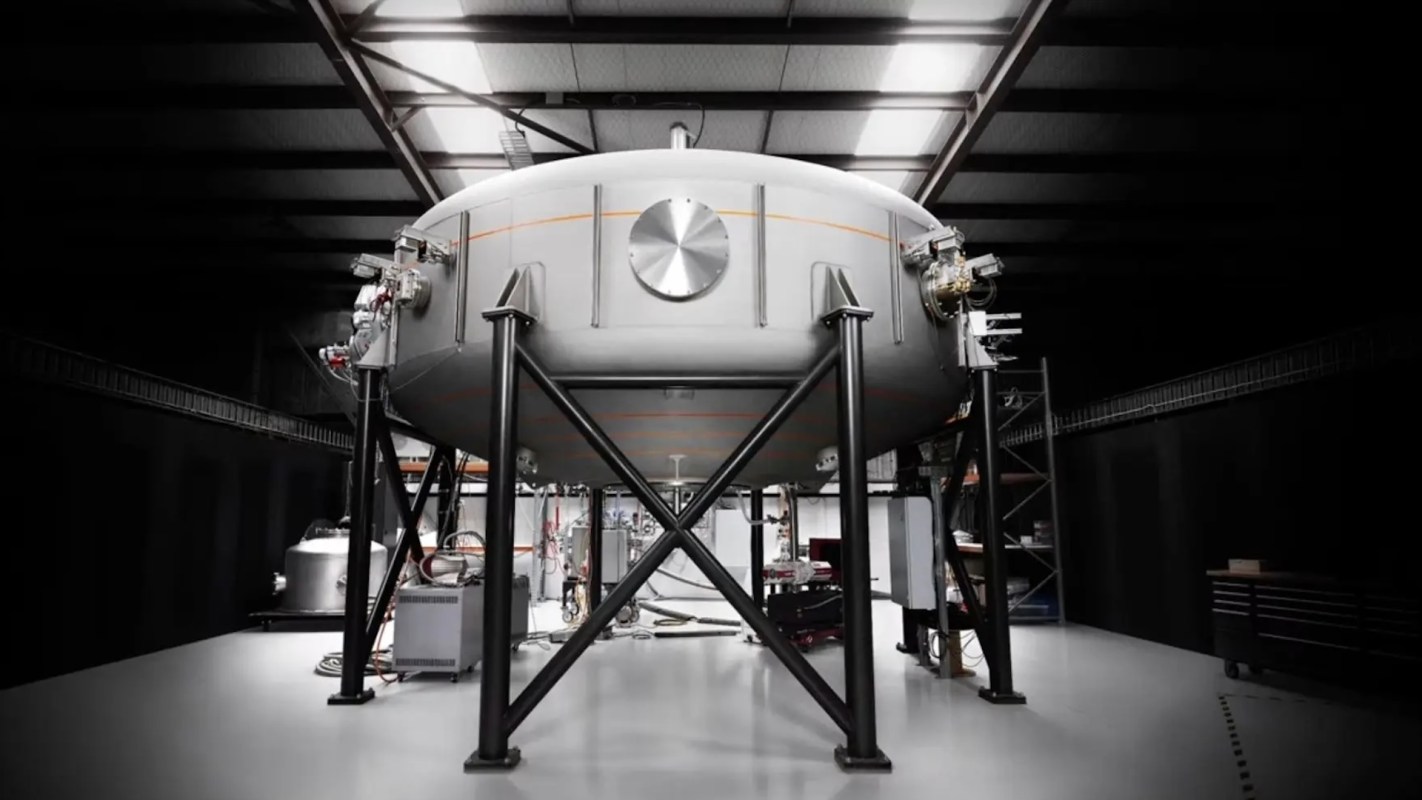
New Zealand's OpenStar Technologies has a bold plan to provide "fast and cost-effective" nuclear fusion energy within five years.
Success would mean delivering a futuristic energy source sooner than most experts expect. Scientific American reported that a leading project in Virginia has a target to go online sometime in the 2030s, for reference. The United Kingdom's STEP prototype fusion power plant is projected to be complete by 2040.
OpenStar is different from most fusion ventures because of the use of a levitating magnet within its reactor design, which is showing promising results during testing with its small-scale "Junior" unit, according to a company LinkedIn post.
Like other forms of fusion reactors under development, it's designed to contain heat that exceeds the temperature of the sun's core. Many leading reactors hold superheated swirling plasma with connected magnets that are part of doughnut-shaped "tokamak" devices, according to the U.S. Department of Energy. Others use more twisted structures, called "stellarators."
OpenStar's reactor design is different from either. According to a video released by the company, it features a levitating magnet weighing more than a half-ton, suspended without mechanical supports within a roughly 17-foot-diameter, 12-ton vacuum chamber. The floating magnet is held in place from above by another, fixed magnet.
The company's website says that the design allows the levitating magnet to "confine the plasma around it, meaning no support structures interfere with the super-heated gas." It adds that Junior is being eyed as a "potentially simpler, cheaper, and easier to maintain" design for the abundant energy source that has been elusive for researchers to sustain affordably.
"Our fully commissioned prototype device … successfully confines plasma while the core superconducting magnet levitates, entirely disconnected from external support," the company posted after a successful February test.
OpenStar's central concept is also known as "levitated dipole" technology, which mimics plasma function in Earth's magnetosphere, per the company.
Interesting Engineering noted other outer space inspirations.
"This internal placement is intended to mimic the magnetic structures found around planets like Jupiter," the publication's Aman Tripathi wrote.
TCD Picks » Quince Spotlight
💡These best-sellers from Quince deliver affordable, sustainable luxury for all




|
Which of these savings plans for rooftop solar panels would be most appealing for you?
Click your choice to see results and earn rewards to spend on home upgrades. |
 Save $1,000 this year 💸
 By removing mechanical supports, the team thinks it can eliminate a source of heat loss and plasma instability. The braces provided a way for energy to escape during reactions. Thus, levitation aids high-temperature maintenance. It can also help to reduce the reactor's size and lower manufacturing costs, according to IE.
There are still technical obstacles to overcome, as IE noted: "While the current prototype does not yet generate more energy than it consumes, the stability of the magnet under these conditions is a prerequisite for future iterations of the technology."
That said, OpenStar has said its approach can "capture early revenue" and operate in a cost-effective way. That's crucial, as fusion projects around the world are reported to cost tens of billions of dollars.
By comparison, solar and wind are the cheapest and fastest energy sources to develop for grid-level work, New York financial advisory firm Lazard reported last year. And unlike fusion, solar is a proven energy provider that can give relief even on the household level through rooftop panels.
Energy independence is crucial, as electricity rates are reported to be rising faster than inflation.
And while both nuclear and renewable-energy sources produce electricity without making harmful carbon dioxide air pollution, current forms of nuclear energy carry other risks. Today's common fission reactors, which split atoms, create long-lasting nuclear waste and carry meltdown risks, which are catastrophic, though historically rare.
Fission plants are used around the world, producing about 9% of global electricity. Proponents argue that the radioactive ceramic pellet byproduct is manageable and the needed energy production is worth storing it indefinitely. The Union of Concerned Scientists has added security and other hazardous pollution to the list of fears, arguing that the industry should be "well-regulated."
OpenStar is working on fusion reactors, which combine atoms during powerful collisions. Fusion nulls the waste, meltdown, and many other fears of nuclear energy. But sustaining reactions has been a big hurdle.
Suspended magnets could be part of the solution.
"This represents a significant advancement from our first supported plasmas achieved in October 2024," the company wrote on LinkedIn of its recent experiments.

Get TCD's free newsletters for easy tips to save more, waste less, and make smarter choices — and earn up to $5,000 toward clean upgrades in TCD's exclusive Rewards Club.
Cool Picks





