


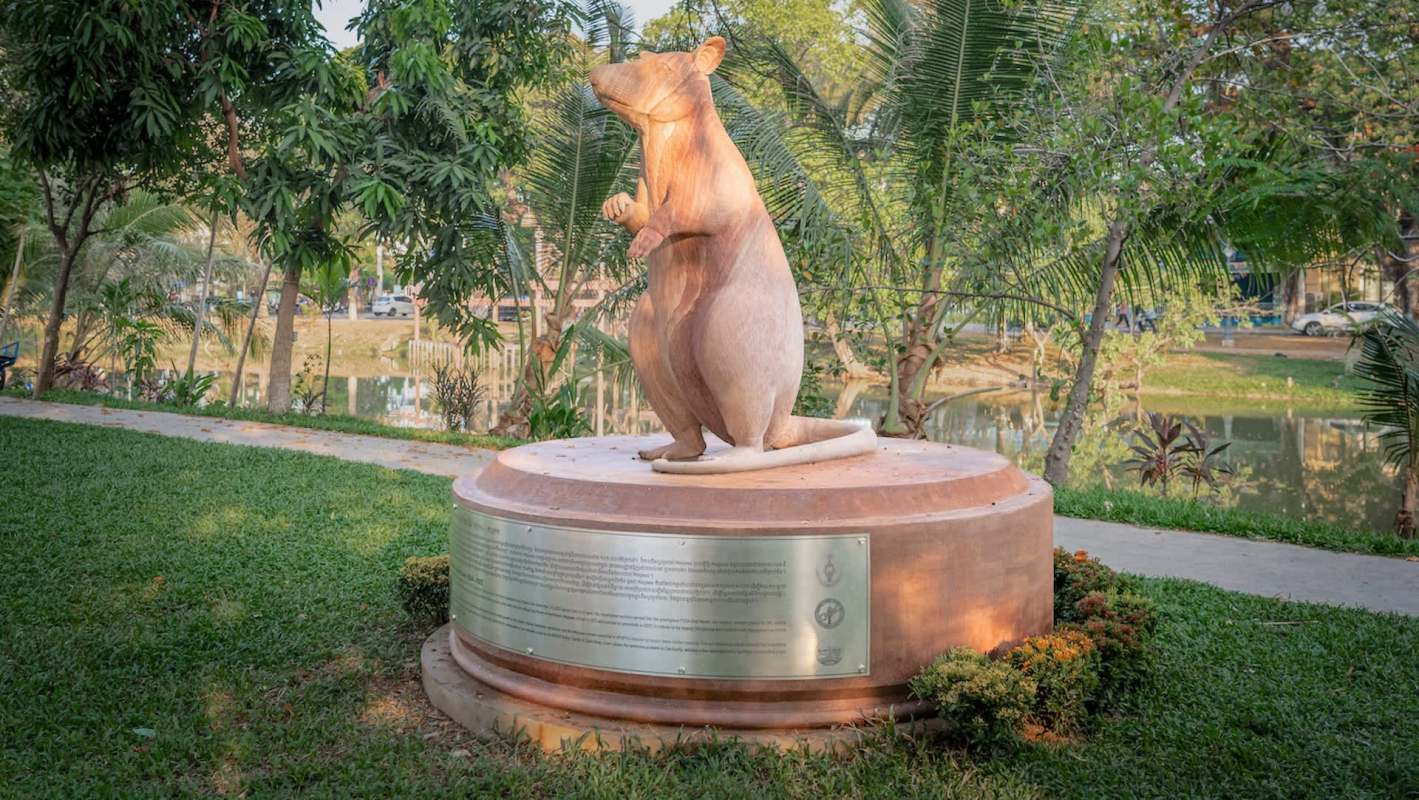
After a lifetime spent helping locate more than 100 unexploded explosives, a prodigious African giant pouched rat is being honored in Cambodia.
Smithsonian Magazine reported the tribute came on April 3, when officials unveiled a seven-foot statue recognizing the rat's role in helping make dangerous land safe again.
What happened?
Around age 2, Magawa arrived in Cambodia in 2016 after training with the Belgian nonprofit APOPO, BBC News said. Handlers taught him to identify the chemicals in unexploded weapons and signal a find by scratching the soil.
Magawa was so light that he could move safely across terrain that could be fatal for humans. He was also highly efficient, able to inspect a tennis-court-sized area in only 20 minutes, per BBC News. When he successfully located a mine, he was rewarded with treats such as peanuts or slices of banana.
Over a five-year career, Magawa helped clear more than 1.5 million square feet of land and ranked among APOPO's most successful bomb-detecting rats, CBS News noted. In 2020, he also became the first rat ever awarded a bravery gold medal by the People's Dispensary for Sick Animals.
The new stone statue in Siem Reap depicts Magawa standing upright and wearing that medal. Government officials and land mine survivors attended the unveiling ahead of April 4's International Day for Mine Awareness, Smithsonian Magazine reported.
TCD Picks » Quince Spotlight
💡These best-sellers from Quince deliver affordable, sustainable luxury for all




"Magawa was one of the best rats we've ever had," APOPO program manager Michael Raine told the Washington Post. "He was curious, very composed and quick at work. He knew his job."
Why does it matter?
Magawa's work addressed a long-running and deadly problem in Cambodia. Conflicts beginning in the 1960s left millions of land mines scattered across the country, making farmland, neighborhoods, and open areas dangerous for families.
APOPO says Cambodia has more mine amputees per capita than any other country, with upwards of 40,000 people having lost limbs to explosives.
The effects of war still shape ordinary parts of daily life, from walking to school to working in a field to letting children play outside. Magawa helped change that reality.
"His contribution allows communities in Cambodia to live, work, and play; without fear of losing life or limb," APOPO said in a statement announcing his death in 2022.
His story also shows the role animals can play in protecting people and helping communities recover, especially when their natural abilities are paired with careful training.
What's being done?
Cambodia has made significant progress on mine clearance, though the work is still ongoing. Earlier this year, Cambodian Prime Minister Hun Manet said that since 1992 more than 1,300 square miles of explosive war remnants have been cleared, Khmer Times reported.
Organizations such as APOPO continue to train animals to identify hidden explosives more quickly and safely than many conventional methods can on their own. In his later years, Magawa even helped train younger rats for the work, extending his legacy beyond his own field service.
Cambodia is aiming to become land mine-free by 2030, and another rat, Ronin, has already carried that work forward by setting a 2025 world record for lifetime land mine detections by a rat, according to Smithsonian Magazine.

Get TCD's free newsletters for easy tips, smart advice, and a chance to earn $5,000 toward home upgrades. To see more stories like this one, change your Google preferences here.






