


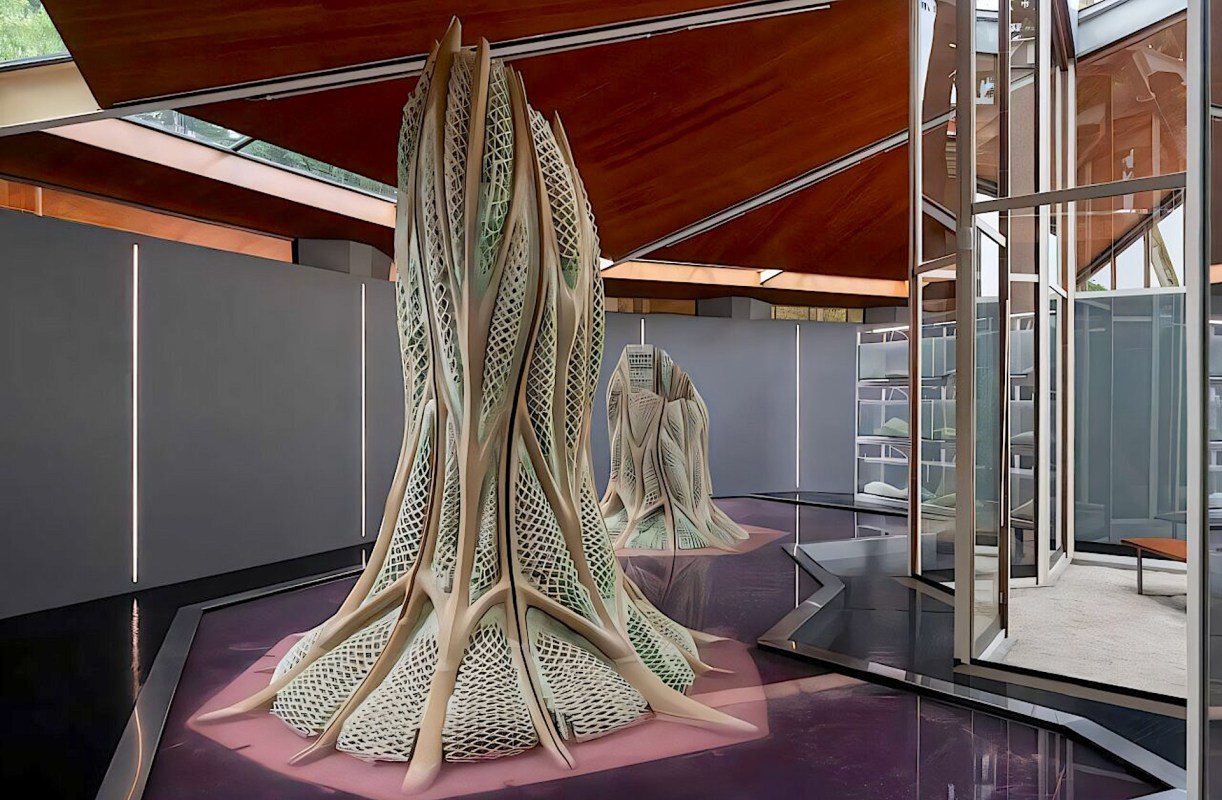
Visitors at the Canada Pavilion in the Venice Architecture Biennale exhibition are walking past a building that's alive — and it could someday help people breathe cleaner air while cutting the climate footprint of construction.
In a study published in Nature Communications, researchers at ETH Zurich, a Swiss university renowned for technology, have created a photosynthetic material that can be 3D-printed into architectural elements. The material hosts cyanobacteria, tiny microbes that use sunlight to capture carbon dioxide, in two ways: by growing new biomass and by causing minerals to form that trap carbon dioxide.
The installation is part science, part public demo. As the team's bio-designer, Andrea Shin Ling, put it, per Tech Xplore: "The installation is an experiment — we have adapted the Canada Pavilion so that it provides enough light, humidity, and warmth for the cyanobacteria to thrive, and then we watch how they behave."
Early lab work showed that the material had good potential to improve and clean the air at scale. However, real-world results will depend on actual size, climate, and maintenance.
This is good news because construction materials have a large climate footprint. According to the World Economic Forum, concrete production alone is responsible for roughly 8% of global heat-trapping pollution. The American Lung Association reported that around 156 million Americans are suffering from poor-quality air, which has long-term health impacts.
If living, low-energy materials can shoulder even a small share of a building's carbon burden across its life, they could complement industry efforts to cut pollution from cement manufacturing through cleaner energy and new binders.
However, there are hurdles. Stability, safety standards, and maintenance routines must be proven at scale, and the carbon math needs careful verification outside controlled settings. Even so, the team already moved beyond the bench. As Tech Xplore reported, one test space is a shingle-clad façade, where microbes create a shifting green patina.
This experiment is part of global efforts to clean the air. Mark Tibbitt, a professor of macromolecular engineering at ETH Zurich, is hopeful about the impact of the experiment. "As a building material, it could help to store CO2 directly in buildings in the future," he said, per Tech Xplore.
|
Do you worry about the quality of the air inside your home?
Click your choice to see results and speak your mind. |
 Yes — often 😬
Join our free newsletter for weekly updates on the latest innovations improving our lives and shaping our future, and don't miss this cool list of easy ways to help yourself while helping the planet.
Cool Picks





