


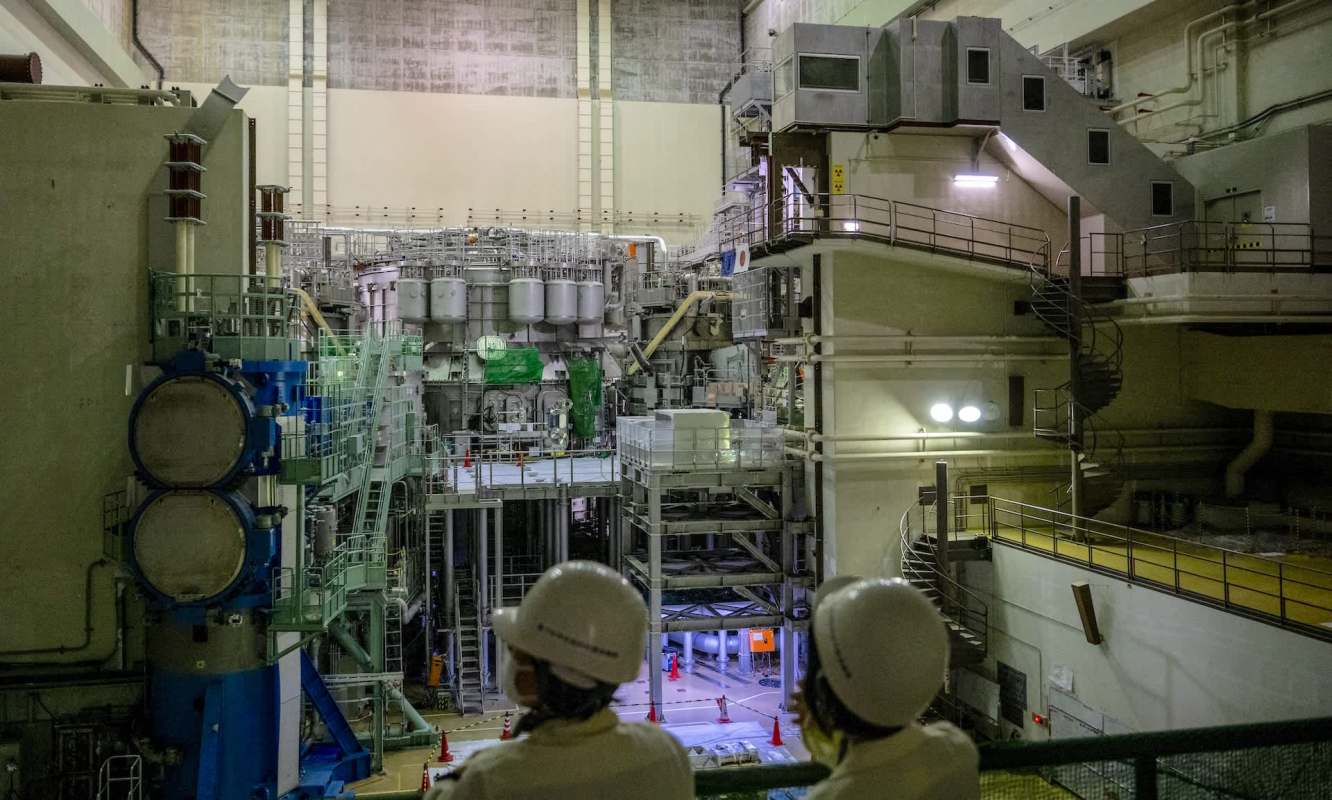
A team of scientists is working to bring the temperature down inside fusion reactors, making them up to a billion times more efficient in the process, according to Interesting Engineering.
It's a tough task, as experiments typically reach 100 million degrees Fahrenheit or more, which is hotter than the sun's core.
But experts from a group of Chinese universities think that low-frequency lasers — instead of high-energy X-ray beams — can help with the cooling off. They might even make the high-cost experiments easier to sustain. While still theoretical, it's another clue for fusion scientists who are trying to commercialize the near-limitless energy source.
The research team includes experts from Shenzhen Technology University, the National University of Defense Technology, and the China Academy of Engineering Physics.
Their success would be timely, as power demand is increasing around the world, including stateside. It's widely reported that energy prices are rising twice as fast as inflation.
During fusion reactions, atoms collide to form a new one. That's different from common fission reactions, when atoms are split. The former method does not produce long-lasting waste or carry meltdown risks. Fission does, evidenced by a well-documented meltdown history at facilities around the world. Nuclear plants make electricity by generating heat, which creates steam that spins a turbine.
While heat is needed, extreme temperatures are tough to sustain. That's part of the reason why scaled fusion energy has been elusive.
"The study addresses a central challenge in controlled fusion research: overcoming the strong Coulomb repulsion between positively charged nuclei, which conventionally necessitates heating fusion fuel to temperatures exceeding tens of millions of kelvin," the experts wrote in the study's findings, published by Nuclear Science and Techniques.
Coulomb repulsion is the electrostatic force that pushes two particles with the same charge away from each other. The experts think that low-frequency, "near-infrared" lasers can tunnel through the barrier at the quantum level, which is needed for collisions. The setting can promote the absorption and emission of a "vast number of photons" during atom impact, according to the report.
"This multi-photon interaction induces a broadening of the effective collision energy distribution, which can substantially increase tunneling probabilities," the experts wrote.
TCD Picks » Quince Spotlight
💡These best-sellers from Quince deliver affordable, sustainable luxury for all




|
What's the most you'd pay per month to put solar panels on your roof if there was no down payment?
Click your choice to see results and speak your mind. |
 $200 or more 💰
 Fusion chances increased from between three and nine orders of magnitude, depending on the low-frequency laser intensity.
"This enhancement effectively bridges the gap between low-temperature and high-temperature fusion conditions," per the findings.
Fusion and fission each produce abundant energy without harmful air pollution, one of the main selling points for proponents who downplay waste and accident risks. The Union of Concerned Scientists listed safety, security, and costs among concerns for atomic energy.
Fusion could alleviate many of the fears if more power can be generated by the reaction that it takes to sustain it. The Chinese laser research could provide a missing piece of the puzzle.
"The findings suggest that intense laser fields may help alleviate the stringent temperature requirements typically associated with controlled fusion experiments," according to the study.
Solar remains the cheapest, fastest energy source to deploy at scale, according to New York financial advisory firm Lazard. Solar panel installation and community solar projects can also provide ratepayers with energy independence.
TCD's Solar Explorer can help you navigate the path to a rooftop array with curated quotes and recommendations to vetted installers. The insight could save you up to $10,000 on installation costs.

Get TCD's free newsletters for easy tips to save more, waste less, and make smarter choices — and earn up to $5,000 toward clean upgrades in TCD's exclusive Rewards Club.
Cool Picks





