


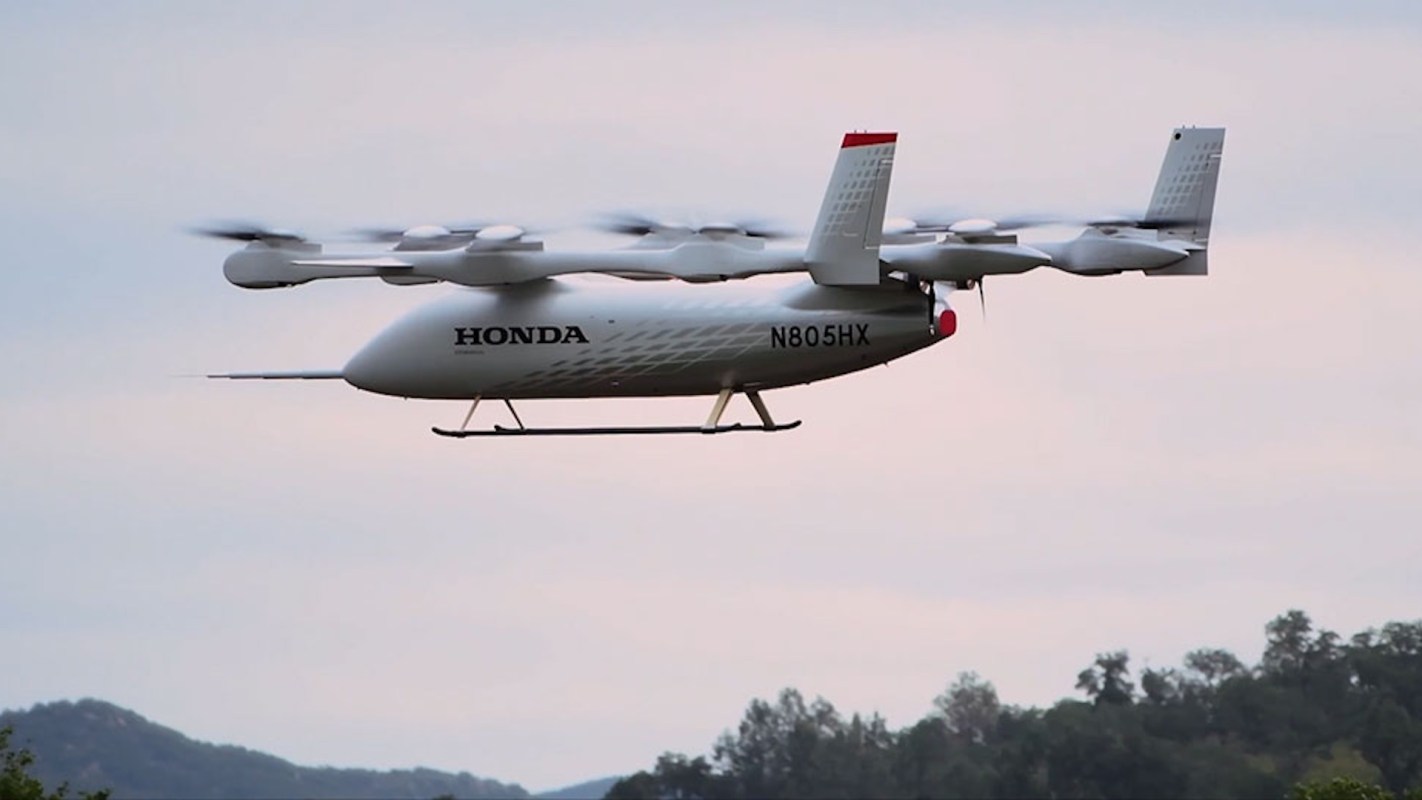
Honda says its full-size electric vertical takeoff and landing, or eVTOL, technology demonstrator has now made its first flight, Aviation International News reported.
What happened?
AIN reported that the remotely piloted aircraft flew on April 1 at Honda's San Luis Obispo, California, test site. The company did not announce it publicly until last week.
The company shared the news in a short video on X showing the 90-second test hop on its Integrated Research Center's account (@HGRX_jp).
✈ Honda eVTOL Reaches a Key Milestone
— Honda 統合研究センター/HGR (@HGRX_jp) May 28, 2026
First Full-Scale Flight Completed
On April 1, a flight test was conducted in San Luis Obispo, California, where a full-scale technology demonstrator weighing approximately 7,000 pounds successfully completed its first flight, lasting… pic.twitter.com/QMasrQGErR
That muted rollout is in line with Honda's tendency to keep the program out of the spotlight since unveiling it in 2021, AIN noted.
The company's caption said that Honda had already completed more than 400 flights with a one-third-scale demonstrator since 2020.
"With this milestone, development advances into the full-scale validation phase, where the foundational technologies of eVTOL are being verified at real scale," Honda wrote in the caption.
TCD Picks » Quince Spotlight
💡These best-sellers from Quince deliver affordable, sustainable luxury for all




AIN reported that the aircraft has eight propellers for vertical lift and two for forward propulsion. Its power system is hybrid-electric and uses a gas turbine generator.
Why is Honda's eVTOL important?
A successful first full-scale flight is a major checkpoint for any aircraft program, especially in the increasingly crowded eVTOL sector. Many companies have made bold promises about futuristic air taxis, but fewer have shown steady progress.
Honda's involvement brings the engineering experience of a major automaker to a field that could eventually reshape short regional travel.
While the aircraft is hybrid-electric rather than fully battery-powered, electrified propulsion still represents a step toward lower fuel use and potentially quieter operations than conventional aircraft.
The success of the eVTOL sector could thus make a major dent in how much pollution there is in short-range flights and long drives. And at the same time, it could ease congestion and noise pollution.
What's happening next?
"We will continue to build on this progress toward the next stage of development," Honda wrote in its post's caption.
Honda is aiming for about 250 miles of range plus FAA type certification in the early 2030s, according to AIN. The hybrid system is here to stay, according to executive chief engineer Susumu Mashio, who spoke with the outlet.
"When we decided to start this project, we knew that battery technology might not be there as much as we had hoped," Mashio told AIN. "For the time being, the hybrid system is a really practical solution."

Get TCD's free newsletters for easy tips, smart advice, and a chance to earn $5,000 toward home upgrades. To see more stories like this one, change your Google preferences here.






