


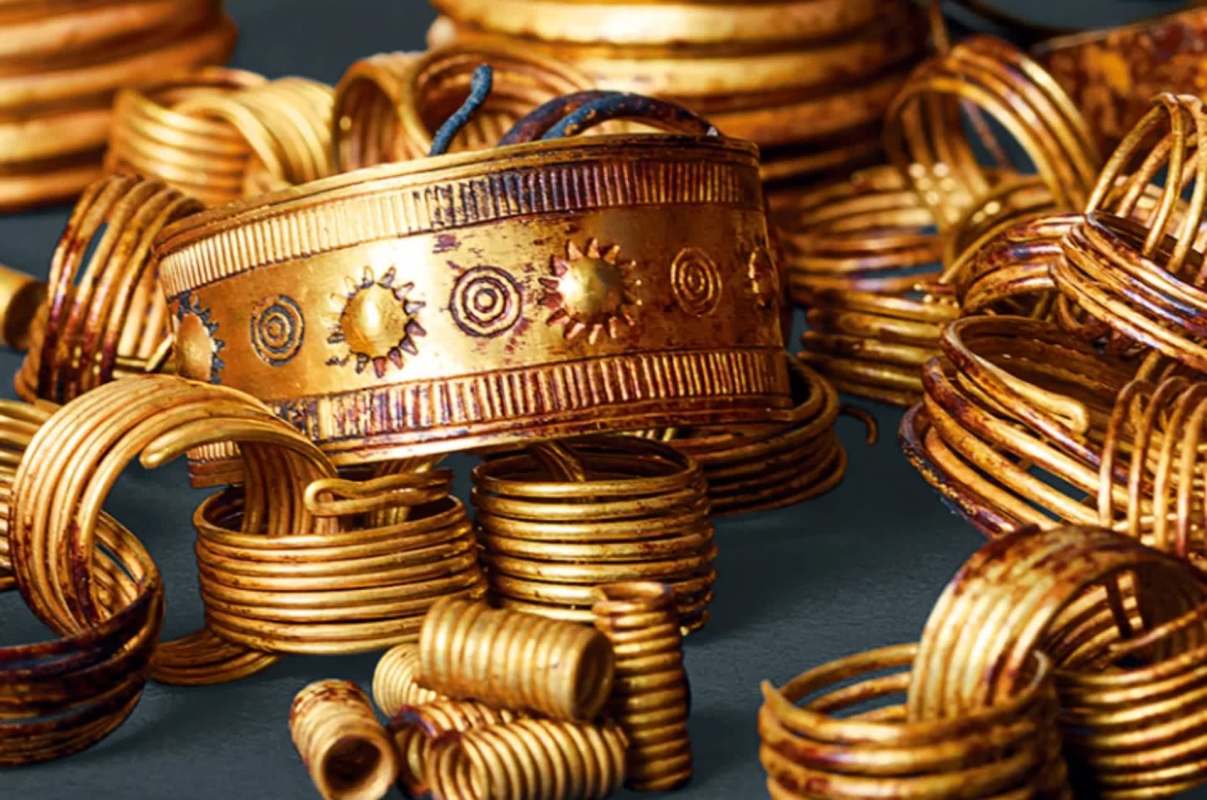
Gold loot might call to mind museum cases or royal collections, but one of the largest gold hoards from prehistoric Europe was discovered in a far less glamorous setting: the route of a natural gas pipeline in northern Germany.
Pipeline workers accidentally uncovered the prehistoric cache near the village of Gessel, close to Syke, in April 2011, Live Science reported.
Buried for more than 3,300 years, the find included 117 gold artifacts weighing more than 3.7 pounds.
Now housed at the Forum Gesseler Goldhort museum, the hoard is believed to date to around 1300 B.C., though it's less certain when it was buried. Archaeologists believe someone placed the objects in a linen bag, fastened it with six bronze pins, and then buried it, though exactly why remains unknown.
Images of the collection show tightly packed spiral rings and chains alongside several especially striking personal objects, including a large bracelet, a twisted armband, and an ornate brooch.
The brooch, originally about 6.3 inches long, had been bent before burial and its pin removed. Its surface features a "ladder-band" pattern along the clasp, along with raised sun symbols and stamped concentric rings.
TCD Picks » Quince Spotlight
💡These best-sellers from Quince deliver affordable, sustainable luxury for all




Experts say most of the gold spirals were probably used as Bronze Age money rather than worn as jewelry.
The Gessel hoard could offer a rare glimpse into how people stored wealth, traded valuable materials, and worked precious metals more than three millennia ago.
Early analysis suggested the gold may have originated as far away as Central Asia, and a new research project announced for 2026 aims to trace the metal's origin, identify its owner, and explain why it was buried.
Accidental finds made during modern infrastructure work can reveal pieces of the deep past that might otherwise remain hidden for centuries. In this case, routine pipeline construction exposed one of prehistoric Europe's most significant gold hoards.
Prehistoric archaeologist Babette Ludowici has said the spiral pieces were made from recycled gold, pointing to a sophisticated Bronze Age system of metal use and reuse.
Archaeologist Stefan Winghart has also argued that the objects were intentionally gathered into a hoard, not hastily discarded, noting how compactly they were arranged and that some pieces had been bent before burial.
According to a 2012 study, no other ancient brooch of solid gold has been found in Central Europe.

Get TCD's free newsletters for easy tips, smart advice, and a chance to earn $5,000 toward home upgrades. To see more stories like this one, change your Google preferences here.






