


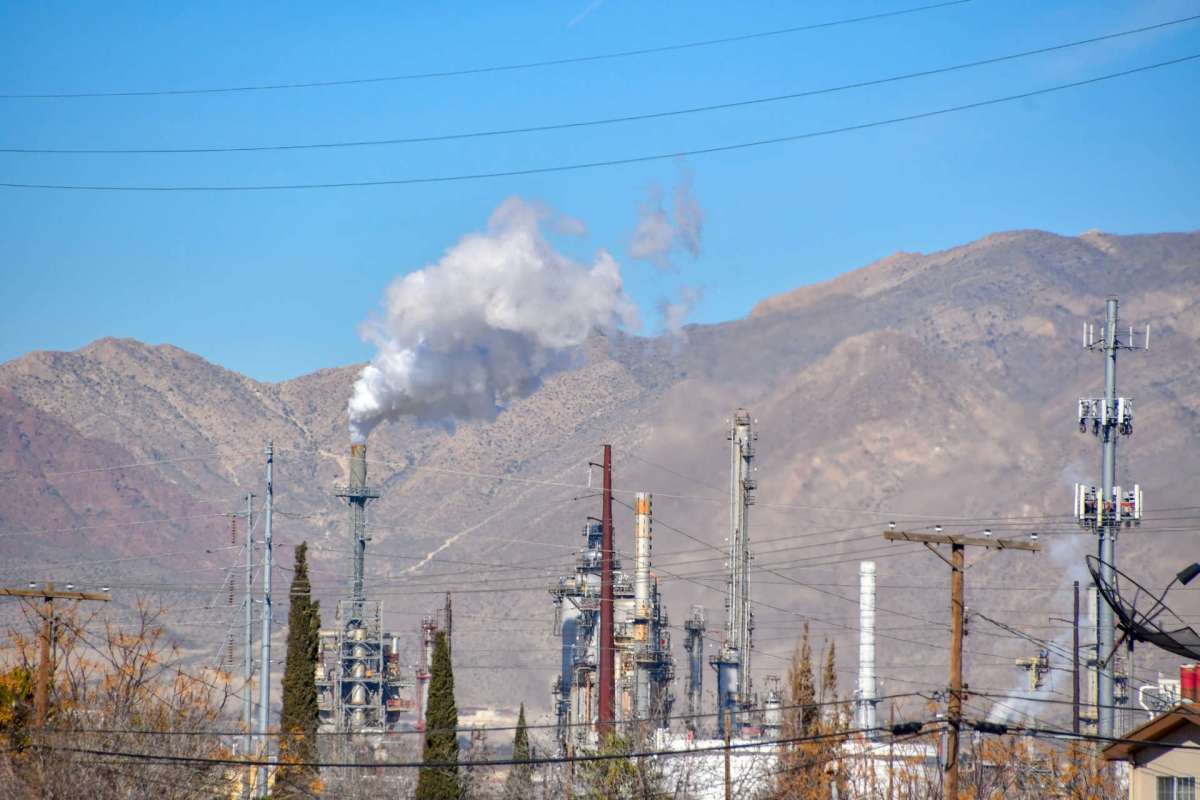
Angry and frightened, El Paso, Texas, residents want answers after hazardous chemicals escaped during flaring at a local refinery with no warning to the surrounding neighborhood.
At an Aug. 18 City Council meeting, community members demanded answers, describing headaches, nausea, and, for some, far deeper personal losses.
Here's what to know
According to Inside Climate News, Gilbert Morales, a neighbor of Marathon Petroleum's El Paso Refinery, said flaring at the site has made him and other members of his family sick. Morales also told city leaders that his wife, a nonsmoker, passed away from lung cancer earlier this summer.
Overnight between the night of Aug. 4 and the early morning of Aug. 5, the company reported to the Texas Commission on Environmental Quality that emissions of 13 compounds exceeded permit limits. Among them were more than 10,000 pounds of the gas propylene, 15 pounds of hydrogen sulfide, and upward of 1,400 pounds of isopentane.
The elevated pollution lasted for several more days and also involved hydrogen cyanide along with two other pollutants above permit levels, Inside Climate News reported.
Residents told officials they experienced nausea, headaches, throat irritation, and overwhelming odors during the incident. Verónica Carbajal, an organizer with the Sembrando Esperanza Coalition, said several people left their homes because the smell became unbearable.
TCD Picks » Quince Spotlight
💡These best-sellers from Quince deliver affordable, sustainable luxury for all




U.S. Rep. Veronica Escobar, a Democrat who represents El Paso, has urged the Environmental Protection Agency to investigate incidents at the site. The city council was also preparing to vote on formal requests asking state and federal regulators for a sit-down with the company to explain what happened.
More background
Homes sit along the refinery's fenceline in south-central El Paso. Census data cited by Inside Climate News showed the ZIP code is 93% Hispanic and that upward of 44% of residents live in poverty.
The site began as two facilities built in 1928 and 1931 that later merged. Marathon purchased the refinery in 2018. What was once at the edge of the city is now surrounded by neighborhoods, making any emissions event an immediate concern for nearby families.
Refineries, along with coal and methane gas power plants, contribute to air and water pollution linked to asthma, heart disease, cancer, and premature death, and they can keep energy costs high for households that rely on these fuel sources instead of more abundant options like sunlight and wind. Critics say industry lobbying can slow the shift to cleaner, cheaper energy that would protect families and cut costs.
El Paso County Commissioner David Stout, whose district includes the refinery, said Marathon's handling of the Aug. 4-5 incident was "entirely unacceptable." He said he was "aghast and felt completely misled" after reviewing the emissions reports.
What's being done?
Marathon is seeking to renew its air permit with TCEQ, and El Paso County has formally challenged that process, Inside Climate News reported. TCEQ commissioners approved the county's hearing request in June, though no date has been set.
Marathon filed a motion in July to appeal that standing decision, but Stout said the case is still moving toward a hearing.
City Representative Josh Acevedo, whose district includes the refinery, pushed for a formal meeting involving Marathon, TCEQ, and the EPA.
Marathon said an electrical problem shut down part of the refinery on Aug. 4 and that hydrocarbons escaped as equipment restarted. The company said monitoring through Aug. 10 found air quality remained under "established community exposure guidelines" and added that it "supports the idea" of a better community notification system.
Carbajal said, "When the air was unsafe to breathe, none of us got an alert."
Morales, for his part, posed the question hanging over the dispute: "How many more loved ones do we have to lose to get the refinery accountable for our health?"

Get TCD's free newsletters for easy tips, smart advice, and a chance to earn $5,000 toward home upgrades. To see more stories like this one, change your Google preferences here.






