


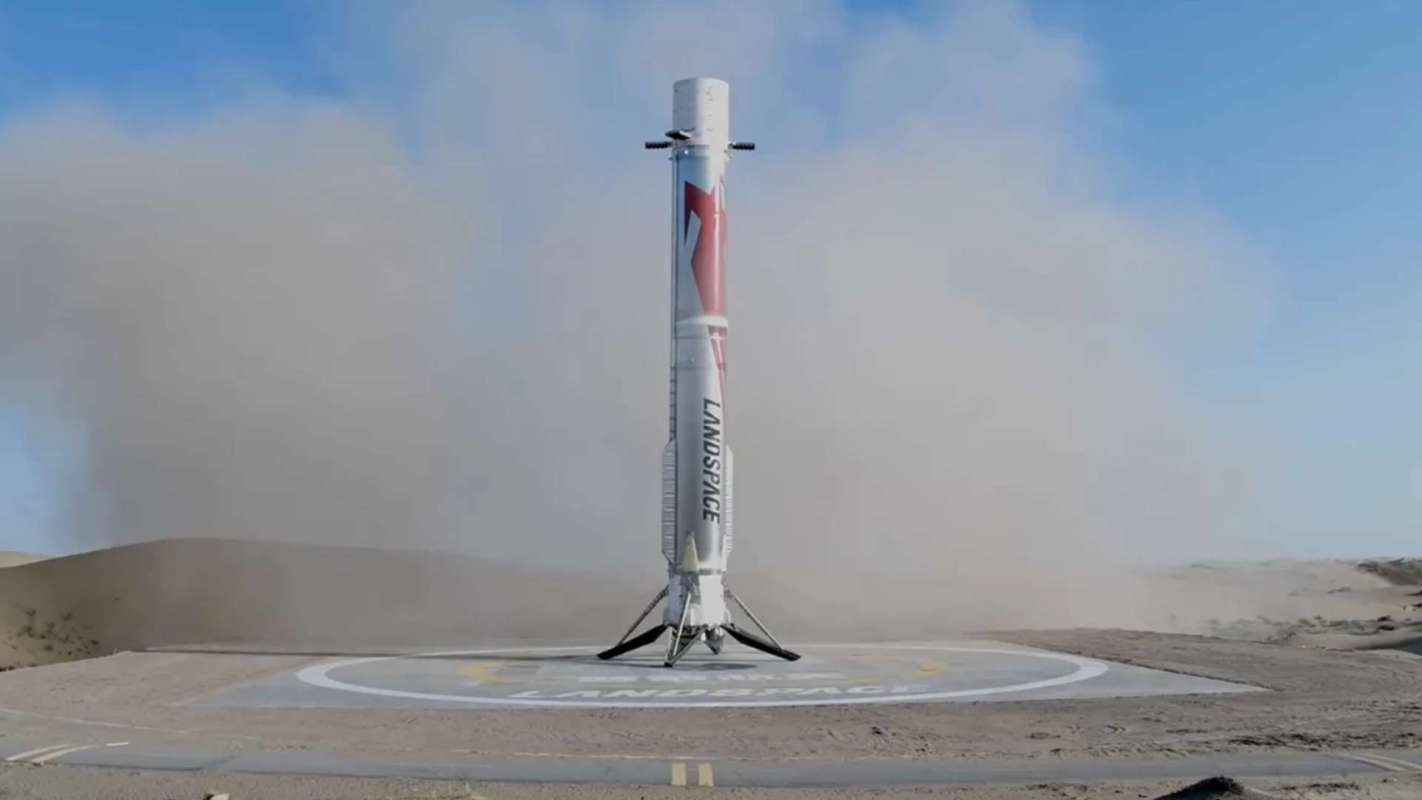
China added a new chapter to the global race for reusable rockets when Beijing startup LandSpace brought the booster stage of its Zhuque-3 rocket back down after launch.
Per Space.com, the landing was a first for China in two respects: no orbital-class booster had previously been recovered on landing legs, and none had previously been brought back on land.
30Here's what to know
Because the mission was only Zhuque-3's second flight, LandSpace also became the first Chinese private company to complete this kind of recovery during an orbital launch.
The stage returned to dry ground under its own control and remained standing on its legs, in the same general recovery style associated with SpaceX's Falcon 9.
China had managed only one other orbital rocket touchdown before this. On July 10, a Long March 10B from the state-owned China Aerospace Science and Technology Corporation came down onto a netting rig mounted on a ship at sea.
Landing directly on land under the rocket's own control is a more established model for rapid reuse, inspection, and relaunch.
TCD Picks » Quince Spotlight
💡These best-sellers from Quince deliver affordable, sustainable luxury for all




LandSpace called the mission "a pivotal flight test for Zhuque-3 as it transitions from the technological demonstration and verification phase toward the engineering application phase of reusability."
More background
Reusability has become a major advantage in spaceflight because it leaves less hardware to be discarded after each mission.
The payoff can spread across many space-based services, with lower costs and faster launch rates benefiting internet and navigation satellites as well as weather and disaster-monitoring systems.
In overall architecture, the rocket has a lot in common with Falcon 9: each combines a reusable booster stage with an upper stage that is not recovered, and the two rockets stand at roughly similar heights, at about 216 feet for Zhuque-3 and 230 feet for Falcon 9.
Their payload capability to low Earth orbit is also in the same range, with Zhuque-3 rated for about 40,350 pounds and Falcon 9 for about 50,265 pounds.
The clearest distinction is propellant. Falcon 9 uses liquid oxygen and rocket-grade kerosene, while Zhuque-3 runs on liquid oxygen and liquid methane, often called methalox, the same general fuel combination used by SpaceX's Starship program.
What's being done?
More competition among launch providers can open up more options for governments, researchers, and commercial satellite operators.
Greater competition can open up more launch options for governments, researchers, and commercial satellite operators.
At the industry level, the next step is consistency. One successful landing is a breakthrough, but routine reuse is what changes the market.
SpaceX achieved Falcon 9's first landing in 2015 and has since recorded more than 600, setting the standard other launch providers are trying to reach.
If LandSpace can repeat the feat, the landing could mark the start of a new phase for China's commercial launch sector.
As LandSpace said, "This mission further verified the design correctness and reliability of the Zhuque-3 reusable launch vehicle system, validated its first-stage recovery capability and engineering maturity."
Where can I learn more?
Zhuque-3's landing is part of a much bigger trend of Chinese engineering projects, from experimental aircraft to large-scale infrastructure and weather-control systems.
• China is also using rockets to seed clouds in a sweeping weather-modification push.
• China's AVIC has flown the AS700 airship long-range mission as lighter-than-air aviation advances.
• EHang completed a pilotless solid-state-battery flight, extending China's experimentation with next-generation vehicles.
• China has also opened a base to test colossal offshore wind turbines.
• In Fujian, China unveiled its first over-water high-speed bullet train corridor.
Seen alongside those efforts, Zhuque-3 looks less like an isolated milestone and more like one piece of a broader push to make hard engineering feats routine.

Get TCD's free newsletters for easy tips, smart advice, and a chance to earn $5,000 toward home upgrades. To see more stories like this one, change your Google preferences here.






