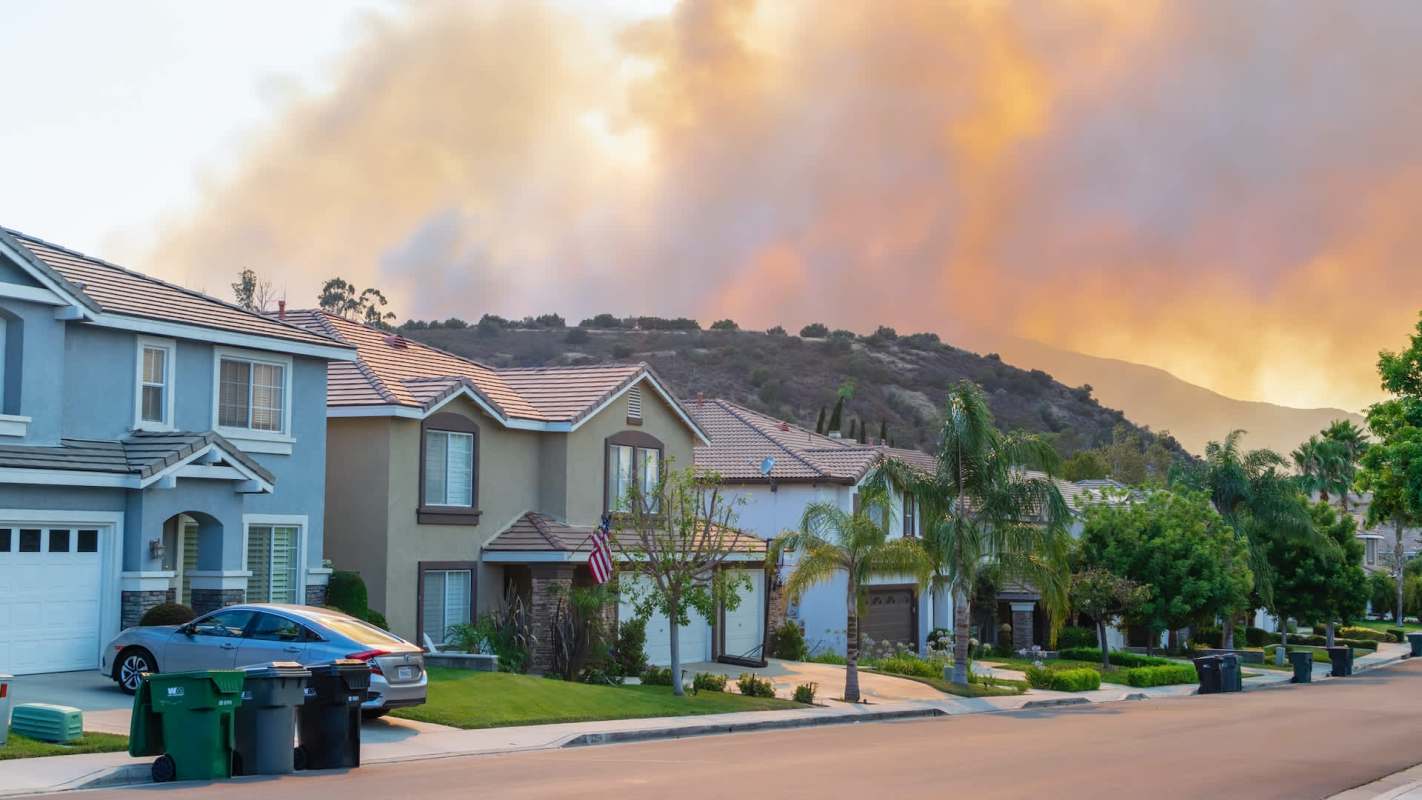
When two wildfires threatened Dave Kokot's home in Spokane in August, Kokot, a retired fire protection engineer with the Spokane Fire Department, and his family gathered keepsakes and prepared to evacuate.
Even so, he said he felt less anxious about the house itself than many of his neighbors likely would have.
That confidence was tied to both his wildfire experience and the steps he had taken at the house, including fire-resistant siding and cleared vegetation.
Yet Washington still has not resolved how much it should require those kinds of protections, even after more than 800 residences and other structures were lost in the area.
Here's what to know
For years, Washington has worked on wildfire safety standards for homes in high-risk places, combining tougher building-code proposals with defensible-space rules around structures. But after public criticism, officials pulled back some of those planned safeguards, NPR reported.
The state still intends to mandate some fire-resistant features in new construction, including roofs and siding, while dropping required vegetation management for homeowners. Research has found that wind-driven embers often ignite houses, and that nearby flammable plants can make those fires much harder to control.
TCD Picks » Quince Spotlight
💡These best-sellers from Quince deliver affordable, sustainable luxury for all




"That got the fire service pretty concerned, because that's our primary protection," he said.
Ryan Maye Handy, whose work at Headwaters Economics focuses on community wildfire planning, said the West has wound up with an uneven mix of rules.
"It's up to the political will of a community to adopt a building code to address wildfire," Handy said. "What we're increasingly seeing is many different interpretations of how to reduce that risk. It is literally all over the map."
More background
Even when the goal is to protect people and neighborhoods, regulations covering homes, yards, and trees can quickly become politically unpopular.
At public hearings in 2023, some opponents said the vegetation requirements could conflict with efforts to expand urban tree cover and help keep buildings cooler during heat waves.
Eric Seibel, testifying on behalf of the Tahoma Audubon Society, said, "Our greatest concern at Audubon is preserving bird habitat. I'm concerned that trees, which are our best defense against climate change, will be destroyed en masse if the provisions of the code pass."
Washington is not alone in the debate. Oregon repealed its wildfire rules after similar resistance, while California has maintained fire-resistant construction standards for nearly two decades. Colorado and Utah have also moved ahead with statewide rules, but many Western states still lack comprehensive codes or even wildfire risk maps.
What's being done?
Washington officials are revising the state's wildfire hazard maps again, with new versions expected in December. State officials say the updated maps will incorporate past wildfire history, giving a more accurate sense of which places face the greatest danger.
Angie Lane, an assistant division manager with Washington's Department of Natural Resources, said it is easiest to account for wildfire safety at the beginning of construction.
"It's trying to make sure that people are smart, building in those areas," Lane said. "When you're starting fresh, it's easier to go ahead and prepare for all of that while you're building."
Specialists continue to view stronger building codes as one of the clearest tools available.
Handy said it plainly: "One of the best ways to get everyone on the same playing field is a wildfire building code."
The odds can improve for both households and communities when homes use fire-resistant materials, vegetation is kept back from structures, and ember-friendly hazards around the property are reduced.
In Spokane, Kokot said the destruction in August should end the assumption that certain neighborhoods are simply beyond wildfire's reach.
"We can't be complacent about the fires," Kokot said. "We have to predict that there's a possibility it could happen. We have to plan for it."

Get TCD's free newsletters for easy tips, smart advice, and a chance to earn $5,000 toward home upgrades. To see more stories like this one, change your Google preferences here.