


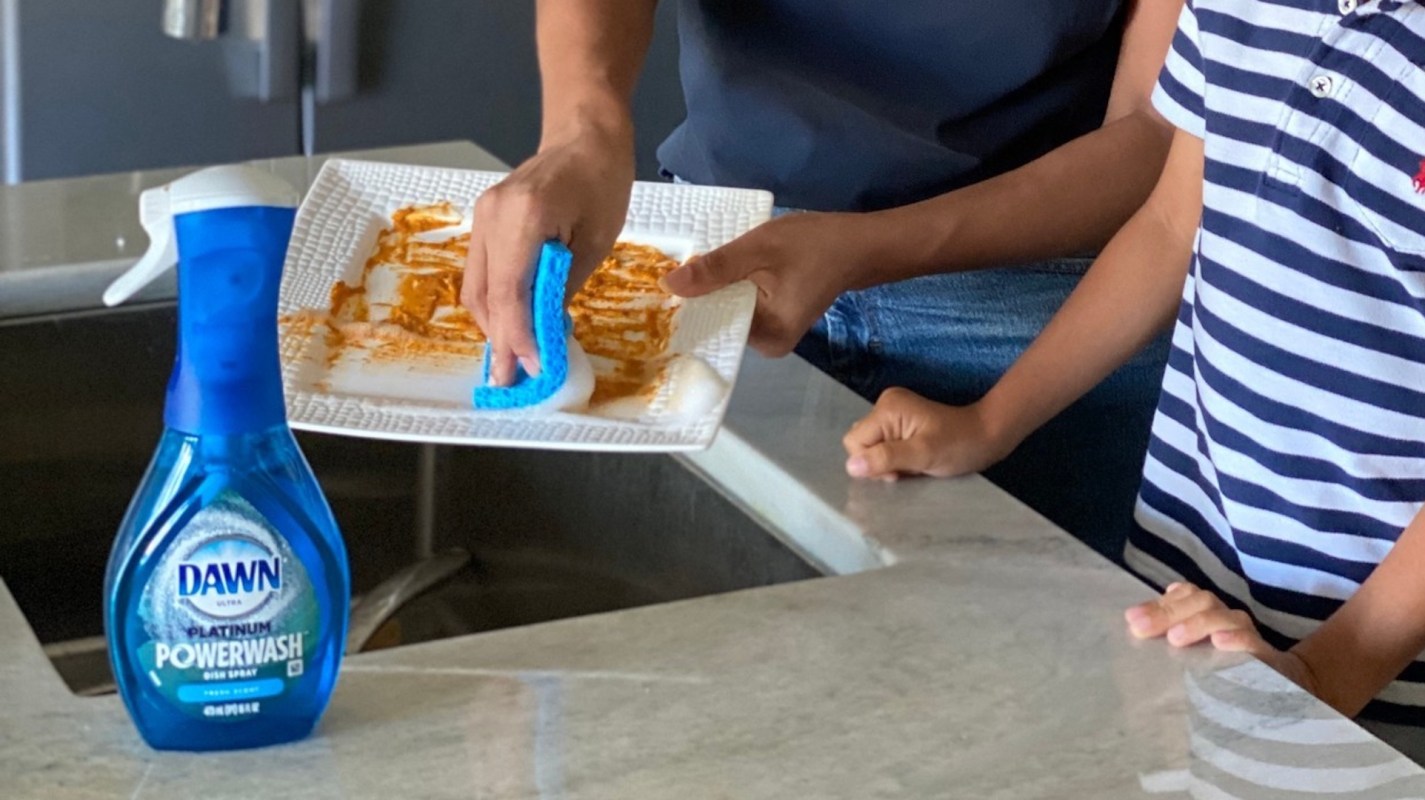
Washing your dishes after a great meal typically takes as much as 24 gallons of hot water and 11 minutes of running the tap — which, believe it or not, is actually more than a single typical shower uses (typically around 17 gallons…although personally, I often blast past that despite best intentions).
And while making use of your dishwasher will help you save water and reduce your utility bills (an Energy Star-certified model uses about four gallons per cycle), there will probably still be a few dishes you want to wash by hand.
And that's where the question of dish-washing detergent comes in — is there anything that works better than traditional dish soap, so you can get things done faster and with less water?
After doing some digging and talking to brands, one of my top picks has wound up being from an industry leader: the Powerwash Dish Spray from Dawn. While it may seem like the obvious answer, the Powerwash Dish Spray is actually still a lesser-known product, and learning more about it has persuaded me that it has some bona fides that allow you to actually cut your water usage by up to 50% when you're doing the dishes — something that could be especially huge in drought-prone communities.
"It's an incredible product, but awareness of it is still fairly low because it is such a different form." That's Morgan Eberhard, principal dishwasher scientist for Procter & Gamble, and she's on a mission to show more people how this product is different and better than conventional soaps.
For example, when the dish spray launched five years ago, people like my parents bought it thinking it was a more effective countertop cleaning spray (embarrassing, but the bottle does look similar to those sprays). Eberhard says that's not surprising — the spray bottle also has given people the assumption that "we've just taken regular Dawn liquid and watered it down … but that is not at all what the product is."
Instead, "it's a totally different formulation," Eberhard explained, and it includes three unique cleaning boosters that you wouldn't be able to get using regular dish soap. So recently, we chatted with Eberhard to learn more about how this unique detergent formula saves people water, time, and a lot of elbow grease for anything you're not putting in the dishwasher.
How it works
Eberhard recommends you spray the Powerwash directly on dirty dishes — not on the sponge and not in the water to make it sudsy. In fact, "water will only dilute the strength of the product" if you're lathering first and foremost, she said.
From there, the suds will start working their magic on any crusty pots, pans, and other items, and they'll actually start changing colors as they work to dissolve grease and grime. That's your cue to wipe off the dish with a sponge.
The last step is just to rinse off the dish to get rid of any remaining bits of grime, rather than having your faucet on the whole time.
|
Do you take steps to conserve water at home? Click your choice to see results and speak your mind. |
 All the time 😎
 How to slash 50% of your dish-washing water use
Because you don't need water until the final rinsing step, Eberhard noted that with a product like this, "you actually save 50% of the water that's used to wash dishes by hand."
Since many of us are so used to starting the process by wetting dishes and then adding soap, it can be a "tricky habit to break," she noted, but the payoff easily makes it worth it: "All of this comes together to help remove 99% of grease and grime in half the time," Eberhard said.
That's almost too catchy to allow it, but use of the spray bore that out in our testing, as water usage became much more about rinsing off at the end than a necessary element of the cleaning itself.
As reported in previous TCD coverage, the folks at P&G (Dawn's parent company) have said that, most importantly, they want to help consumers to use less water as a way to make more sustainable choices.
Right now, roughly 70% of P&G's products use water, and in an increasingly water-scarce world where one-third of people live in water-stressed regions, that could even one day threaten the future of P&G's business. It may sound extreme, but it's not in some areas, and that threat has been the backdrop of some of the company's experimentations.
The company recently launched a similar awareness campaign on the washing machine front, with a series of Tide ads encouraging people to trust their laundry to cold cycles much more often and noting that their brand has been tested to work well on cold, resulting in a win-win for wallets and the environment.
How long does the Powerwash take to kick in?
For things like salad dressing or olive oil — food that isn't baked onto a dish — Eberhard noted the cleaning powers are pretty instant. "By the time you get done spraying and putting it down and grabbing the sponge ... it's probably ready [to be wiped off]. But for more baked-on stuff, I would say three, four minutes is plenty."
"People are used to setting things for an hour or something and coming back, but [using Powerwash takes around] three, four, or five minutes," she said. As the resident dish-washer in my household, I'm always happy to avoid scrubbing a pot that's been soaking for so long, the water is stone cold.
But sidenote, make sure that when you do start spraying, you're not doing so on a still-hot dish, as much of the detergent will just end up evaporating before it can do any good.
What's actually in the Powerwash formula?
Eberhard explained the Powerwash detergent has three cleaning boosters that aren't included in regular dish liquids — and she noted they can help break down and loosen grease five times faster, according to the company's testing stats, which helps reduce the amount of time you need to keep the faucet running while you're washing.
First, there's the added alkalinity: "What that's doing is it's making all of the 'soils' swell up. So if you've ever soaked something overnight … after it soaks, when you go back to pour that water out, the soil is puffy or gummy." The same thing happens with the Powerwash, but instead of taking all night, the added alkalinity makes "that process of puffing up the soil happen in a matter of minutes," she said.
Then there's the cleaning booster — called a chelating agent, or a "chelant" — which removes the calcium in dirty dishes to make everything easier to break down and scrub away.
"Calcium acts as a mortar or a glue, holding the rest of soils together, so that chelant is going to go in and grab out that calcium, and it makes everything else … easier to break down," Eberhard said. "It's really good for baked-on, burnt, cheesy, and complex soils, whereas a traditional dish liquid primarily is going after grease."
Lastly, the Powerwash also has a specific solvent that works to dissolve grease and grime. This is the ingredient that's changing the color of the suds from white (when you spray) to whatever color is underneath (e.g., red for pasta sauce). Once the suds change color, "that's a really good indicator that … it's ready to be wiped and then rinsed," Eberhard said.
There's also a "Free & Clear" version with no fragrances or dyes added.
Uses beyond dirty dishes
Because the Powerwash comes in a spray bottle, you can spot-treat troublesome areas on pots and pans, as well as things like burnt food on a stovetop.
But Eberhard also explained that the spray is great for "getting into some of those really hard-to-reach places, like the inside of a reusable water bottle or a coffee pot, where it's hard to get your hand down in there to really clean."
"Think about all of the different gadgets around your kitchen that you're using that have either a lot of parts to them or a lot of nooks and crannies … (cheese graters, wine glasses, baby bottles) … [and] also the things like air fryers, even all of the parts of an at-home espresso machine or something like that." Eberhard also pointed out that the Powerwash works on outdoor grills, so you don't have to carry the whole grate into your kitchen to clean.
For all those tricky items, being able to mainly just spray and wipe is an effective way to reduce the amount of water you're using to clean them.
"I also keep one in my laundry room," she added. "It's great for pre-treating — especially greasy stains or food stains on clothing."

Get TCD's free newsletters for easy tips to save more, waste less, and make smarter choices — and earn up to $5,000 toward clean upgrades in TCD's exclusive Rewards Club.
Cool Picks






