


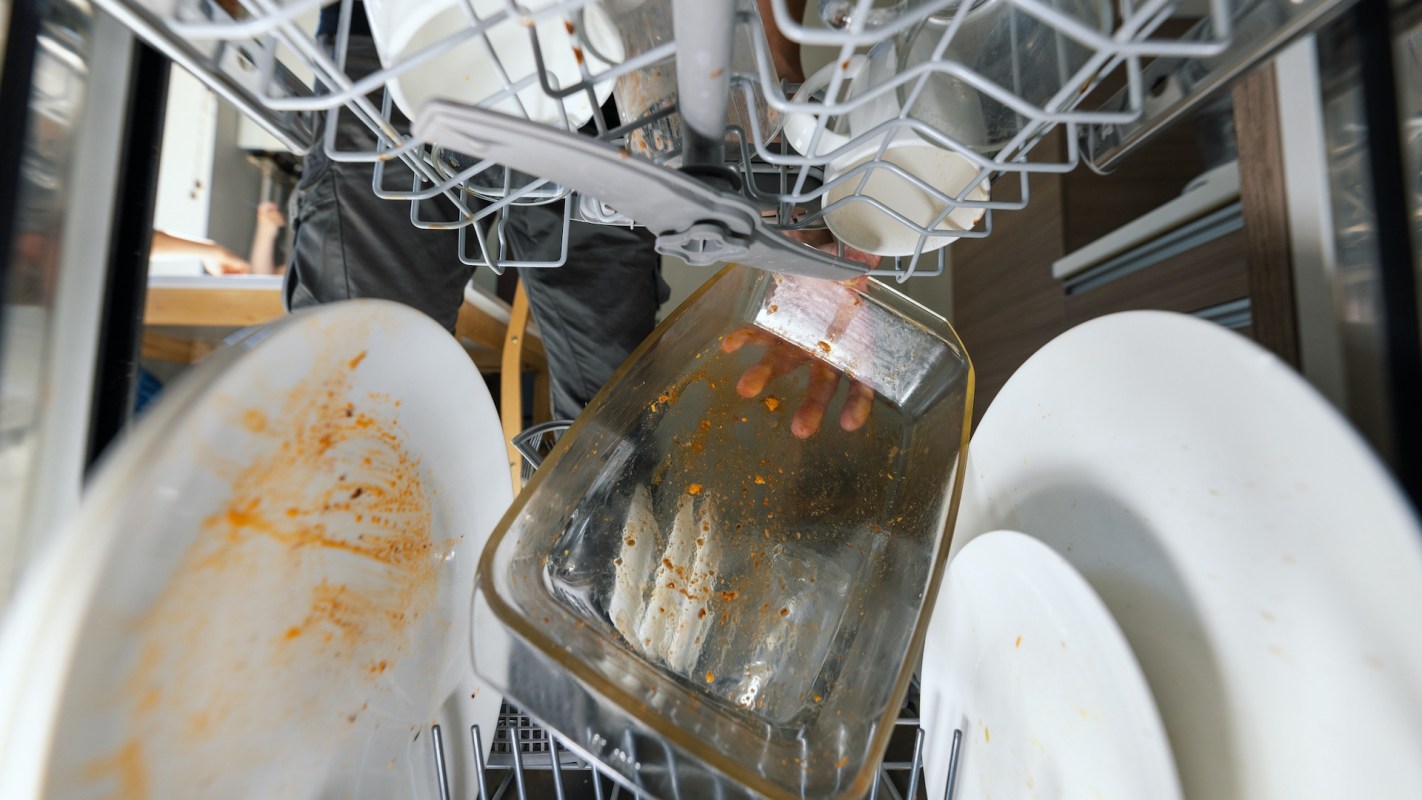
In the past few years, dishwashers have become faster and more efficient — which can add up to over $130 in savings annually compared to washing by hand. But as dishwashers evolve to use less water and energy, that means much more of the cleaning power is reliant on one other very important factor: the detergent you're using.
"The product that you're using in there really does matter — same with the tier of product," said Morgan Eberhard, principal dishwasher scientist for Procter & Gamble.
"If you're using a lower-tiered product that doesn't have as much of those cleaning ingredients in there … you're going to be more likely to experience a failure at the end of the cycle," she said. "Either your dishes are still dirty or still wet — and that reiterates this [sense] that in order to get clean dishes, you have to basically put them into your dishwasher already clean.
"And if you are spending the time and energy and water to wash your dishes at the sink before you're putting them in, you're negating all of the sustainability benefits of using the dishwasher," Eberhard added. Case in point: Energy Star-certified dishwashers can save you up to 8,400 gallons of water each year compared to washing by hand, which will show up on your utility bill.
(Dishwashers also save almost 10 days' worth of time over the course of a year too — and as they say, time is money. So if you don't have one or have been putting off replacing a broken one, consider it an investment that begins paying off the sooner you have one.)
Either way, it's important to read reviews and pick a dishwashing detergent that actually works well enough to confidently skip pre-washing and ensure you don't need to put anything back in for another cycle — particularly in drought-prone areas, where saving water is crucial. To get the details on how to end up with sparkly dishes every time you use the dishwasher, The Cool Down recently sat down with Eberhard to get her advice.
Why dishwasher pods are an effective solution
Generally speaking, there are three types of dishwasher detergents: liquid/gel, powder, and pods (which combine powder and gel components). All three types have their pros and cons, but pods have become highly popular (71% of consumers prefer them, according to Consumer Reports). Mainly that's because they're convenient to grab and toss in there, but Eberhard said it's also because they're able to give you the best of both worlds by featuring both cleaning enzymes and bleach ingredients and keeping them separate until the wash cycle begins.
"If you think of a [dishwashing] gel product, for example, you can't put bleach and enzymes in the same product, because the bleach will degrade the enzymes over time…. so gel products [what many consider liquid] either need to choose: 'Do I want to be able to bleach things like tea and coffee and red sauce stains, or do I want to have enzymes in there to break down those tougher … starches and proteins?'" said Eberhard. "They can't do both, whereas a multi-chamber unit-dose product [aka pods] allows you to."
Beyond that, Eberhard mentioned pods enable you to use ingredients in their most effective form (ex: "enzymes are much stronger as a solid form, instead of trying to force them into a liquid"), and pods also ensure you're using the right amount per cycle.
In so many cases, people over-use detergents for things like laundry cycles and refilling surface cleaners. But Eberhard told us P&G's lab found that most people actually underdose when it comes to dishwashing detergent.
|
When do you typically wash your dishes? Click your choice to see results and speak your mind. |
 Right after cooking 🍳
 "If [they're] using a gel or a powder, they're not filling up the compartment to the top [or] they're not utilizing the pre-wash compartment at all, which is what you should be doing with those types of products, because they're not as effective on their own," she said. And when people underdose detergent, they're "more likely to get a failure," she said, which leads to a negative spiral where most of us just throw in the towel and start hand washing more items, or throwing imperfectly cleaned dishes back in for another cycle.
"And then it's negating all of the sustainability benefits that you get from using the dishwasher," she said. "So it's really important to make sure that you're using the product as intended … so that you're not using additional water and heat to get the dishes clean."
Understanding what's actually in a dishwasher pod
The way that dishwasher pods can contain both powder and gel detergents is that they're wrapped in a type of plastic called polyvinyl alcohol, or PVA. It's a water-soluble polymer that's also used in things like medicinal pill capsules and eye drops.
These days, any mention of plastic soon leads to a discussion of microplastics — the tiny, near-invisible plastic particles found all over the world, right down to the human bloodstream. And while the science about microplastics' human health effects is still emerging, many scientists are concerned.
So do pods made with PVA end up releasing microplastics into dishwashers and eventually our downstream water supply? A recent article in The New York Times' Wirecutter explored what happens to the plastic in dishwasher pods after someone tosses them in the dishwasher.
As Wirecutter noted, "according to information from the multiple scientists interviewed for this article, solubility is what makes PVA/PVOH a completely different synthetic polymer than traditional (or hard) plastics. Hard plastics break into tiny shards that persist in the environment, unable to be broken down by microorganisms. By contrast, dissolved PVA/PVOH can be broken down by microorganisms in the correct environment, and multiple experts say this environment exists in wastewater treatment plants."
As Time magazine noted in a similar article, PVA molecules, "once they've dissolved in water, fall outside of the definition of microplastics since they're liquid instead of solid" and "because the residue washes away, most experts agree there's little risk of toxicity from directly consuming anything left over on your plates."
"PVA is one of the most well-studied materials," Eberhard said, "and it dissolves down to the individual molecule, so before it ever leaves your dishwasher or washing machine, it already could not be considered a microplastic."
P&G goes into great detail about its Cascade dishwasher pods to illustrate that point, citing dozens of studies and reinforcing that the Environmental Protection Agency has included PVA on its Safer Chemical Ingredients List.
Still, Consumer Reports reviewed PVA last year and said that it's difficult to reach a conclusive consensus about whether there could be any environmental side effects. Ultimately, CR's reporting suggested there should be further research through independently funded studies.
Importantly, detergent pods also have the Environmental Working Group's EWG Verified status, and Wirecutter wrote that "the Food and Drug Administration has green-lighted PVA/PVOH for a number of uses, including as a food additive. And the European Food Safety Authority has no concerns over its safety either. The same goes for regulatory agencies in Canada."
One area with no real debate is that the pod delivery system allows for reduced shipping weight over liquid detergent as a result of being more concentrated. Over time, it could also allow more companies to replace plastic packaging with cardboard, as long as the packaging is strong enough to keep any moisture out.
What we're eating actually impacts detergent formulas
Beyond talk of the PVA casing, detergent pods all have unique cleaning properties — and Eberhard's dishwasher team can actually keep refining that chemistry to ensure the pods are cleaning as effectively as possible.
Eberhard explained that her team is constantly doing "soil studies" to understand what consumers are cooking and how their cleaning experience has been going: "We will ask people to fill out essentially a diary for two weeks, give or take, and we'll ask them to let us know every single thing that they're cooking in their homes and what's going into their dishwasher during that time period."
"They are documenting all of the food being cooked, and then they're also rating it on their satisfaction of how it got clean."
From there, Eberhard's team works to understand the foods that are cooked most frequently and are not getting as clean as people would like.
"We'll track things … to understand what's changing about eating habits and food trends," Eberhard noted, and then they'll adjust the detergent formulas to help users tackle those tough stains.
Overall, the point Eberhard wanted to get the word out about is that trusting your dishwasher and detergent is key to making sure you're actually still saving time and money by not washing by hand — all while still ending up with sparkling dishes.

💰Get TCD's free newsletters for easy tips to save more, waste less, and make smarter choices — and earn up to $5,000 toward clean upgrades in TCD's exclusive Rewards Club.
Cool Picks




