


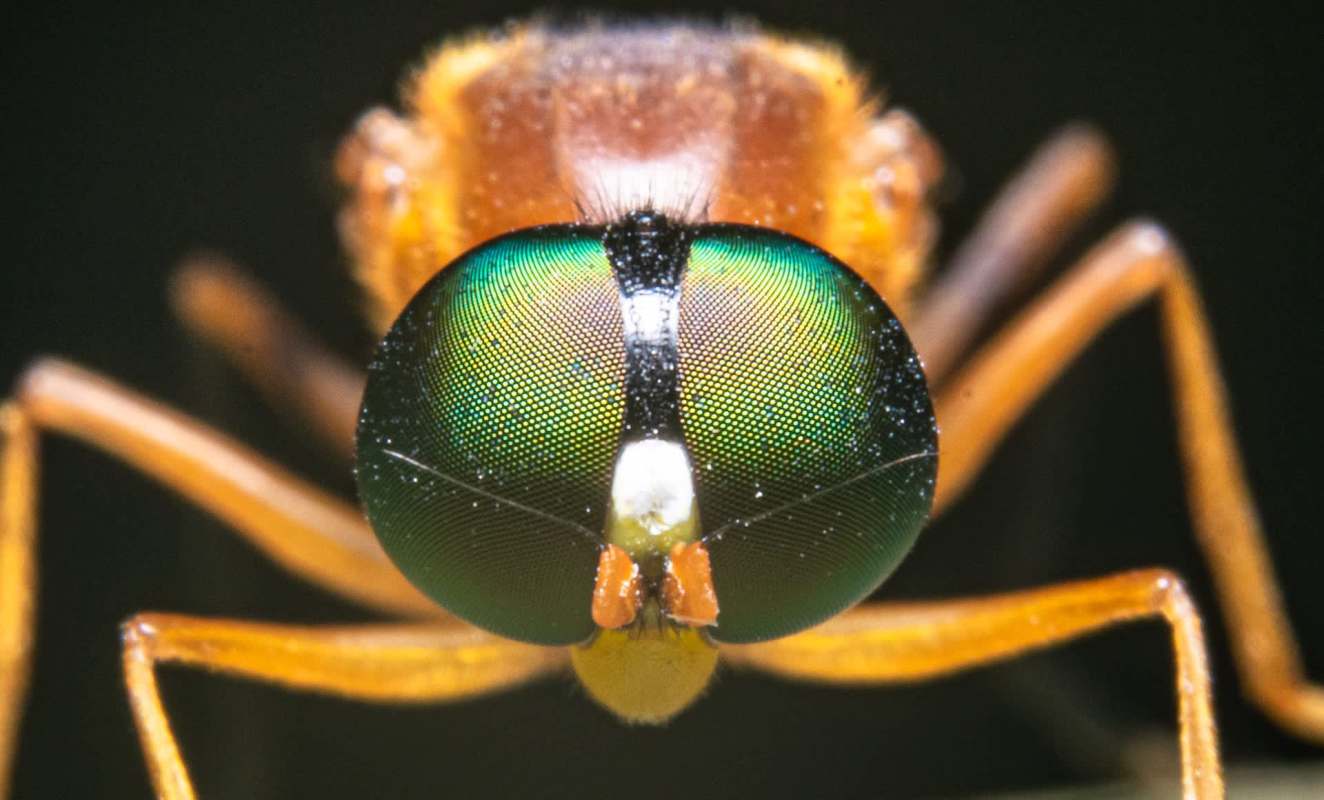
A newly identified trick in fly vision could help engineers build AI systems that react faster while using less energy.
In a study that could have implications far beyond biology, researchers say insects don't just passively take in visual information — they actively sharpen it through movement.
Researchers at the University of Sheffield published their findings in Nature Communications. As they shared in Phys.org, they found that house flies and fruit flies use tiny, rapid body and eye movements to improve what their brains can see and process in real time.
By combining behavioral observations, studies of fly eyes and brains, and digital simulations, the team identified a "turbo boost" in insect vision: a mechanism known as high-frequency jumping. During fast turns or other sudden movements, the visual system, according to the study, effectively moves into a faster mode, sending information to the brain at roughly three times its usual speed.
That helps explain how insects can dodge threats, navigate cluttered spaces, and, as reported in the study, respond on millisecond timescales — sometimes before the visual message has fully arrived. Senior author Professor Mikko Juusola said the work points to "a fundamentally new way of thinking about how brains compute information," with speed and efficiency emerging from active interaction with the environment.
The finding matters because it challenges a long-standing assumption that brains mainly process sight through fixed pathways with unavoidable delays. Instead, the study suggests that movement itself can reduce lag and improve perception.
TCD Picks » Quince Spotlight
💡These best-sellers from Quince deliver affordable, sustainable luxury for all




As reported in Phys.org, that idea could have major implications for AI, robotics, and autonomous vehicles, which often rely on massive amounts of computing power to interpret their surroundings and make decisions.
If engineers can borrow from insect brains, they may be able to design machines that process only the most useful data at the right time instead of brute-forcing every decision. That could mean smarter robots and more efficient AI systems.
Rather than separating sensing and action into rigid steps, the research supports systems that adapt on the fly, using movement to gather better information more efficiently.
Lead model developer Dr. Jouni Takalo said the team's model shows how many small sensors act together and can rapidly shift attention to the most important area. That kind of coordinated sensing could be especially useful for robots and vehicles operating in rapidly changing environments.
More broadly, it offers a reminder that better AI is not always about bigger computers — sometimes it may come from better design inspired by nature.
As Professor Aurel A. Lazar put it, "Nature shows us that intelligence doesn't come from processing more data, but from processing the right data at the right time." And Lars Chittka added, "Understanding how biology achieves this kind of predictive, low-delay sensing could inspire new approaches in artificial vision and neuromorphic engineering."

Get TCD's free newsletters for easy tips, smart advice, and a chance to earn $5,000 toward home upgrades. To see more stories like this one, change your Google preferences here.






