


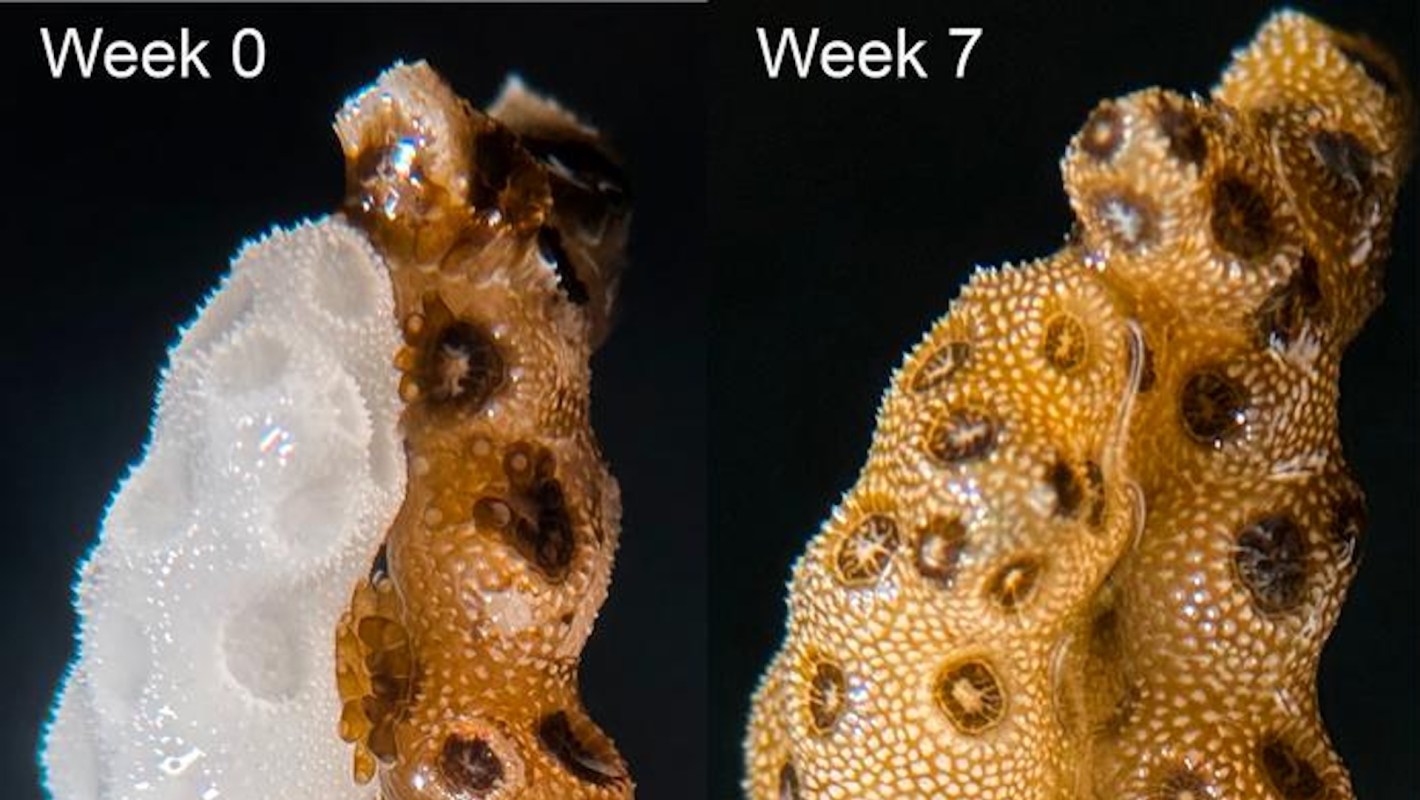
At Stanford University in California, scientists documented an unusually fast change in bleached coral fragments: their color returned within seven weeks.
That rebound came with an important limitation, with the stressed corals only recovering when they touched healthy, genetically identical partners directly.
Bleached fragments separated by just a few millimeters — only a few tenths of an inch — did not recover and eventually died, ZME Science reported.
Here's what to know
In a study published in the journal Science Advances, researchers reported laboratory results involving the branching coral species Pocillopora damicornis.
Stanford researchers paired 10 bleached fragments with 10 healthy pieces taken from the same genetic individual. They placed five pairs in contact and separated the other five with tiny gaps.
Every bleached piece recovered when it was touching a healthy partner, while the separated fragments did not.
TCD Picks » Quince Spotlight
💡These best-sellers from Quince deliver affordable, sustainable luxury for all




Bleaching is usually a long-lasting emergency for coral reefs. When ocean temperatures rise too high, corals eject the colorful algae living in their tissues, even though those organisms supply most of the energy corals need to survive and grow.
"While bleached corals may be dying, they are not dead yet," said Danny Collins, lead author of the study and an oceans Ph.D. student at the Stanford Doerr School of Sustainability.
As marine heat waves become more common and intense, even a small reduction in recovery time could give restoration teams another tool to keep damaged corals alive.
More background
The discovery stemmed from an incidental insight in 2025. Steve Palumbi, a Stanford marine biologist, noticed that a bleached fragment and a healthy fragment from the same colony had tipped over in a tank and come to rest against one another.
Color started returning at the spot where they touched, a sign that helpful algae were moving back into the bleached coral.
Collins had already thought about contact as a route for coral disease, especially from bacteria carried on plastic debris that settles on reefs.
"Harmful bacteria enter corals through physical contact," Collins explained. "We were curious about what would happen if we used contact to reintroduce something good — the beneficial algae from healthy corals."
Using a high-powered microscope, the researchers found that once genetically identical fragments touched, tiny channels in their tissues aligned to form a living pipeline. By day three, algae from the healthy fragment had already entered the bleached one.
Algae levels inside the bleached fragments doubled every four days during the second week of contact — about 10 times faster than scientists usually observe in wild corals.
What's being done?
The researchers also tested how long the coral pairs needed to remain together.
Recovery could begin after about a week of contact, and in some cases, only five days were needed. Some fragments took up enough algae after just three days to keep healing.
That does not mean the technique is ready for large-scale deployment across ailing reefs.
The experiment used only a limited number of fragments from a single species under laboratory conditions. The process also requires a healthy genetic match for each bleached fragment.
The results suggest another possible reef-survival strategy alongside efforts such as breeding heat-tolerant corals, replanting reefs with nursery-grown corals, and transplanting coral microbiomes.
The Stanford team plans to test whether they can deliver beneficial algae without physically pairing coral clones. One idea is to collect algae from healthy corals ahead of a heat wave and later apply them in bulk to bleached corals.
Stanford marine scientist Fiorenza Micheli noted that a broader goal is to buy corals time.
"We hope this new research will inspire solutions that keep corals healthy long enough to enable full recovery after heat waves through slower processes such as growth, reproduction, and recruitment of new colonies," Micheli said, per ZME Science.

Get TCD's free newsletters for easy tips, smart advice, and a chance to earn $5,000 toward home upgrades. To see more stories like this one, change your Google preferences here.






