


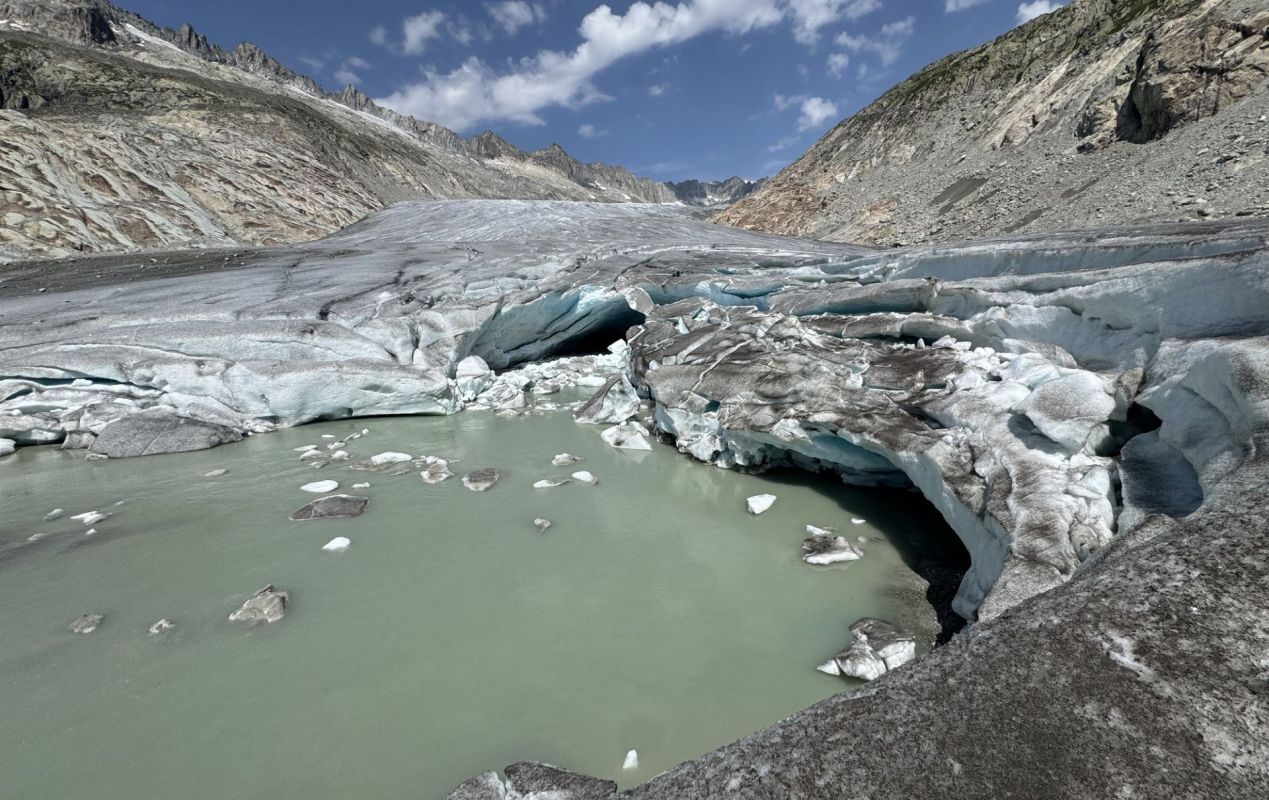
Switzerland's glaciers lost 5.5% of their volume over the first two-thirds of 2026, a staggering decline that nearly matched the country's record annual loss.
According to The Guardian, in some parts of the Alps, glacier retreat has become so extreme that former ice fields now resemble rock deserts, with only isolated remnants of old ice melting on sun-heated stone.
Here's what to know
The 2026 decline followed a winter with little snow and a summer marked by scorching heatwaves.
An annual monitoring report found that Swiss glacier ice has fallen by 19.4% since 2021.
Researchers said some small glaciers have essentially disappeared, though they have not yet finalized a formal count.
The report, produced by Switzerland's glacier monitoring network and the Swiss Commission for Cryosphere Observation, found that individual glaciers thinned by an average of 8.2 feet (2.5 meters) to 13.1 feet (4 meters) in 2026.
TCD Picks » Quince Spotlight
💡These best-sellers from Quince deliver affordable, sustainable luxury for all




Matthias Huss, a glaciologist at ETH Zürich and the report's lead author, described how quickly the landscape is changing.
"I visited one last week and it's so impressive to stand in this moonlike landscape where there was a big layer of ice — an extensive glacier — just a few years ago," he explained.
"And now it's a rock desert where there's some scattered blocks of old ice still lying around and melting on the hot rocks."
More background
Europe is heating up at about double the worldwide average, and Alpine regions are among the hardest hit.
A separate analysis from MeteoSwiss found that April through September was the hottest and driest summer half-year since Swiss records began in 1864.
Over roughly that same period, humanity added 1.8 trillion tons of carbon dioxide to the atmosphere and warmed the planet by about 2.5 degrees Fahrenheit (1.4 degrees Celsius).
Heatwaves increase public health risks, drought intensifies pressure on water availability and community safety, and the loss of predictable snow, ice, and seasonal conditions destabilizes mountain economies.
Researchers have warned that glacier retreat is increasingly driven by internal breakdown, not just surface melting. Huss said water moving beneath the ice can hollow out caverns that weaken a glacier from within.
As Huss noted, glaciers can develop "huge holes like cheese in the middle of the ice that have collapsing roofs," a process that "tear[s] the glaciers apart and make[s] them retreat even faster."
What's being done?
Swiss researchers continue to track losses through coordinated glacier monitoring and cryosphere observation, giving the country a detailed year-by-year record of how quickly the ice is disappearing.
The monitoring is also helping explain why 2026 came close to, but did not exceed, the worst losses seen in 2022.
Scientists cited relatively light Saharan dust deposits — which darken snow and cut its reflectivity — along with a bit more late-winter snow and increased summer sunlight as reasons Arctic ice loss did not break those records.
As a Ph.D. student, Huss worked with data from the former Plattalvafirn, also called the Griess glacier, which was among the most closely monitored glaciers in the world in the 1950s. It saw its area shrink by 99% over only 20 years.
Using long-term measurements as a comparison point, Huss said the current pace of ice loss looks nothing like what earlier records showed.
"What was different at that time is that the rates of retreat were still kind of at a normal level," he observed. "What we are seeing now is a complete explosion of these melt rates, leading to the disintegration of glaciers. They're really just falling apart."
Where can I learn more?
Glacier loss is reshaping alpine landscapes and the communities around them.
• In Blatten, a glacier collapse buried a small Swiss village in mud and rock.
• Across the Alps, huge holes like cheese are tearing weakened glaciers apart.
• Worldwide, much of the damage to glaciers cannot simply be undone.

Get TCD's free newsletters for easy tips, smart advice, and a chance to earn $5,000 toward home upgrades. To see more stories like this one, change your Google preferences here.






