


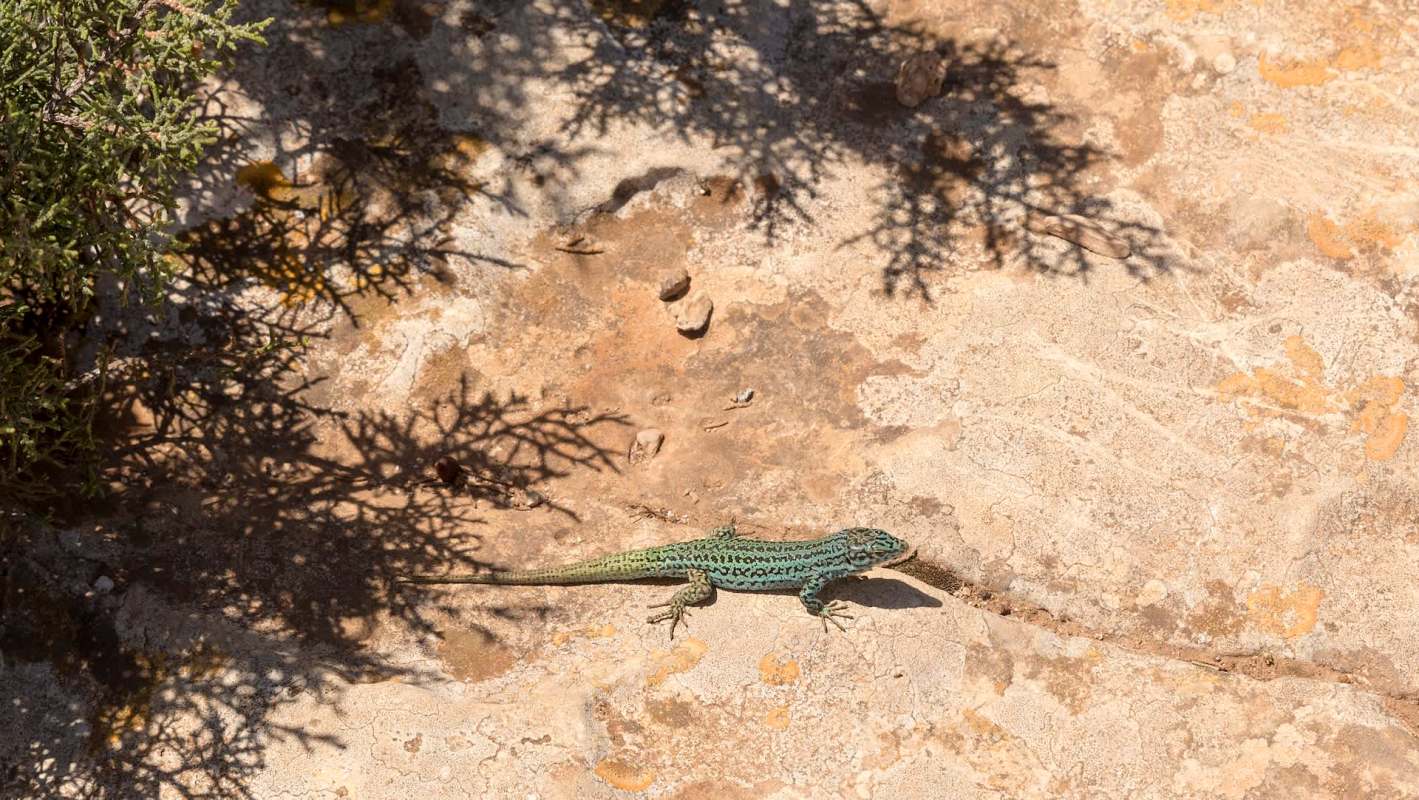
Across the Spanish island of Ibiza and nearby islets, tiny wall lizards show up in striking shades, including gleaming greens and blues as well as copper, orange, and near-black tones.
That extraordinary range of colors is shrinking as invasive snakes move through the island and its offshore outcrops.
Here's what to know
With losses mounting, scientists are urgently recording the wall lizard populations that remain before additional groups are gone.
According to National Geographic, the strikingly colored species are found in Ibiza, Formentera, and the surrounding rocky islets, where long-isolated populations produced more than two dozen separate color forms.
Few vertebrates show that much local variation, which is why the lizards are prized by biologists and still puzzle them. Nathalie Feiner, an evolutionary biologist at the Max Planck Institute for Evolutionary Biology, said the animals are unusual because "within the small region, you find so many very, very distinct types of coloration."
A 2021 analysis in Current Zoology estimated that Ibiza wall lizards could vanish from the island within a decade, along with many populations on the surrounding islets.
TCD Picks » Quince Spotlight
💡These best-sellers from Quince deliver affordable, sustainable luxury for all




The species is also considered a keystone animal, helping pollinate plants, disperse seeds, and control insects.
More background
The snake problem appears to have begun in 2003, when olive trees were brought in from mainland Spain for landscaping. Horseshoe whip snakes were likely hidden in hollows and crevices in the trees during transport, then spread across Ibiza after arriving.
Ibiza's lizards evolved over millions of years with very few natural predators. Oriol Lapiedra, a biologist at CREAF and National Geographic Explorer, explained, "They have evolved in a context where they didn't have to be afraid of anything."
As a result, the lizards often do not react quickly enough when snakes appear.
The invasion is reshaping the islands. Some places where lizards once thrived no longer have any. Researchers have also documented snakes swimming from Ibiza to nearby islets, showing that even offshore populations are no longer protected by distance.
The loss would be cultural as well as ecological. Lapiedra called the lizards "a cultural icon for these islands," and their image appears on tourist souvenirs across Ibiza.
What's being done?
Researchers are using several approaches to slow the losses. To preserve a record of the lizards' diversity, scientists are photographing populations, taking DNA samples, and comparing lineages across the Balearic Islands as they investigate how the colors evolved before more lineages disappear.
Local monitoring and trapping efforts have expanded. Citizen science reports have helped researchers track the snake invasion, while improved traps placed in gardens are being used to remove the predators.
Captive breeding is also underway. Barcelona Zoo recorded the first dozen Ibiza wall lizard babies in June 2025, and Bioparc Valencia is planning another breeding effort. Regional officials hope those programs can preserve more of the species' genetic diversity.
When a small island population disappears, an entire unique color form may vanish with it. As evolutionary biologist Roberto García-Roa put it: "We are witnessing the extinction of a species' life — and not only a species, but probably one of the most striking cases of color biodiversity on Earth."

Get TCD's free newsletters for easy tips, smart advice, and a chance to earn $5,000 toward home upgrades. To see more stories like this one, change your Google preferences here.






