


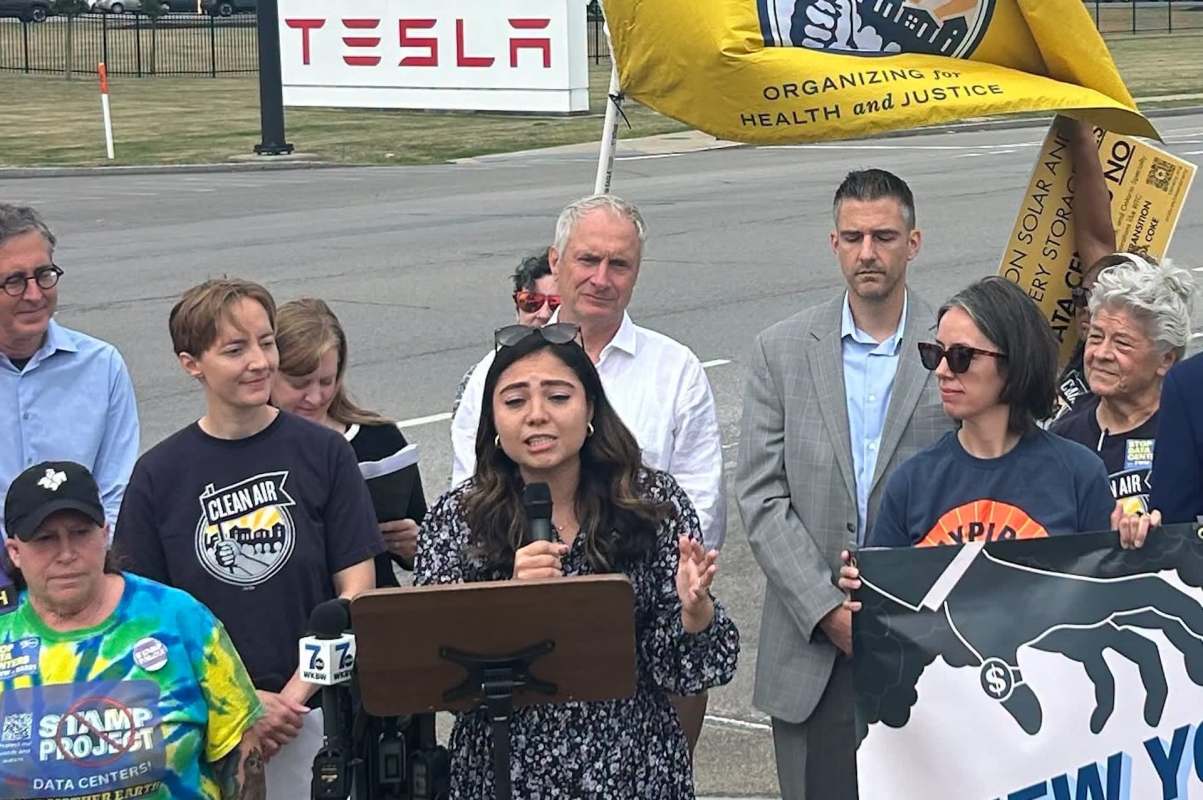
Local activists and leaders converged on Tesla's Buffalo facility on August 22 to protest the expansion of data centers.
The demonstration was part of a wider statewide push for a stronger moratorium on data center development.
Here's what to know
The Buffalo, New York, rally was one stop on the "Stop Data Centers" tour organized by State Senator Kristen Gonzalez and Food & Water Watch, according to a press release from the organization.
The city's Tesla location was once a site for the company's Dojo supercomputer project, which CEO Elon Musk announced last summer would be shutting down.
But with concerns still high over hyperscale data centers more broadly, residents, environmental advocates, and other community organizations recently gathered outside Tesla Buffalo. They argue that such projects — often driven by the push to power artificial intelligence operations like those a part of Musk's company xAI — too often move ahead without sufficient scrutiny.
Other rally participants included Clean Air Coalition of Western New York, PUSH Buffalo, the Buffalo Chapter of the Democratic Socialists of America, and a panel of Niagara Falls and Niagara County residents, according to the press release.
TCD Picks » Quince Spotlight
💡These best-sellers from Quince deliver affordable, sustainable luxury for all




While Gov. Kathy Hochul signed an executive order establishing a statewide moratorium on new data centers over 50 megawatts in July, Gonzalez and others want tougher measures. They are calling on the governor to sign the lawmaker's proposed legislation — known as the Responsible Data Center Development Act — into law. According to Food & Water Watch, it would pause data center permitting for one year on facilities over 20 megawatts.
The bill, which was approved earlier this summer by both chambers of the New York legislature with bipartisan support, would also establish regulations for the operation of large data centers, set energy-efficiency goals, and require certain community benefits.
More background
While data centers may bring some economic opportunities, critics say nearby communities often shoulder the burden of noise, water use, pollution, and strain on local utilities.
AI may offer real benefits, such as helping utilities forecast demand, manage grids more efficiently, and better integrate wind and solar power. At the same time, the servers powering those tools can consume huge amounts of electricity and water.
Critics warn that rapid expansion could raise energy bills, strain infrastructure, drain resources, create security and misuse concerns, and deepen economic and other inequalities.
What's being done?
At the Buffalo rally, opponents described these tradeoffs in blunt terms.
"Who is profiting from data centers and supercomputers? In the case of Tesla and xAI, the profit flows to Elon Musk, the world's richest man," said Sam Magavern, a Senior Policy Fellow at Partnership for the Public Good, according to the press release.
"Hyperscale data centers are invasive and resource extraction monsters that make too much noise, raise our utility bills, and consume and contaminate our water," added Eve Wackett, a New York State Certified Wildlife Rehabber and member of the Clean Air Coalition.
Demands for transparency, effective regulations, and engagement with elected officials are central to the efforts of organizers seeking to reduce data center impacts.
At the Orangeburg stop of the "Stop Data Centers" tour, Gonzalez said of her bill that it "specifically creates separate classes so that the cost of energy isn't passed down to us or reflected in our utility bills," according to local outlet Mid Hudson News.

Get TCD's free newsletters for easy tips, smart advice, and a chance to earn $5,000 toward home upgrades. To see more stories like this one, change your Google preferences here.






