


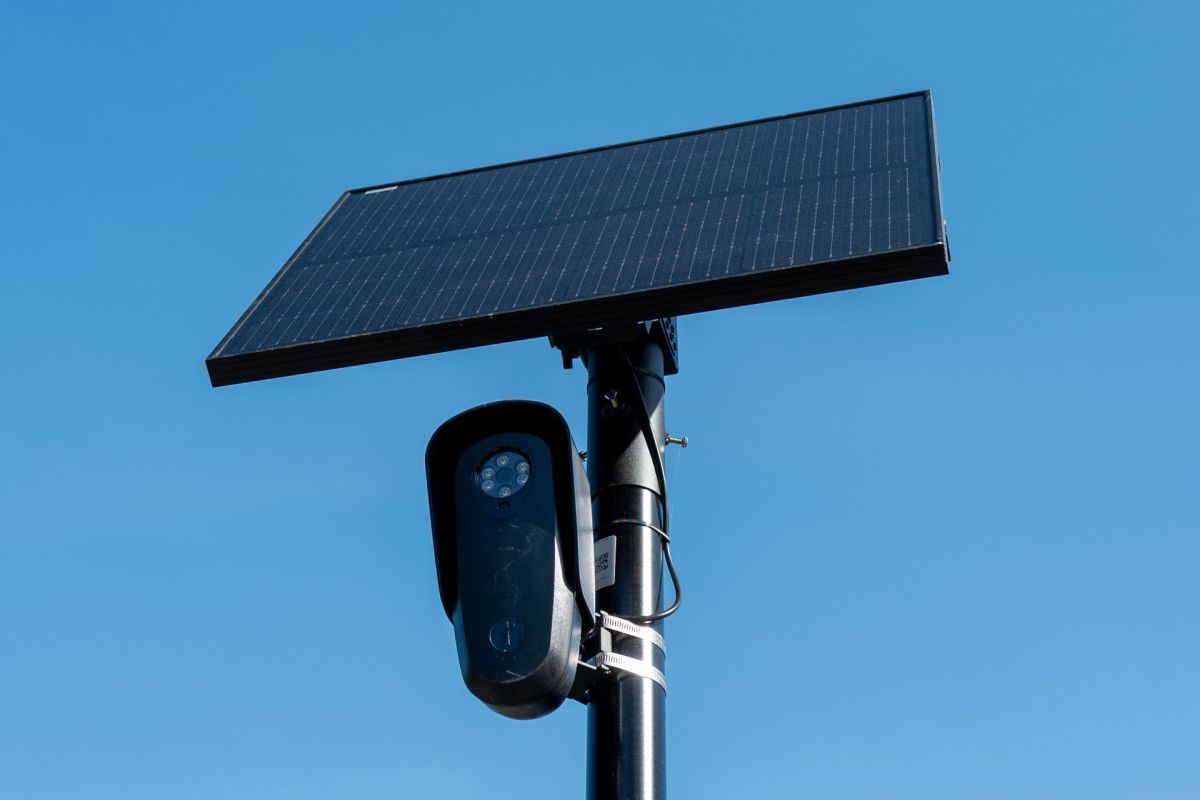
When Brady O'Rourke goes to a busy intersection near his home in Crystal, Minnesota, he brings an unusual protest tool: a roof rake with a bright yellow sign taped to the end, part of his one-person demonstration against Flock cameras.
At the corner, he raises it to obstruct a Flock camera in a small act of resistance against AI-driven police surveillance.
Here's what to know
His solo demonstration is part of a much larger backlash against automated license plate readers, NPR reported. Flock Safety, the Atlanta-based company behind many of the cameras, said more than 5,000 law enforcement agencies use its technology.
Across the country, the scale is vast: DeFlock, an advocacy group that tracks the cameras, estimated that more than 130,000 AI-powered license plate readers are installed on U.S. streets. NPR reported that the devices collect billions of scans each month, along with information including a vehicle's make, model, color, and visible alterations.
Clare Garvie, the deputy director of technology law and policy at New York University's Policing Project, said the systems "monitor, quite simply, when we go to and from work, where we go to the doctor, where we drop our kid off at daycare."
Supporters in law enforcement have said the cameras can help recover stolen vehicles and find missing people. As Jeff Potts, executive director of the Minnesota Chiefs of Police Association, noted, per NPR, "There's no question that license plate readers can be very helpful tools for law enforcement."
TCD Picks » Quince Spotlight
💡These best-sellers from Quince deliver affordable, sustainable luxury for all




Critics, however, have cited both alleged misuse and errors. NPR pointed to cases in which officers allegedly used the technology to stalk former partners, pulled data for immigration enforcement without local approval, and tracked a Texas woman who may have had an abortion. A 2024 analysis by a California police department also found Flock misread license plates in 71% of the alerts it sent to police.
More background
What started as a privacy fight has spilled into direct action. NPR, citing local reports, found that Flock cameras have been vandalized in at least 36 states, while DeFlock said 100 or more cities have either turned off cameras or ended deals with Flock or similar companies.
Jay Stanley, a senior policy analyst with the ACLU's Speech, Privacy and Technology Project, said the pushback stretches across the political spectrum.
"We're seeing opposition from the left," he said. "We're seeing opposition from MAGA Republicans. We're seeing opposition from mainstream Republicans, from centrists."
The cameras rely on AI and cloud-based data systems, part of AI's growing role in public infrastructure. AI can offer real benefits, including helping optimize traffic flow and supporting cleaner, more efficient energy systems.
However, AI networks require electricity-intensive computing and water-hungry data centers. That can add pressure to the grid and, in some cases, contribute to higher energy costs. It also raises security concerns when sensitive information is centralized.
What's being done?
Flock said it has begun adding tighter safeguards. Garrett Langley, CEO of Flock Safety, told NPR, "We are so transparent about the business. We don't own this data. We don't sell this data. Cities have control over how long it's stored. And who it's shared with."
The company changed some features in August by shortening its recommended storage periods and cutting off access for officers who appear to be misusing the system.
Civil-liberties advocates, however, want lawmakers and local governments to go further. Garvie also called for more oversight from lawmakers.
Residents are getting involved. DeFlock organizers are holding a National Week of Action with protests and education sessions around the country, and the group said more than 25,000 people have signed up for events.
"I don't want to pay to be surveilled," O'Rourke said. "My tax dollars are funding cameras at the end of my block. I don't want to live like that. I don't think anybody should have to live like that."

Get TCD's free newsletters for easy tips, smart advice, and a chance to earn $5,000 toward home upgrades. To see more stories like this one, change your Google preferences here.






