


Microplastics are turning up everywhere from farm fields to waterways, and once they settle into the environment, they are notoriously difficult to remove.
Now, researchers in the Czech Republic say swarms of tiny magnetic microrobots could offer a promising new way to capture them.
Here's what to know
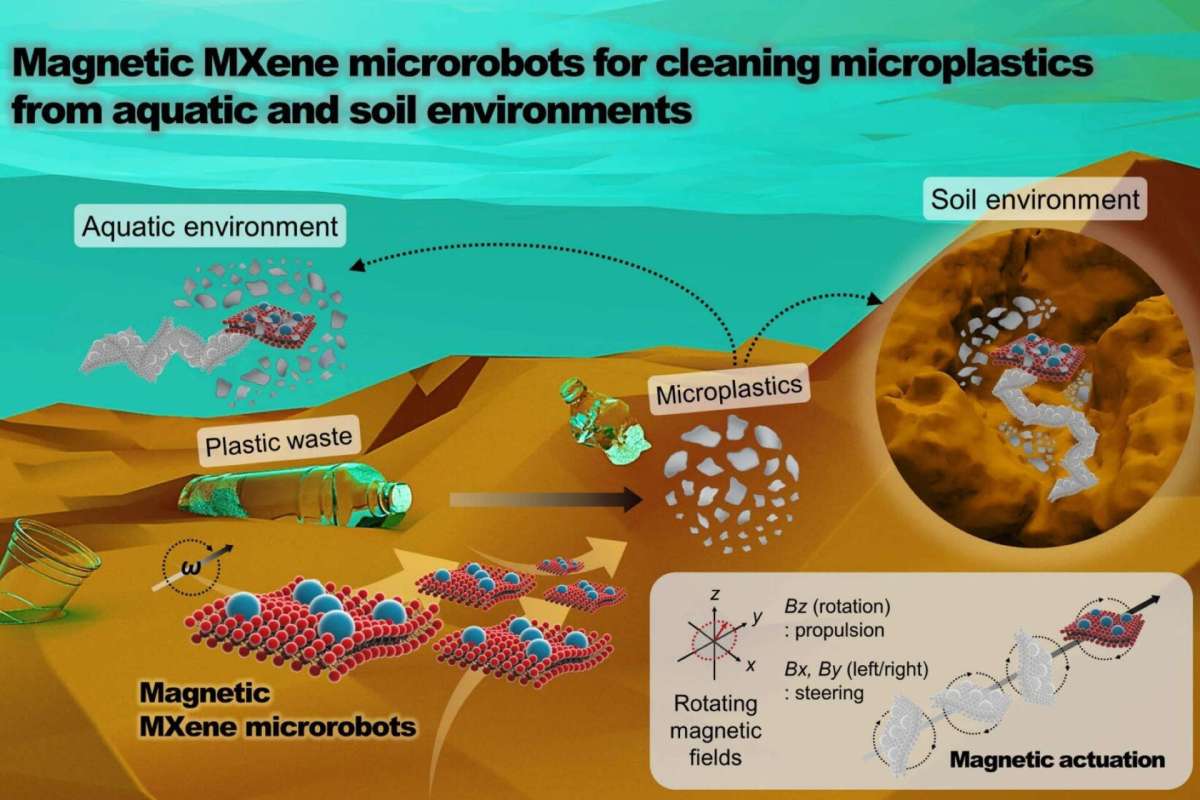
In the lab, the team built microscopic robots from MXene, a layered material with a large surface area that helps attract plastic. After coating the particles with magnetic nickel nanoparticles, the researchers could guide them with rotating magnetic fields, and they published the findings in npj Asia Materials.
Phys.org reported that the microrobots actively traveled through water and into tight, water-filled spaces in soil, rather than relying on plastic fragments to drift toward them. Those are places where microplastics can become trapped within soil.
Performance was strongest in water, where the robots removed about 94% of polystyrene and 89% of PET in roughly an hour. In model soil, they extracted about 81% of polystyrene and 72% of PET, beating MXene used without magnetic motion.
The study authors wrote, "In soil environments, the microrobots can navigate through water-permeated soil microenvironments, actively disrupt microplastic entrapment within soil matrices, and extract them."
TCD Picks » Quince Spotlight
💡These best-sellers from Quince deliver affordable, sustainable luxury for all




More background
Microplastics, plastic particles smaller than 5 millimeters, are becoming a larger threat across land and water ecosystems. In soil, they can disrupt fertility and nutrient cycling, while in rivers, lakes, and oceans they can harm wildlife and move through the food chain.
That makes cleanup important, even though it is hard to do. Soil is especially difficult because these fragments can lodge tightly within underground structures, where traditional passive methods may struggle to reach them once they are embedded.
A tool capable of moving through those spaces and physically pulling microplastics out could eventually help reduce contamination before it spreads further through the food chain.
Microrobot cleanup is still a long way from operating in neighborhoods, but advances such as this could help shape future methods for restoring polluted land and water more efficiently.
What's being done?
The work has stayed in the experimental stage. The team tested the microrobots under controlled lab conditions and then used magnets to retrieve the bots along with the plastic they had captured.
Whether the process can work outside the lab, where conditions are far more complicated, still needs to be shown.
The study also noted potential concerns, including metal-ion leaching and the possibility that not every robot could be magnetically recovered after use.
The platform reflects a broader trend in cleanup science: the development of active materials that do more than simply sit in place and absorb pollution.
Instead, they can be directed to seek out contaminants in hard-to-reach environments.
Microplastic pollution is increasingly being treated as a solvable engineering problem rather than an unavoidable byproduct of modern life.
The researchers said the technology could have lasting value if those real-world hurdles are addressed: "This microrobotic cleanup platform represents a versatile and sustainable strategy for active pollutant decontamination in both aquatic and terrestrial ecosystems."

Get TCD's free newsletters for easy tips, smart advice, and a chance to earn $5,000 toward home upgrades. To see more stories like this one, change your Google preferences here.







