


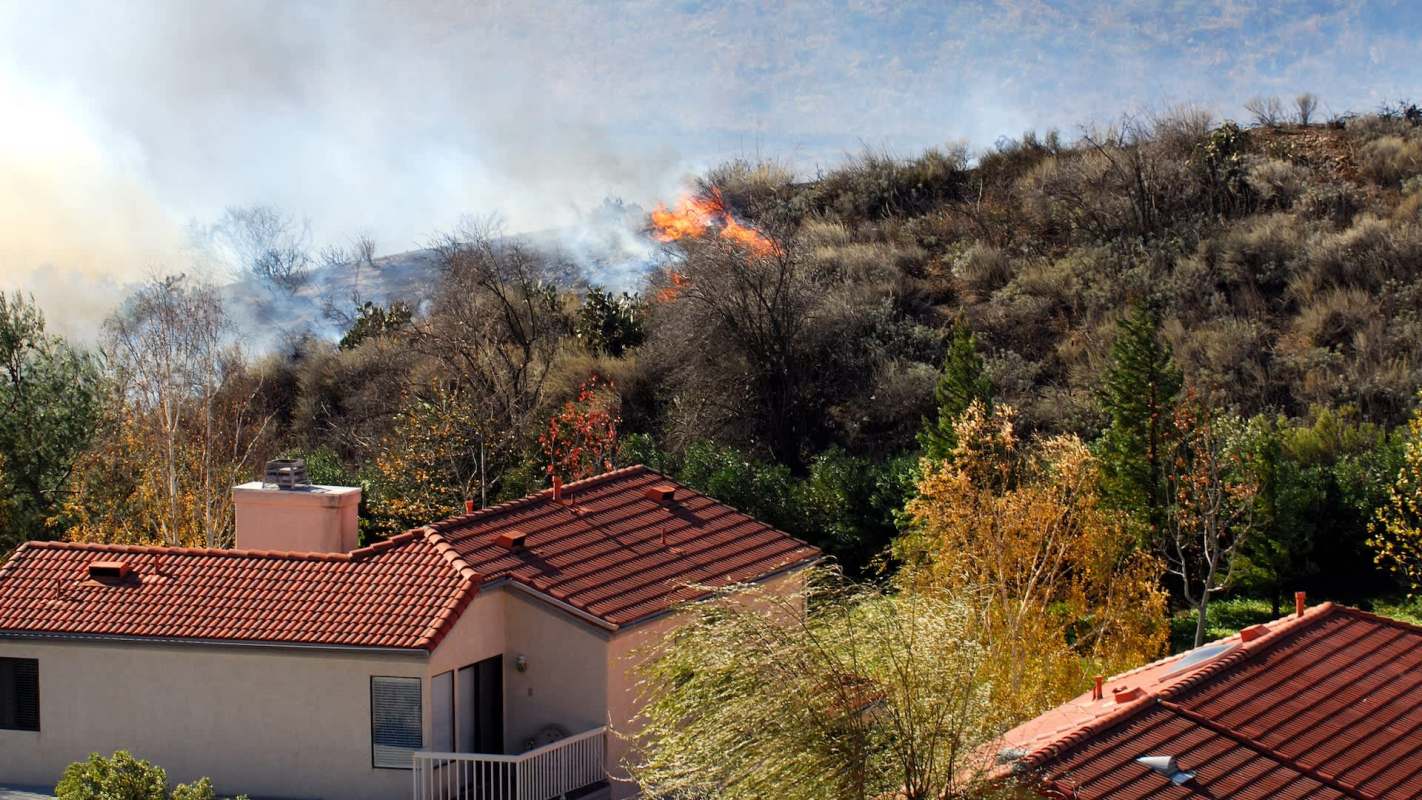
For years, wildfire assessments focused heavily on forests, brush, and steep hillsides. But newer models are putting a spotlight on a different threat: neighborhoods where one burning home can ignite the next, a risk that suggests millions of Western households — along with a huge amount of housing wealth — may be even more vulnerable than older assessments indicated.
Instead of treating wildfire mainly as a problem of wooded slopes and heavy brush, the latest models also examine what happens in neighborhoods, where a single burning home can ignite nearby houses.
Here's what to know
In the Santa Monica Mirror, Sarah Lin reported that the property analytics firm Cotality identified more than 2.5 million properties across the 10 most-impacted Western states with elevated exposure to structure-to-structure wildfire spread. Their combined reconstruction value is roughly $1.4 trillion.
What the newer maps add is "wildfire conflagration risk" — the scenario in which embers ignite houses, and those burning structures then carry fire to neighboring buildings.
Earlier hazard mapping often treated developed areas as comparatively safer because it weighted steep slopes and dense vegetation more heavily than the threat posed by closely spaced combustible structures.
The concentration is highest in California. The report estimates that there are about 1.28 million vulnerable properties there, with potential reconstruction costs of roughly $850 billion.
TCD Picks » Quince Spotlight
💡These best-sellers from Quince deliver affordable, sustainable luxury for all




Lin reported that Los Angeles ranks first among metro areas nationwide, with nearly 250,000 properties in the high-hazard tier and more than $209 billion in replacement value.
When an entire neighborhood can effectively become wildfire fuel, the risks include insurance costs, housing stability, evacuation planning, and recovery.
More background
One of the biggest implications is that wildfire danger cannot be understood only as a problem at the edge of wildlands.
Once a fire enters certain Western neighborhoods, the community's own building pattern can intensify the damage.
A homeowner can invest in fire-resistant improvements, yet the report indicates those measures may offer less protection if nearby houses remain highly vulnerable. In dense communities, the danger is shared rather than purely individual.
The exposure is broad geographically as well. Lin reported that Colorado and Texas together have about 560,000 vulnerable properties, with reconstruction costs totaling roughly $252 billion.
Outside California, Austin leads the list with $49 billion in exposed real estate, Sarah Lin reported, followed by San Antonio, Denver, and Spokane, Washington.
That risk map may also shift in 2026. Lin wrote that forecasters expect an unusually strong El Niño, which could bring more winter moisture to the Southwest while leaving the Pacific Northwest drier and more susceptible to large, fast-moving fires.
What's being done?
The report also suggests that coordinated work at the neighborhood level can materially reduce losses.
Lin reported that California communities emphasizing vegetation clearing and organized fire-prevention efforts had expected losses to fall 78% below the statewide average.
Steps such as removing combustible material near homes, improving defensible space, hardening roofs and vents, and reducing shared ignition risks can all help lower the odds that a single spark becomes a neighborhood-wide disaster.
Hazard maps are also used to set building standards, shape emergency response, and guide land-use decisions.
The greatest danger is not always just the forest at the edge of town — it may be the sheer speed of moving flames once they reach the street.

Get TCD's free newsletters for easy tips, smart advice, and a chance to earn $5,000 toward home upgrades. To see more stories like this one, change your Google preferences here.






