


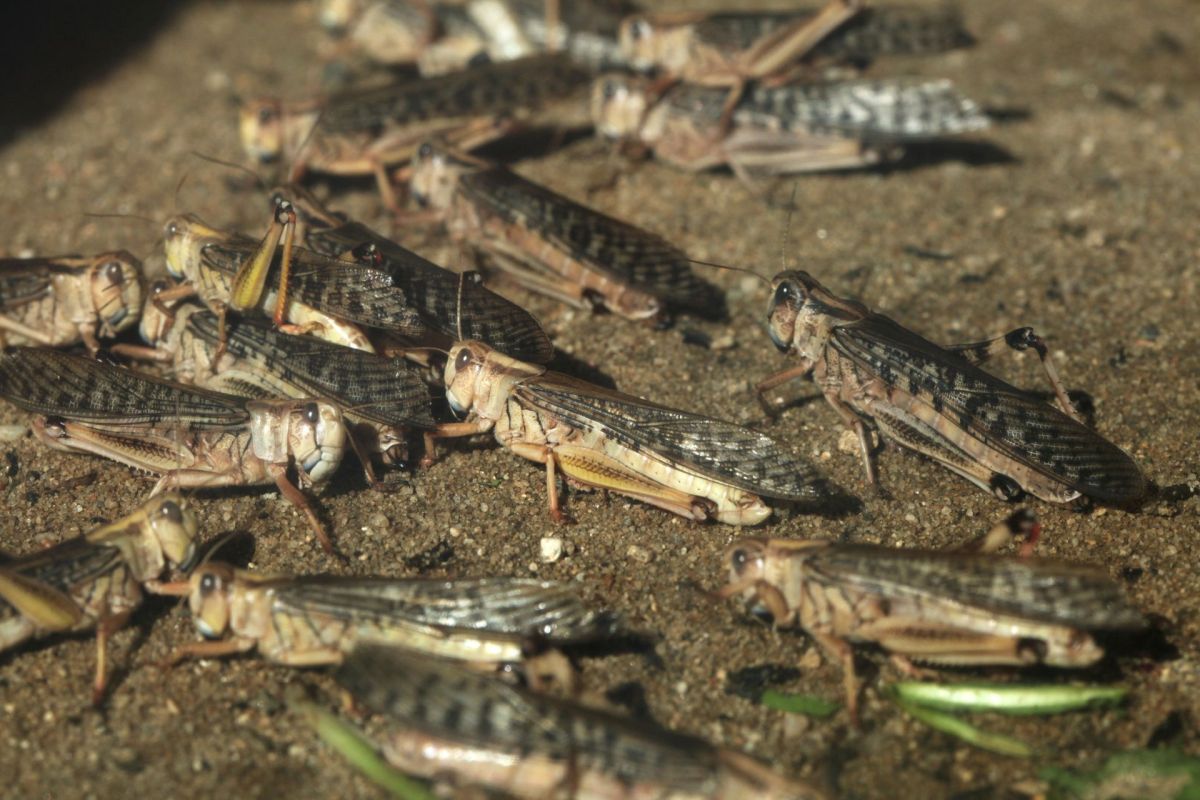
A tiny insect may help solve a major public health challenge: detecting "forever chemicals" before they spread through drinking water and the wider environment.
Researchers at Michigan State University found that locust neurons can respond to PFAS, raising the possibility of quicker, portable testing that could work outside specialized laboratories.
Here's what to know
To see whether locusts could sense PFAS — short for per- and polyfluoroalkyl substances — at the low levels that matter outside the lab, researchers at Michigan State University monitored neural activity in the part of the insects' brains associated with odor. As MSU reported in an article shared on Phys.org, the locusts were exposed to gas mixtures that included several PFAS chemicals.
Results suggested the approach has promise: The insects' neurons reacted to environmentally relevant PFAS concentrations, including PFOS, which is among the most common and most tightly regulated PFAS compounds found in the environment.
That matters because spotting these chemicals is not easy. Debajit Saha, an associate professor at Michigan State University's College of Engineering and its Institute for Quantitative Health Science and Engineering, said, "PFAS are extremely difficult to detect."
Because testing typically relies on costly laboratory analysis that can be slow, communities may not get quick answers about possible contamination in their water.
TCD Picks » Quince Spotlight
💡These best-sellers from Quince deliver affordable, sustainable luxury for all




More background
Found in products such as nonstick cookware, waterproof fabrics, and firefighting foams, PFAS are widely used in both household and industrial settings. Their nickname, forever chemicals, comes from how slowly they break down.
Once released, PFAS can linger for long periods in water, soil, and living organisms, which makes pollution difficult to track and difficult to clean up.
Rather than building a detection system entirely from scratch, the Michigan team is drawing on the sensing abilities of living organisms. Scientists have worked for decades on chemical sensors, yet many artificial tools still fall short when faint chemical signals need to be detected.
Dogs are famous for picking up many different compounds, and insects use smell as a key way to move through their environment, as the article noted. That built-in sensitivity may offer a more practical, accessible option for environmental monitoring.
What's being done?
The challenge now is converting that biological capability into a tool that can be used outside the lab. Researchers said the work could help lead to portable sensors that detect PFAS without sending every water sample away for analysis.
If that happens, communities could get faster information about local water quality. Residents and officials might be able to test near the source of concern instead of waiting on slower, centralized lab results.
That would not eliminate the need for broader cleanup efforts or stronger regulation, especially in cases of widespread contamination. But it could help identify potential problems earlier and support follow-up testing, filtration, and public health responses.
Better detection could make it easier to monitor contamination, prioritize cleanup, and reduce uncertainty about what is in drinking water.
The study suggests a quicker way to find chemicals that are both hard to detect and hard to remove.
As Saha said, "There is a tremendous need for technologies that can identify them at very low concentrations."

Get TCD's free newsletters for easy tips, smart advice, and a chance to earn $5,000 toward home upgrades. To see more stories like this one, change your Google preferences here.







