


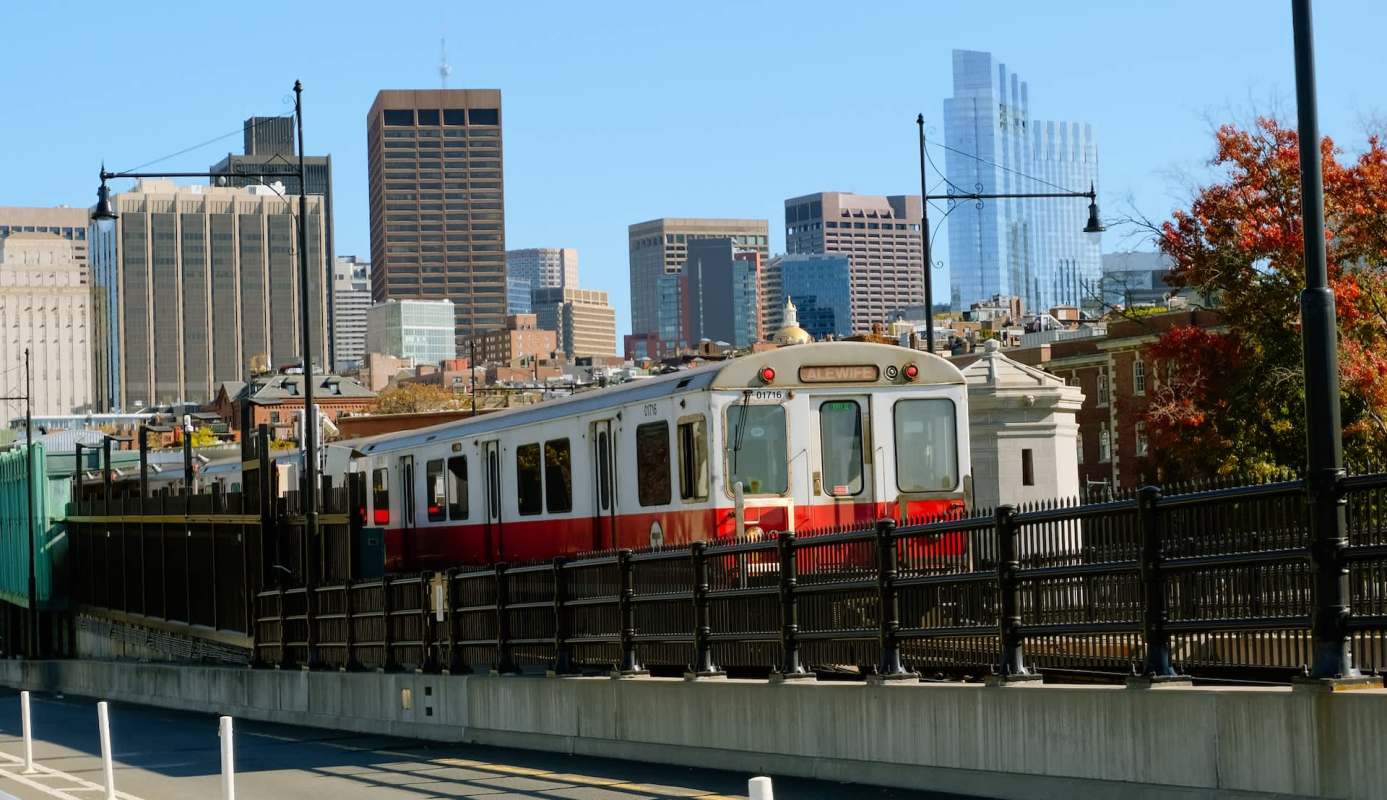
Boston transit leaders called commuter rail electrification "historic" in November 2019. Now, the Massachusetts Bay Transportation Authority (MBTA) is finally approaching its first major test with the initiative — a $765 million effort on Boston's Fairmount Line that has been slowed by years of delay.
For communities along the Fairmount Line, that slow progress means waiting longer for cleaner air, faster service, and better access to jobs and other daily essentials.
Here's what to know
The MBTA's 15-year, $765 million agreement would lease 28 battery-powered train cars for Boston's 9.2-mile Fairmount Line, according to CommonWealth Beacon.
Testing on the first of the battery electric trains from Swiss manufacturer Stadler is expected by the end of 2029, and passenger service is projected to start in 2030. MBTA officials say the trains could increase frequency while cutting the planet-warming pollution tied to the system's current fleet of roughly 100 diesel locomotives.
Running through Boston neighborhoods with large Black populations, the Fairmount Line has long been one of the area's more limited transit links. Cleaner and more dependable rail service could reduce both local air pollution and greenhouse gas emissions while improving daily trips for riders.
However, the high price and extended timeline have also drawn concern. Sen. Brendan Crighton, co-chair of the Legislature's Transportation Committee, told CommonWealth Beacon that the effort has "absolutely taken longer than I hoped."
TCD Picks » Quince Spotlight
💡These best-sellers from Quince deliver affordable, sustainable luxury for all




More background
The central debate is whether the MBTA is making a practical investment in battery trains or taking on avoidable risk with newer technology. These trains can go about 50 miles on a charge and need less overhead wiring, which supporters say could make future expansion simpler and less disruptive.
MBTA commuter rail executive director Mike Muller called the strategy "scalable and future-proof." He said, "The technology has evolved to a point now where you don't need to put up 650 miles of overhead catenary."
Skeptics say that approach leaves the agency dependent on equipment with little track record in the U.S. Brian Kane, executive director of the MBTA Advisory Board, said, "It's a little bit untested in the United States, and that gives me great pause, great concern."
Because the 2019 electrification votes were nonbinding and came without funding, the project was vulnerable to delay from the start. The pandemic, safety failures, and accessibility design changes added even more time.
What's being done?
At this stage, the Fairmount Line is being used as a demonstration project. The MBTA is also procuring 10 electric locomotives for the Providence Line, which already has overhead catenary because the route overlaps with Amtrak's Northeast Corridor, CommonWealth Beacon noted.
What comes after a few short electrified rail lines in Boston?
State lawmakers also want a larger plan. As CommonWealth Beacon reported, an education and transportation spending bill requires the MBTA to submit (by summer 2028) a roadmap for building a fully transformed commuter rail network with more frequent electrified service, along with the timeline and sequence of steps.
All in all, even a promising pilot can fall short of producing systemwide benefits without a long-term strategy and reliable funding.
As Joseph Aiello, former chair of the Fiscal and Management Control Board, put it, "The cost and the reality of competing interests for federal and state dollars means that the regional rail initiative needs sustained public and political support over a couple decades."

Get TCD's free newsletters for easy tips, smart advice, and a chance to earn $5,000 toward home upgrades. To see more stories like this one, change your Google preferences here.






