


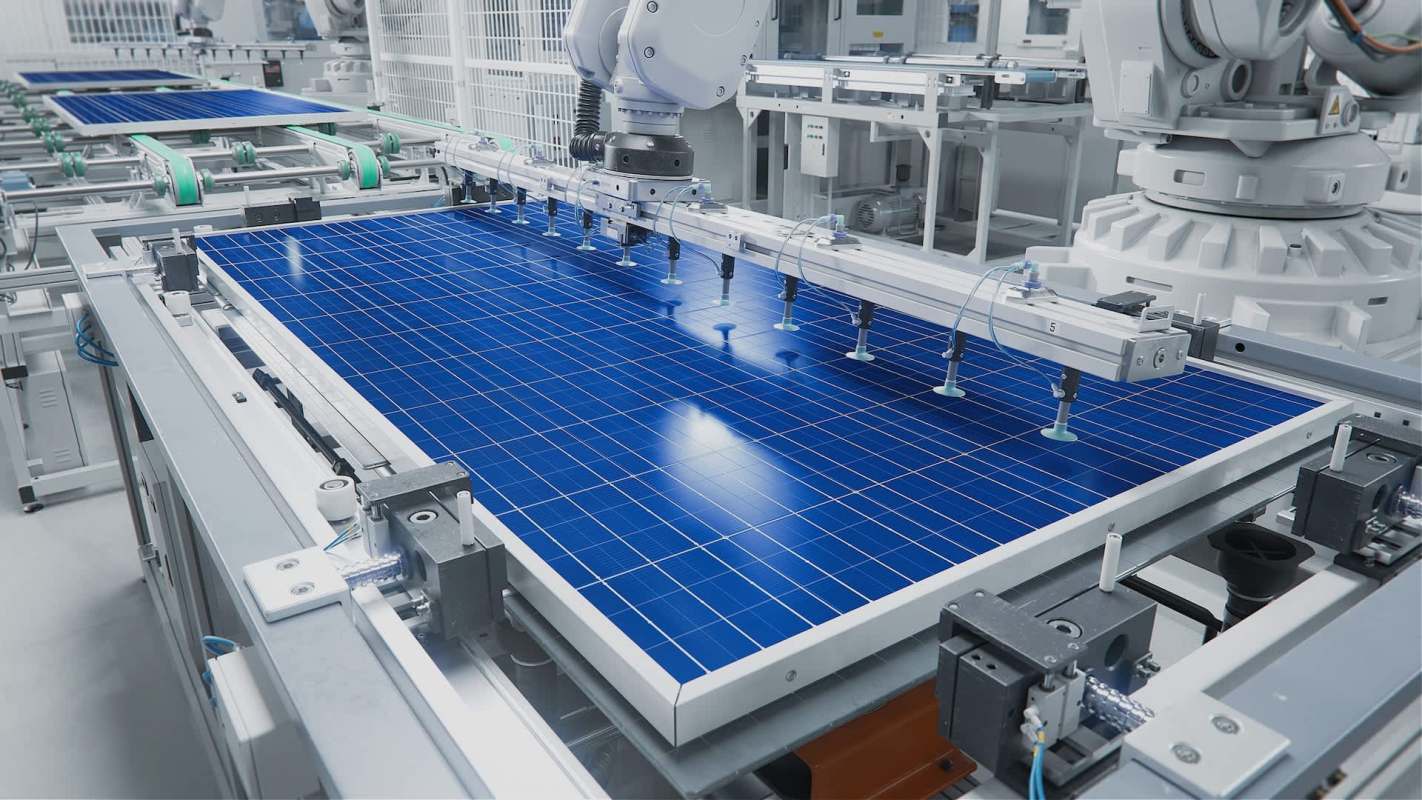
Chinese prices for TOPCon solar modules have ticked lower again, suggesting manufacturers are trimming their offers as more high-efficiency supply reaches the market.
That could have implications well beyond the factory floor, as lower panel costs can eventually help make solar projects more affordable for utilities, businesses, and homeowners alike.
What's happening?
In OPIS' July 28 Global Solar Markets Report, the Chinese Module Marker for TOPCon modules under 645 watts on a free-on-board China basis was assessed at $0.109 per watt, with spot indications running from $0.104/W to $0.119/W, according to pv magazine.
For 2027 loading cargoes, OPIS assessed Q1 at $0.109/W, Q2 at $0.108/W, and Q3 at $0.109/W. Q3 2026 and Q4 2026 cargoes were both also assessed at $0.109/W, indicating softer forward pricing.
Supply growth in higher-output products is part of what's pushing offers down. TOPCon modules above 650 watts were also heard lower, in the high-$0.100/W to mid-$0.110/W range. Back-contact modules still command a premium of roughly $0.02/W to $0.03/W over those higher-efficiency TOPCon products.
The pricing pressure is also building as China pushes manufacturers toward more efficient technology. Pv magazine reported that a national energy efficiency standard will take effect on January 1, 2027, setting new minimum efficiency and power-output thresholds for TOPCon, heterojunction, and back-contact modules.
TCD Picks » Quince Spotlight
💡These best-sellers from Quince deliver affordable, sustainable luxury for all




Why does it matter?
Solar panels are only one piece of the cost of a cleaner energy project, but they are a major one. When module prices fall, developers can build projects more cheaply, which can support more renewable power on the grid.
That may put downward pressure on electricity costs over time, and it can speed up the replacement of coal, oil, and gas-fired power with cleaner energy. More solar on the grid can also improve energy security by diversifying power supplies.
These are wholesale export prices in China, not the sticker price a homeowner sees on a rooftop system. Shipping, tariffs, installation labor, financing, permitting, and local market conditions all shape what consumers ultimately pay.
A sustained drop in module pricing can give installers and project developers more room to offer competitive deals, especially if higher-efficiency panels generate more electricity from the same amount of space.
What's being done?
China's industry and policy response aims to tie those price declines more closely to quality and efficiency, rather than to a race to the bottom. The China Photovoltaic Industry Association released the "General Principles for the Cost Accounting Model of the Photovoltaic Industry," a framework meant to standardize how costs are calculated across polysilicon, wafers, cells, and modules.
CPIA executive secretary Liu Yiyang said the model should help prices track more closely with what it actually costs to make a module, as well as its quality and competitiveness.
If you're thinking about solar for your own home, tools like EnergySage can help. The free marketplace lets you compare quotes from local, vetted installers without handing out your phone number, so you can shop around before committing.
These pricing shifts are part of a pattern of Chinese manufacturers pushing module efficiency higher while prices keep falling. Trina Solar chairman Gao Jifan told pv magazine greater cost transparency could "accelerate the phase-out of inefficient capacity" and "discourage excessive cost-cutting at the expense of product quality."

Get TCD's free newsletters for easy tips, smart advice, and a chance to earn $5,000 toward home upgrades. To see more stories like this one, change your Google preferences here.






