


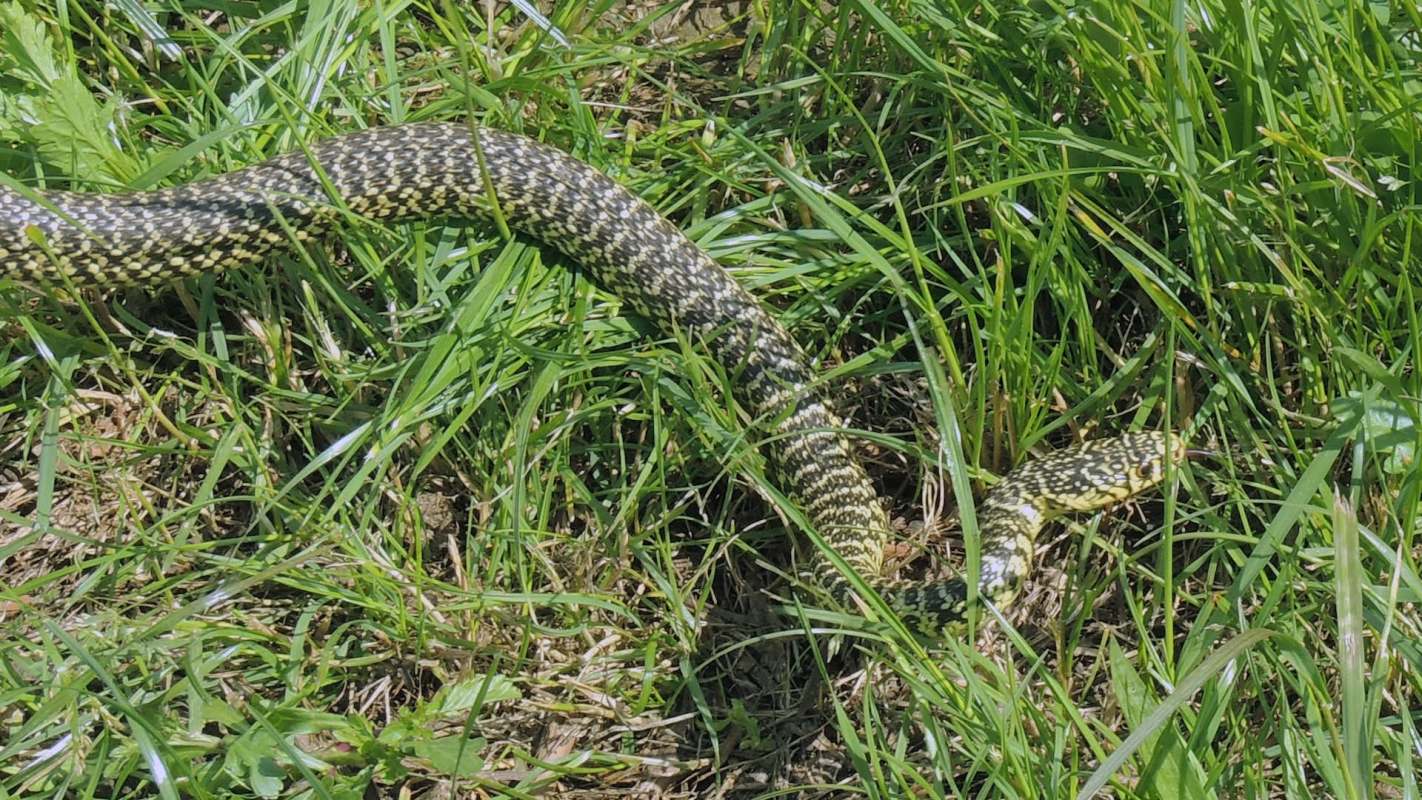
In southwestern Germany, a landfill has become home to what appears to be an expanding population of invasive green-and-yellow whip snakes.
One expert has already removed more than 300 of the snakes, but the total number living on and around the site may still be in the hundreds.
What's happening?
At the Mörsbach landfill near Zweibrücken in Germany's Western Palatinate, landscape ecologist and reptile expert Hubert Laufer has been following the snakes' presence for years.
As Euronews reported, Laufer thinks the species — known as Zornnatter in Germany because of its tendency to bite in self-defense — arrived around 2017 in discarded waste, possibly including a pregnant female that later reproduced at the site.
Although the species can reach about 1.5 to 2 meters (5 to 6.6 feet) in length, Laufer said the green-and-yellow whip snake is not considered dangerous to humans.
"When you catch a Zornnatter, it tries to bite the person catching it. But if the snakes can flee, they do. If you leave them alone, they won't do anything," he told Euronews.
TCD Picks » Quince Spotlight
💡These best-sellers from Quince deliver affordable, sustainable luxury for all




However, Laufer said the Zornnatter has posed a threat to native animals. The effects are already visible at the landfill site.
"There are almost no lizards left on the landfill site. If there is absolutely nothing else, they eat mice or young rats. But lizards are their favourite food," he told Euronews.
Why does it matter?
Invasive species can disrupt local ecosystems, throwing food webs out of balance and making it harder for communities to maintain healthy, resilient natural environments.
In 2021, the U.S. National Invasive Species Information Center reported that the global economic toll of invasive species over the past 50 years exceeded $1.2 trillion.
For Germany, Laufer said the threat is already concrete.
"Zornnattern are invasive and have negative effects on native fauna in Germany. That is why we want to capture them as quickly as possible," he told Euronews.
The case also highlights how waste sites can unintentionally help animals establish themselves outside their natural ranges. According to Euronews, the snakes shelter under roofing felt at the landfill, where trapped heat creates conditions suited to reptiles from southern France and Italy.
What's being done?
In 2025, Laufer was honored with the Gerhard Thielcke Nature Conservation Award for his work. He is continuing to capture the snakes, and the ones he removes are being given to caretakers who can house them properly, according to Euronews.
The Zweibrücken environmental and service operator UBZ, which oversees the Mörsbach landfill, is also seeking public help in tracking the snakes' spread.
Anyone who thinks they have seen a Zornnatter is encouraged to report it, ideally with a photo, so experts can determine whether it is the invasive snake or a native species.
Laufer told Euronews that about 25 sightings had been reported this year, though some turned out to be other species. Still, as he put it, "We would rather also receive grass snake sightings than miss a report of a Zornnatter."

Get TCD's free newsletters for easy tips, smart advice, and a chance to earn $5,000 toward home upgrades. To see more stories like this one, change your Google preferences here.







