


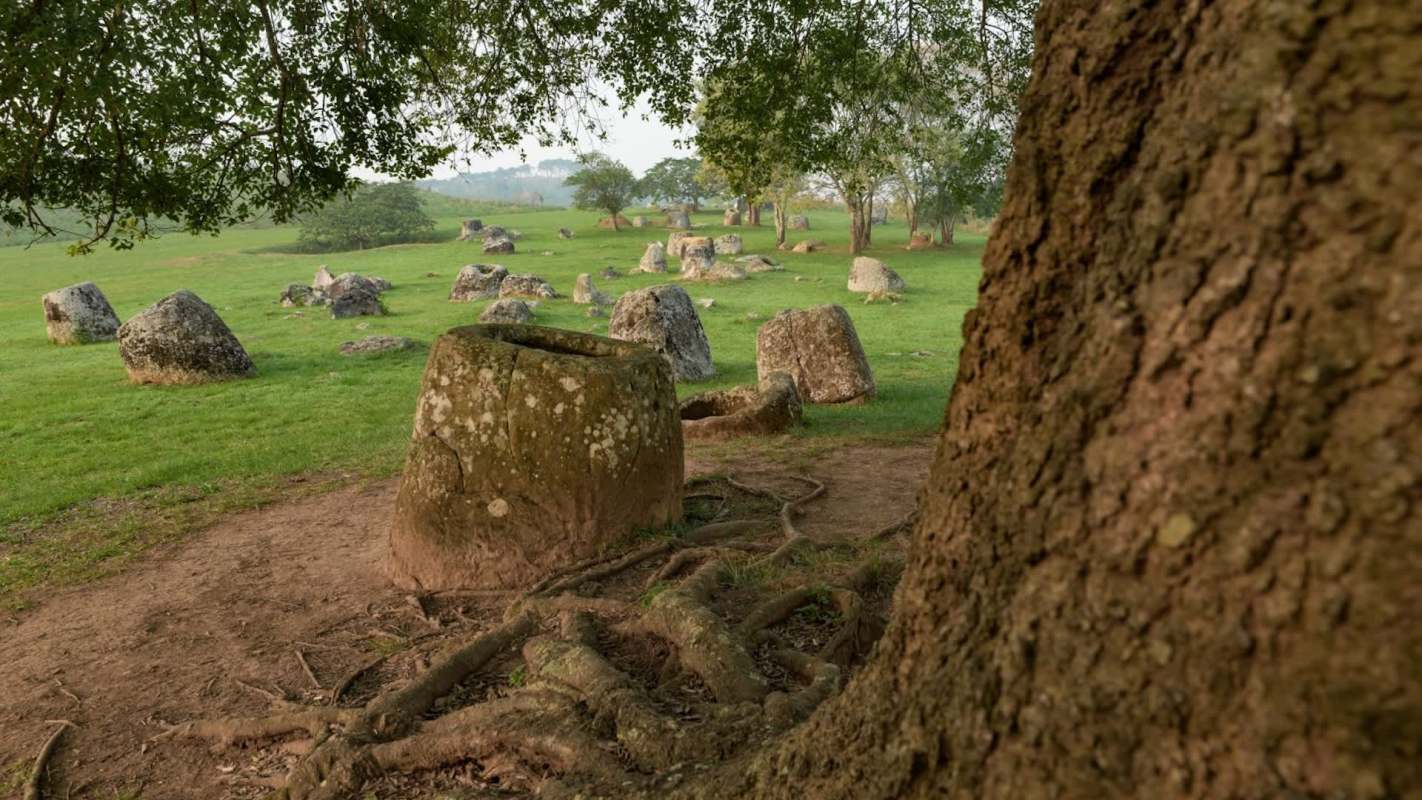
For decades, archaeologists have tried to explain the thousands of huge stone vessels spread across Laos' Plain of Jars in the highlands.
A major clue has now come from one of the largest examples: Instead of grain or sediment, researchers found bones belonging to 37 or more people inside it.
What happened?
At Site 75 in Laos' Xieng Khouang province, a team led by archaeologist Nicholas Skopal of James Cook University excavated a massive stone jar measuring nearly 7 feet wide at its base.
Earth.com reported that three field seasons of work turned up densely packed human bones inside the vessel, along with pottery fragments, several glass beads, a tiny copper bell and an iron blade.
Together, these finds offer the clearest sign so far that some of the region's giant jars served as collective burial sites. Comparing repeated bones and teeth, the team put the jar's toll at 37 people or more, from children about 18 months old to adults.
The bones weren't placed haphazardly. Skulls had been set around the vessel's outer edges, with long bones grouped nearby, pointing to deliberate arrangement.
TCD Picks » Quince Spotlight
💡These best-sellers from Quince deliver affordable, sustainable luxury for all




Radiocarbon dating puts the jar's use at roughly 270 years, likely between around A.D. 900 and 1200. The study appeared in Antiquity.
Why does it matter?
The discovery helps answer a question that has lingered since French archaeologist Madeleine Colani first documented the jars in the 1930s.
Researchers have identified more than 120 jar sites across the plateau, but since most of the vessels are empty, confirming what they were originally used for has been difficult.
The new evidence suggests the vessels may have anchored an elaborate mortuary tradition in which bodies decomposed elsewhere before the bones were collected and placed in the larger jars. It also suggests these rituals likely involved entire communities rather than a small elite group.
Trade connections also appear in the items buried with the dead. Chemical testing linked several of the glass beads to South Asia, suggested a couple may trace to Mesopotamia, and pointed to another possibly coming from southern China or northern Vietnam. These findings are similar to a 2,000-year-old gold ring recently recovered in western Thailand that pointed to the same kind of ancient trade network.
The burial practices and imported goods suggest highland Laos wasn't isolated. The communities using these jars appear to have been connected to broader regional networks of trade, culture, and identity.
What's being done?
Researchers are continuing to study the remains in greater detail, including at the Australian National University, where specialists are carrying out closer bone analysis and trying to recover ancient DNA.
That next stage of research could reveal how the buried individuals were related.
The Site 75 excavation is also giving archaeologists a new framework for interpreting the many other jars across Laos. Rather than assuming empty jars were unfinished or looted, researchers can now consider that some may once have held human remains that later decayed, were removed, or were relocated.
One giant jar has now changed the conversation around the entire landscape. After nearly a century of speculation, the Plain of Jars is beginning to give up one of its biggest secrets.

Get TCD's free newsletters for easy tips, smart advice, and a chance to earn $5,000 toward home upgrades. To see more stories like this one, change your Google preferences here.






