


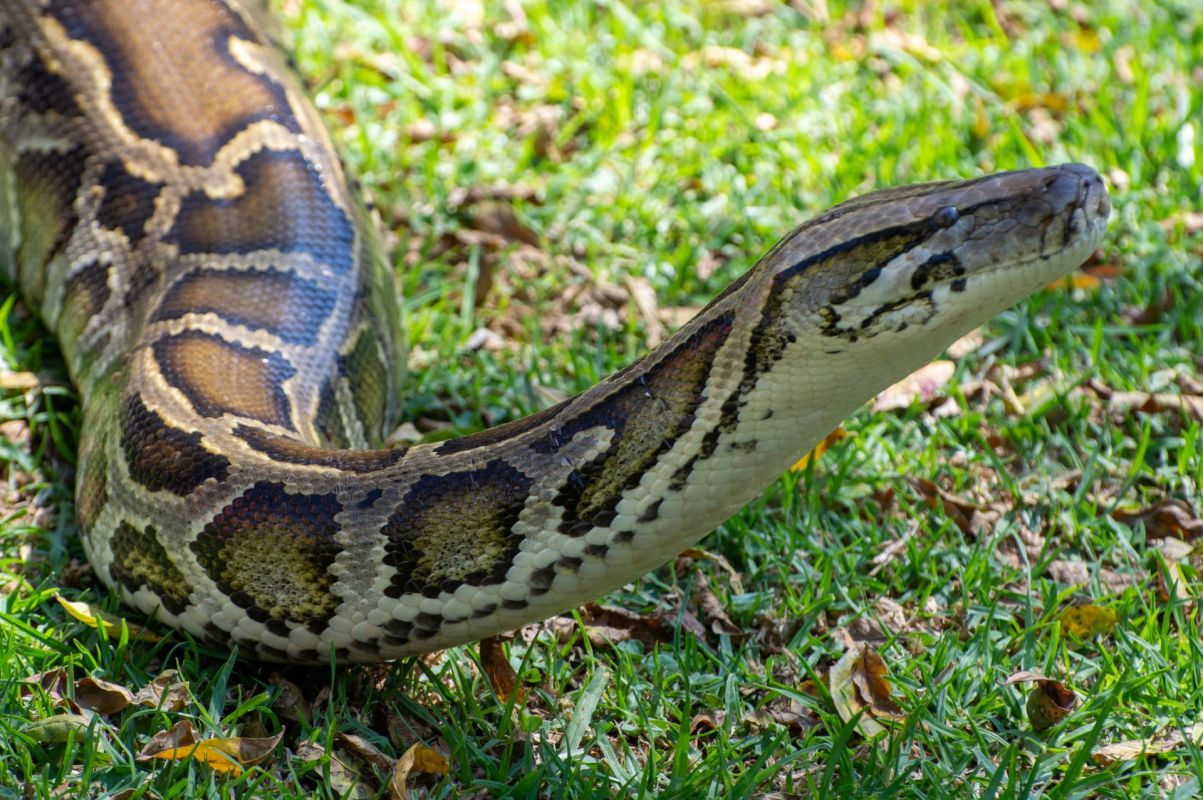
One of the Everglades' most destructive invasive species has a feeding ability that Florida biologists say was likely underestimated. They have now confirmed that Burmese pythons can swallow adult deer and American alligators whole.
What's happening?
A South Florida video showing a 115-pound snake consuming a 77-pound white-tailed deer has become a striking illustration of just how widely these pythons can open their mouths.
What makes this possible is how quickly a python's feeding capacity changes as the animal gets larger.
As reported by A-Z Animals, Bruce Jayne and colleagues at the University of Cincinnati published research showing that maximal gape does not simply rise in proportion to body length, but expands dramatically in bigger snakes.
Rather than dislocating their jaws, Burmese pythons rely on elastic ligaments linking the lower jawbones and on a flexible quadrate bone near the skull that allows the jaw structure to swing outward. Along with highly elastic skin, those features let the snake gradually work its jaws over prey and pull it down bit by bit.
Researchers say the deer incident is not a freak occurrence. Necropsies of captured Florida pythons have found adult and fawn white-tailed deer, mature alligators, wading birds, and endangered Key Largo woodrats inside them.
TCD Picks » Quince Spotlight
💡These best-sellers from Quince deliver affordable, sustainable luxury for all




Why does it matter?
This is a human-caused ecological problem.
Burmese pythons are native to Southeast Asia, but they established a breeding population in Florida largely because exotic pets escaped or were intentionally released. What began as a man-made wildlife trade problem has since become a threat to one of the country's most important ecosystems.
Native Everglades animals did not evolve alongside giant constrictors, which means many species lack the instincts needed to avoid them. Because the snakes also have no natural predators in Florida, they can spread and reproduce with little resistance.
Burmese python populations can also increase quickly. A single female can lay more than 50 eggs at a time.
Whenever scientists raise their estimate of what these snakes can consume, more animals end up on the vulnerable list. This has major implications for biodiversity, the health of the Everglades food web, and the people who depend on the region for recreation, tourism, and the environmental benefits a healthy wetland provides.
What's being done?
Florida has been trying to slow the invasion for years.
The Florida Fish and Wildlife Conservation Commission's annual Florida Python Challenge has helped remove more than 1,400 snakes since 2013. Professional hunters also work year-round to remove thousands more.
Researchers are now testing more advanced tools to locate snakes that are otherwise nearly invisible in sawgrass or water. Those methods include eDNA water sampling, K9s trained to find pythons, and radio-tagged wild snakes that can guide scientists to breeding groups.
Still, experts no longer see total eradication as realistic. The focus has shifted to suppression in high-priority areas and preventing the snakes from moving farther north or into coastal regions.

Get TCD's free newsletters for easy tips, smart advice, and a chance to earn $5,000 toward home upgrades. To see more stories like this one, change your Google preferences here.






