


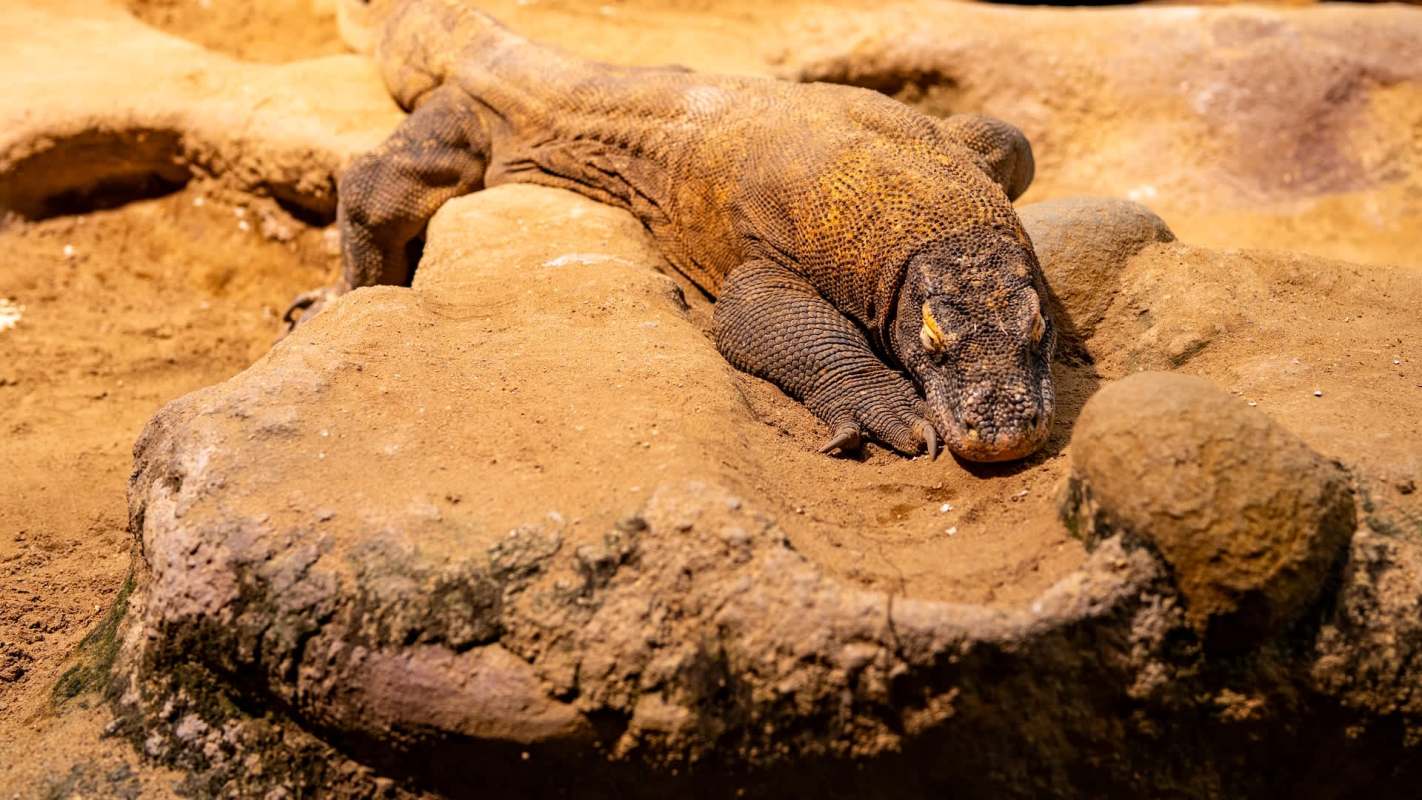
Indonesia's ancient "hobbits" may have endured not as daring hunters but as scavengers that capitalized on whatever food they could find, according to new research that questions one of the most familiar images of the tiny human relative.
As CNN reported, a study published Friday in Science Advances indicates that Homo floresiensis may have eaten meat after Komodo dragons had already fed on it and may not have cooked that food with fire.
What happened?
The remains that defined Homo floresiensis were discovered in 2003 at Liang Bua cave on Flores, Indonesia, according to CNN. Nicknamed the "hobbit," this small-bodied hominin likely reached about 3.3 feet in height and had a brain only slightly larger than a chimpanzee's.
Scientists had long connected the fossils with nearby stone tools and bones of Stegodon florensis insularis — an extinct elephant relative estimated to weigh about 1,260 pounds — which led many to infer that the hobbits hunted large animals and may also have used fire.
That reading bolstered the idea that the species displayed unexpectedly sophisticated behavior despite its very small brain.
"I wanted to see if we really could show that H. floresiensis was the hunter that it had been portrayed as for decades," Veatch said.
TCD Picks » Quince Spotlight
💡These best-sellers from Quince deliver affordable, sustainable luxury for all




To investigate that possibility, the researchers set ancient marks on Stegodon bones alongside two comparison sets: stone-tool cut marks and bite marks produced when a Komodo dragon named Rinca fed on a goat during a test at Zoo Atlanta.
Those comparisons showed that most of the ancient damage more closely matched traces left by Komodo dragons than evidence of active hunting.
The team also examined 4,500 rodent bones from Liang Bua and found no charring, which further suggests Homo floresiensis was probably not making cooking fires there.
Why does it matter?
If that interpretation holds up, it could change how Homo floresiensis is positioned on the human family tree.
Large-prey hunting and habitual fire use are often treated as key behavioral thresholds associated with larger-brained human groups, including Neanderthals, Homo sapiens, and Homo erectus.
A lifestyle centered on scavenged raw meat, along with plants and insects, would imply a very different way of surviving — one shaped by life on an isolated island where Komodo dragons were the dominant carnivore.
It also points to a human evolutionary story in which increasingly complex behavior did not emerge along a single shared track.
Rather than a pint-sized hunter, the species may now appear to have been an especially resourceful scavenger.
The study also adds to the debate over whether Homo floresiensis descended from Homo erectus or from a more primitive ancestor, closer to Homo habilis or even to Australopithecus-like forms.
What's being done?
Researchers are not treating the study as the final word, CNN noted.
They are expanding their work to look more broadly at what Homo floresiensis ate and how it fit into the Flores ecosystem over tens of thousands of years.
Veatch is continuing to study whether the species consumed other animals.
Research like this can overturn entrenched assumptions even without the discovery of new skeletons.
In this case, a living Komodo dragon, 3D scans, and tiny marks on bone combined to produce a clearer view of prehistoric life.
Human evolution was not a straight line.
Different relatives adapted in different ways, and some may have survived not by controlling fire or bringing down large prey, but by using what a dangerous landscape left behind.
"A more simplistic behavioral repertoire may indicate an ancestry that separated from the Homo lineage prior to these more advanced behavioral adaptations appearing in later-Homo species," Veatch said, according to CNN.

Get TCD's free newsletters for easy tips, smart advice, and a chance to earn $5,000 toward home upgrades. To see more stories like this one, change your Google preferences here.






