


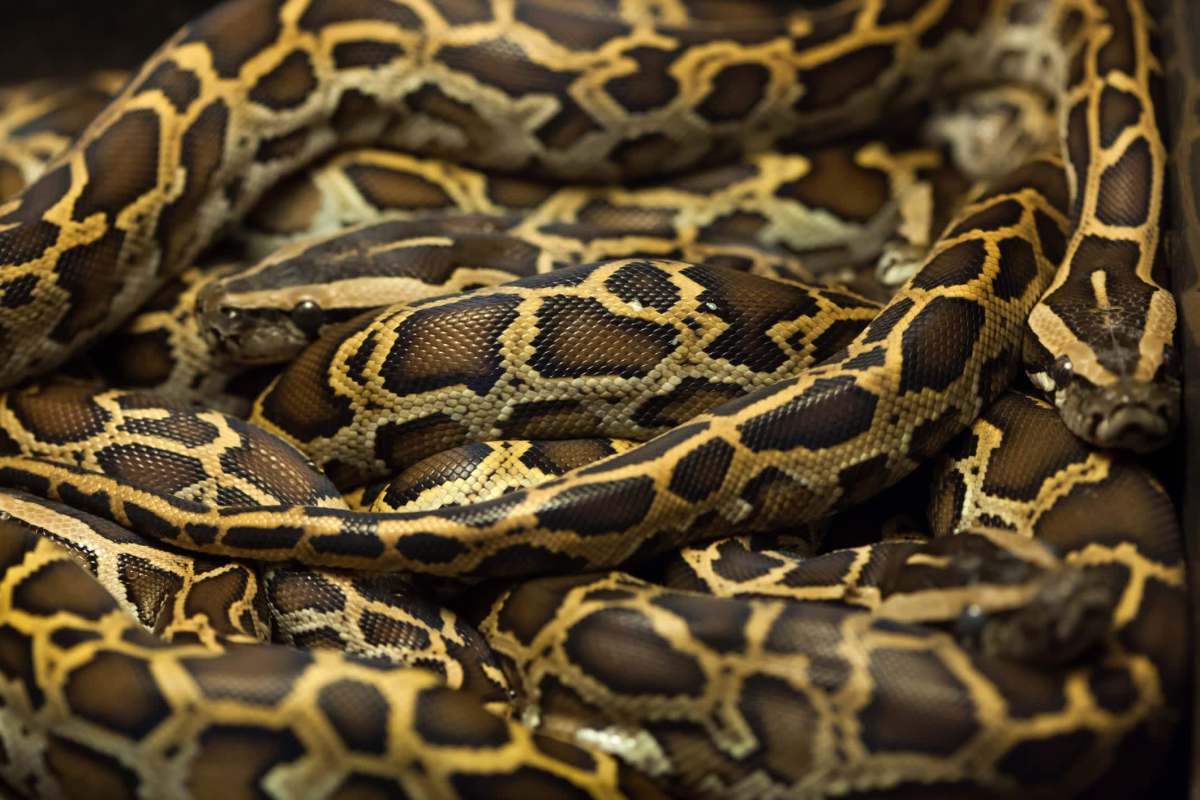
A Burmese python curled up inside a tractor-trailer engine near a Miami home is the kind of shocking discovery that can make any neighborhood feel like it's brushing up against the wilderness of the Everglades.
And it was not an isolated incident. Two more large pythons were removed from residential properties in South Florida.
What's happening?
On Aug. 23, Miami-Dade Fire Rescue found a Burmese python in the engine compartment of a parked tractor-trailer. In two other encounters described by The Palm Beach Post, one snake was captured in a home's yard the next day, and another was removed from a shed after a report of a snake at a Miami home.
South Florida already has an established population of Burmese pythons. Native to South Asia, these nonvenomous constrictors gained a foothold in Florida after people involved in the pet trade released them, intentionally or accidentally. Their spread has since become one of the state's most destructive invasive-species problems, with the U.S. Geological Survey estimating the population at tens of thousands in the Everglades.
These snakes can also grow to enormous sizes. Adults are commonly reported at around 10 to 16 feet long, while the longest recorded in Florida measured 19 feet. The heaviest recorded in the state weighed 215 pounds.
Research cited in the report suggests that pythons tend to stay away from the most urbanized areas while still favoring habitat relatively close to development, with habitat "selection peaking at a distance of just 515 meters from urban development."
TCD Picks » Quince Spotlight
💡These best-sellers from Quince deliver affordable, sustainable luxury for all




Why does it matter?
The study noted that areas with plant waste, hobby farms, artificial lakes and nearby natural habitat can attract small mammals and birds — the kinds of prey that may also draw pythons closer to neighborhoods. Chickens, goats, and other farm animals luring these snakes highlight how human development can affect wildlife behavior.
Similar conflicts are becoming more common as communities overlap with wildlife habitats, such as when a California bear's euthanization due to a human encounter sparked public backlash with calls for policies that prioritize less lethal solutions.
Neighborhoods bordering wetlands, canals, and preserves can unintentionally create the conditions invasive wildlife needs to thrive.
The biggest threat, however, is to native animals. Burmese pythons have spread through more than 1,000 square miles in South Florida, according to the Palm Beach Post, and have been linked to steep declines in mammals including raccoons, opossums, bobcats, foxes and rabbits. With few natural predators in the region, they can consume prey ranging from rodents to deer.
The Palm Beach Post reported that Florida has not recorded any human deaths from wild Burmese pythons. The larger danger is the ecological disruption caused by a species humans helped introduce into the landscape in the first place.
What's being done?
In the latest cases, Miami-Dade Fire Rescue removed the snakes. Florida Fish and Wildlife officials also continue monitoring where pythons are established, though they note that confirming expansion can take time because the animals are so difficult to detect.
Do not try to handle or approach a large constrictor yourself. If one is spotted near a home, shed, garage, pond, or vehicle, local authorities or wildlife officials should be contacted.
Clearing yards of dense debris or plant-waste piles, securing small animals, and staying cautious near canals and lakes can help reduce the prey signals that may attract snakes.
Invasive-species problems rarely happen by accident alone. From the exotic pet trade to development built closer to natural habitat, human decisions can influence where wildlife ends up — and who ends up crossing paths with it.
As the U.S. Geological Survey put it, "attacks are improbable but possible in any locality where the animals are present and people are also present." It added, "The simplest and most sure-fire way to reduce the risk of human fatalities is to avoid interacting with a large constrictor."

Get TCD's free newsletters for easy tips, smart advice, and a chance to earn $5,000 toward home upgrades. To see more stories like this one, change your Google preferences here.







