


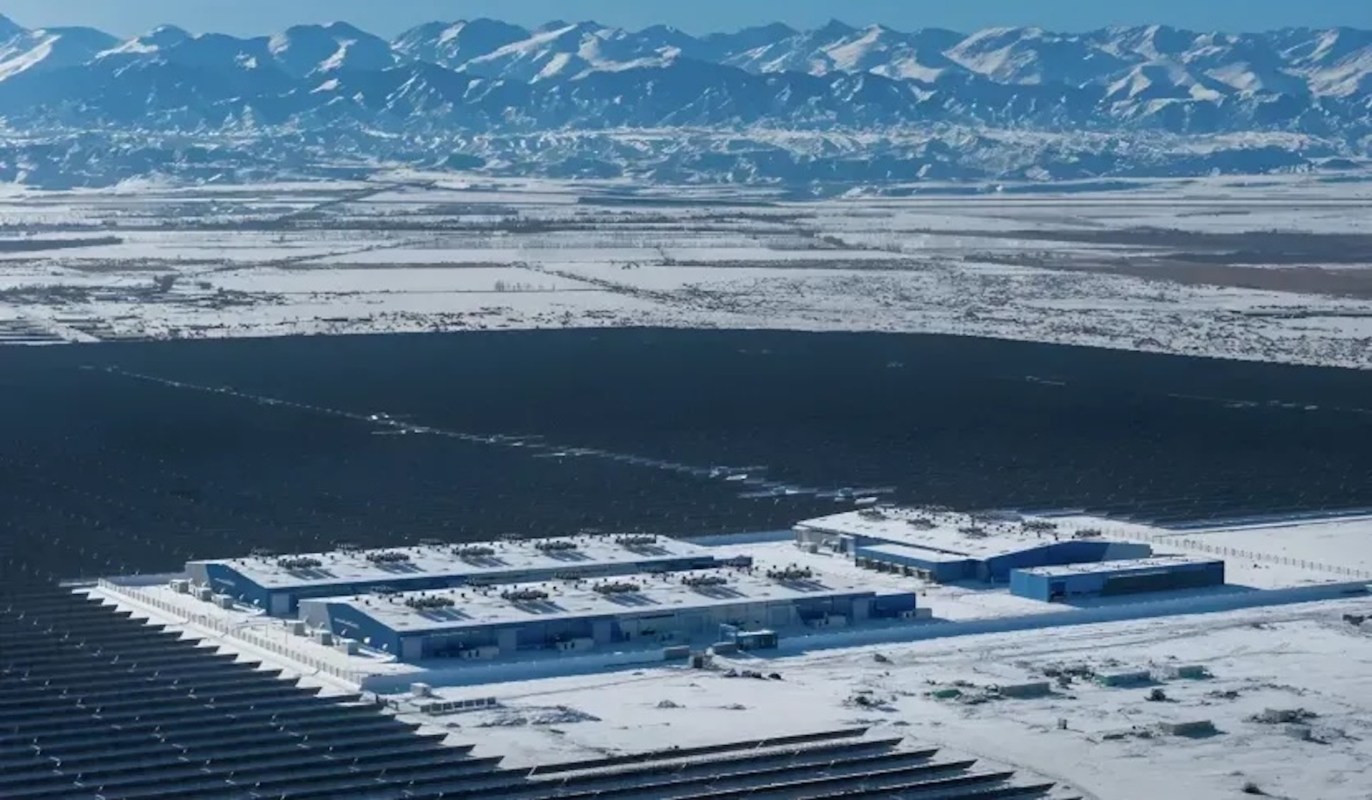
China's Gobi Desert is home to a new solar complex with an unusual capability. The project can continue supplying electricity to the grid for eight hours after sunset without using lithium batteries.
At 1 gigawatt, the installation will serve as a major real-world test of whether solar power can provide more dependable nighttime electricity without relying on huge battery systems that come with expensive costs and supply-chain pressures.
What happened?
According to Tech Times, China Three Gorges Corporation announced on July 1 that its Hami hybrid solar project in Xinjiang had entered commercial trial operation. The 1-gigawatt site pairs 900 megawatts of standard solar panels with a 100-megawatt concentrated solar power system that stores energy in molten salt.
The concentrated solar power system uses a linear Fresnel design, where 800,000 square meters of flat tracking mirrors concentrate sunlight on absorber tubes, heating molten salt for energy storage.
Instead of shutting down as daylight fades, the plant uses 260,000 tracking mirrors to focus sunlight, heat molten salt to roughly 1,022 degrees Fahrenheit (550 degrees Celsius), and store that energy for later use. The stored heat is used to produce steam and run a turbine during high evening demand.
Niu Jianle, director of the Hami project, said it is "capable of delivering stable power for up to eight hours straight," describing it as a key tool for "non-stop grid reliability." If the facility performs as expected, it could generate 2.07 terawatt-hours of electricity annually — enough to power about 830,000 households.
TCD Picks » Quince Spotlight
💡These best-sellers from Quince deliver affordable, sustainable luxury for all




Why does it matter?
Solar power is often cheapest and cleanest during the daytime, but electric utilities still need reliable energy at dusk, when people return home, turn on lights, and use appliances. That mismatch often forces grids to ramp up fossil fuel plants quickly, driving up costs and worsening air pollution.
A project like this could help address that problem. If thermal storage proves affordable at large scale, cities and utilities may have another option for keeping electricity steady without relying heavily on gas peaker plants or massive battery installations. That could help keep power prices more stable, while also cutting emissions and soot pollution that lead to higher temperatures and harm health.
The Hami plant also stands out because it uses desert land with intense sunlight and connects to long-distance transmission lines that carry renewable electricity to major population centers. The project is expected to prevent about 1.8 million U.S. tons (about 1.63 million metric tons) of CO2 each year, Tech Times reported.
What are people saying?
Niu said the facility is a "landmark leap, bringing the technology out of laboratory research and into large-scale commercial rollout," according to PV Tech.
Analysts, however, have been more cautious. Ember has estimated that shifting solar power into the evening with batteries still adds significant cost, while NREL researchers estimated that battery prices could continue falling by 2030. The real test will be whether strong performance and low costs hold up over years of operation.
Industry researchers also note that while CSP with thermal storage can provide long-duration dispatchable power, it typically competes with battery systems that may become chapter over time, especially for shorter-duration storage needs.
Even at an early stage, the Hami project shows that solar can be turned into more reliable, around-the-clock grid power by using innovative and clean heat sources like molten salt.

Get TCD's free newsletters for easy tips, smart advice, and a chance to earn $5,000 toward home upgrades. To see more stories like this one, change your Google preferences here.






