


An archaeological find announced in Mexico is attracting notice because it may shed light on an Indigenous culture from about 1,400 years ago that remains poorly understood.
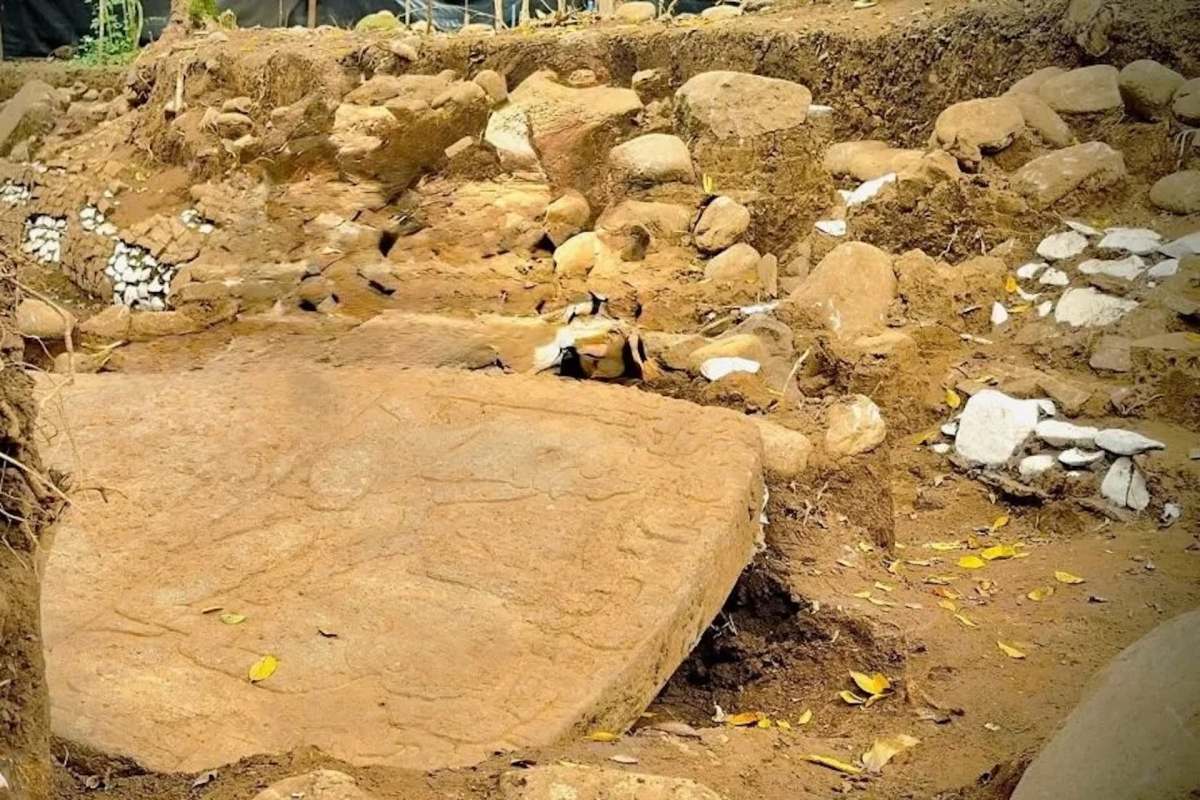
Near Coatepec in Veracruz, the team found an enormous stone platform, a carved stela, and what appear to be ritual offerings, including charred corn.
What happened?
Near Coatepec on Mexico's eastern side, archaeologists in Veracruz identified remains that seem to belong to an ancient settlement. According to Smithsonian Magazine, some of the discoveries resemble Maya traditions even though the site lies outside the Maya heartland.
In a translated statement, Mexico's National Institute of Anthropology and History (INAH) said the platform measures about 100 feet long and 40 feet wide. It was built with flagstones and a gypsum-like limestone that may have been heated, and it includes lines, boxy designs, and two circular stones.
Researchers also recovered buried vessels, fragments of burned maize, and a broken greenstone bead, which may have been deposited as offerings.
The excavation also revealed a stela, a carved stone slab about six feet tall that had been laid face down beneath later construction.
TCD Picks » Quince Spotlight
💡These best-sellers from Quince deliver affordable, sustainable luxury for all




In a video shared by the institute, INAH archaeologist Mireya Moreno Aguirre said, "The stela was placed face down, and structures were built on top of it."
Researchers think the carving depicts two elaborately dressed figures engaged in a ritual, possibly one involving water.
Why does it matter?
The discovery could help archaeologists better understand how ancient cultures in central Veracruz developed their own identities while still sharing ideas with neighboring regions.
Although the artifacts are reminiscent of Maya culture, experts do not believe the site necessarily belonged to the Maya or the nearby Totonac, according to the Smithsonian. Instead, it may point to a distinct local group whose traits have been compared to those of other ancient coastal peoples.
Charred maize, for example, suggests the central role of agriculture in ritual life, while the stela's possible depiction of a "divine liquid" may point to concerns over rain and drought — issues that still shape daily life for farming communities today.
What are people saying?
Describing the discovery, INAH archaeologist Lino Espinoza Garcia called it "a unique, unprecedented finding."
He said the figures on the stela appear to be part of a ritual in which "they have a bowl and are receiving something; we think it's a liquid."
Fellow INAH archaeologist Alberto Vázquez Domínguez described the platform as "a very particular structure," adding, "We don't have any records so far of a correlation with other (ancient) sites."
Annick Daneels, an archaeologist at the National Autonomous University of Mexico, said the stela's design is especially notable because "what is unusual for central Veracruz is a composition featuring two seated figures facing one another."

Get TCD's free newsletters for easy tips, smart advice, and a chance to earn $5,000 toward home upgrades. To see more stories like this one, change your Google preferences here.






