


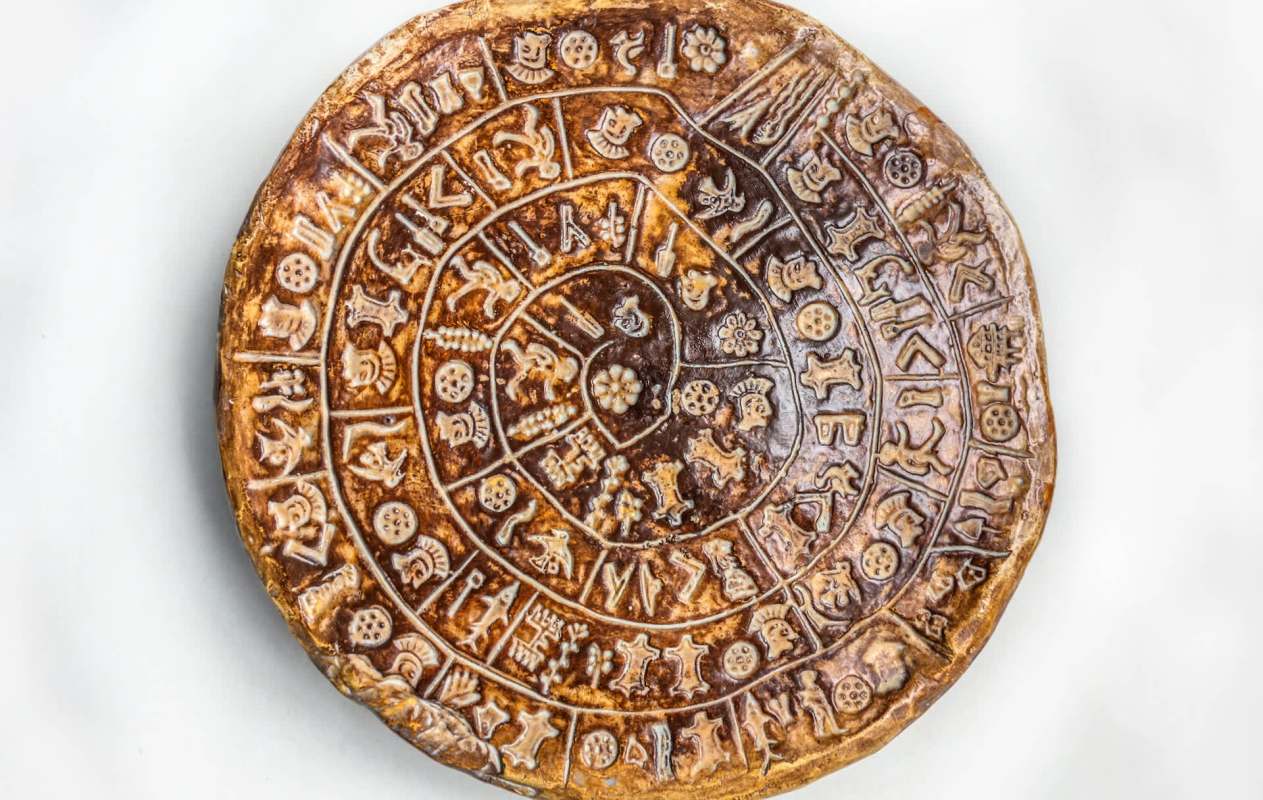
More than a century after it was first uncovered, the Phaistos Disc continues to baffle archaeologists and historians alike.
The ancient clay object from Crete has long been regarded as one of archaeology's most famous unsolved puzzles. Now it is gaining steam again after the revelation that researchers say there is more reason to believe it could be a long-lost board game.
What happened?
As Popular Mechanics detailed, the disc was unearthed on July 3, 1908, when Italian archaeologist Luigi Pernier was working at the palace site of Phaistos on Crete.
About 6.3 inches wide, the circular object is covered with 241 stamped signs laid out in a spiral. Only 45 of those symbols are unique, which is a total that is too large for a basic alphabet but much smaller than a typical hieroglyphic system, Popular Mechanics said.
The images include human figures, animals, objects, weapons, and armor, and the sequence seems to run from the rim inward toward the center.
Some scholars have long argued that the disc preserves a performative text, such as a poem, chant, or hymn. A preprint, though, has advanced a very different idea: that the object may have been used for play.
TCD Picks » Quince Spotlight
💡These best-sellers from Quince deliver affordable, sustainable luxury for all




Backers of the game theory point to the spiral format and stamped construction as clues that it was meant for entertainment rather than reading, Popular Mechanics said.
The publication pointed out that the clay appears not to have been intentionally fired. That could mean it was a prototype that survived only because a later palace fire hardened it.
Why does it matter?
The Phaistos Disc sits at the intersection of language, technology, and everyday life in the ancient world.
If it is truly a text, it would remain one of archaeology's most famous undeciphered messages. But if it turns out to be a game board, that could reshape how historians understand leisure, design, and communication in Minoan society.
Its method of manufacture is also striking. Instead of cutting the signs into the clay, the maker impressed them with stamps, which indicates an early example of blind printing.
That process suggests a surprisingly sophisticated production technique, one that would not become common again until medieval Europe.
What are people saying?
The pre-print's author, Constantinos Ragazas, summed up the argument based on a culmination of factors that could indicate it was in fact a board game.
"Manufacturing indicators, spatial zoning, orientation, comparative game design, and depositional context converge on an interpretation of the Phaistos Disk as an iterative procedural artifact, plausibly a specialized board game," Ragazas wrote in his research.
Ultimately, Popular Mechanics noted that the artifact "remains as mysterious as ever," due to its confluence of unusual characteristics.
"This reclassification accounts for long-recognized anomalies without recourse to undeciphered writing and places future investigation on firmerarchaeological ground," Regazas concluded in the preprint.

Get TCD's free newsletters for easy tips, smart advice, and a chance to earn $5,000 toward home upgrades. To see more stories like this one, change your Google preferences here.







