


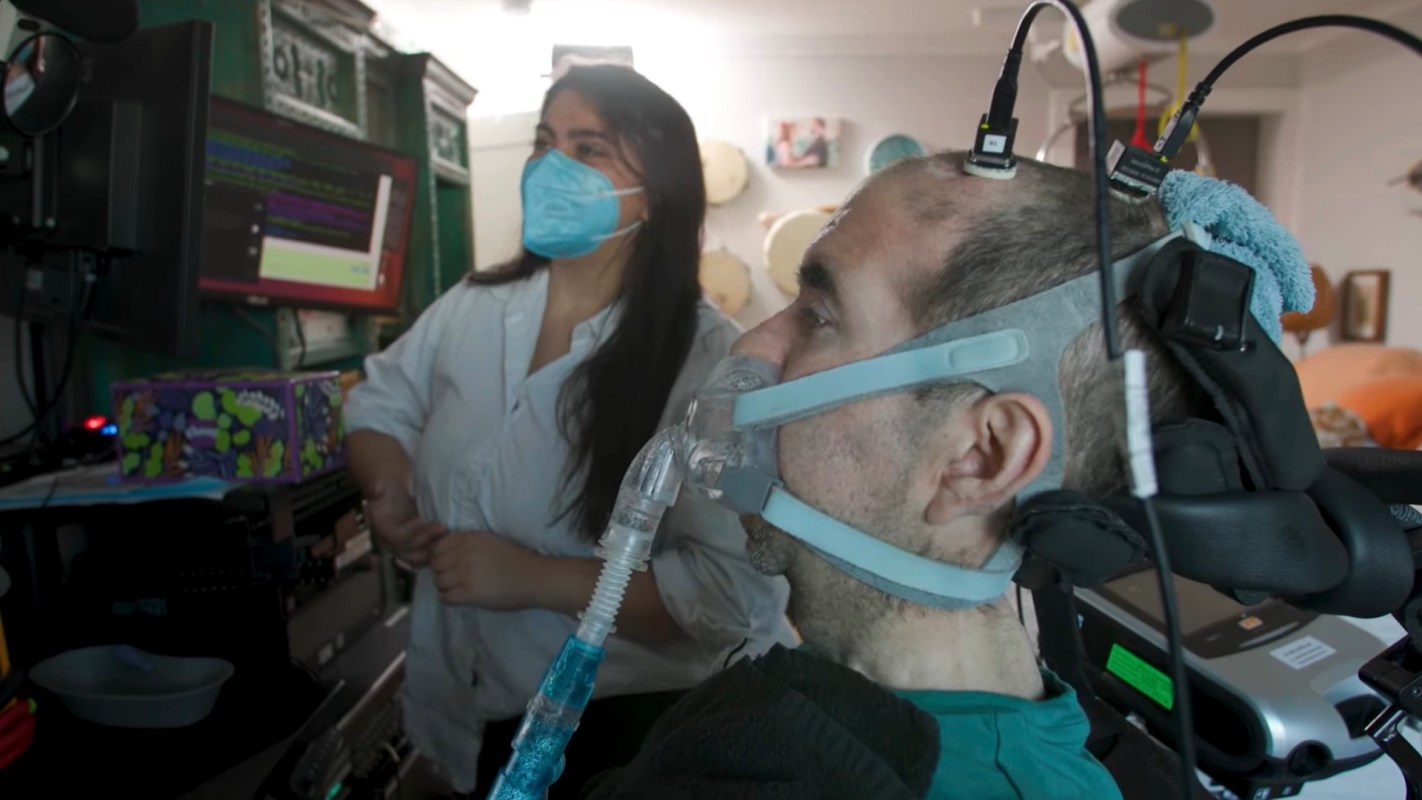
Nearly three years after getting a brain implant, a man with ALS is once again able to communicate clearly enough to work and use the internet.
MIT Technology Review reported that his case arrives as brain-computer interface research is accelerating, and gives a concrete example of how the technology could affect everyday life.
What happened?
Casey Harrell, a climate activist living with ALS, received a brain-computer interface, or BCI, in July 2023 through a University of California, Davis, research team.
Harrell is paralyzed and, MIT Technology Review reported, cannot reliably make himself understood without the system. Electrodes on the brain capture speech-related activity, and software converts those signals into speech sounds while predicting what he is trying to say.
Before the message is spoken aloud, Harrell uses an eye-gaze tracker to catch and correct any mistakes.
In practice, that has given Harrell a large degree of independence to "speak," go online, reconnect with friends and family, and continue doing his job.
TCD Picks » Quince Spotlight
💡These best-sellers from Quince deliver affordable, sustainable luxury for all




MIT Technology Review also reported that researchers added everyday features such as a privacy mode and a profanity filter meant to reduce the chance of accidental swearing when he talks with his daughter.
Harrell called the experience "nothing short of revolutionary!"
Why does it matter?
Harrell's experience points to a possible future for assistive technology.
Brain-computer interfaces are still experimental, but his case suggests they could help people who lose speech or movement avoid deeper isolation by preserving communication, employment, independence, and close contact with loved ones.
MIT Technology Review noted that BCIs have mostly been tested in volunteers with spinal cord injuries, though newer efforts are targeting speech restoration for conditions including ALS.
The technology is also improving quickly. Some systems are fully implanted and wireless, while others, like Harrell's, connect to external computers.
A 2024 review cited by MIT Technology Review found 67 volunteers in BCI trials spanning 1998 through the end of 2023.
Since then, the number of people implanted with a brain electrode has grown to more than double that total, as companies including Neuralink, Synchron, Neuracle, and Precision Neuroscience, along with academic groups such as BrainGate, expand trials.
Harrell has been open about what he sees as both the personal and scientific importance of participating.
He told MIT Technology Review he joined the effort to "pay it forward and do the scientific research … [and] get some personal benefit."

Get TCD's free newsletters for easy tips, smart advice, and a chance to earn $5,000 toward home upgrades. To see more stories like this one, change your Google preferences here.







