


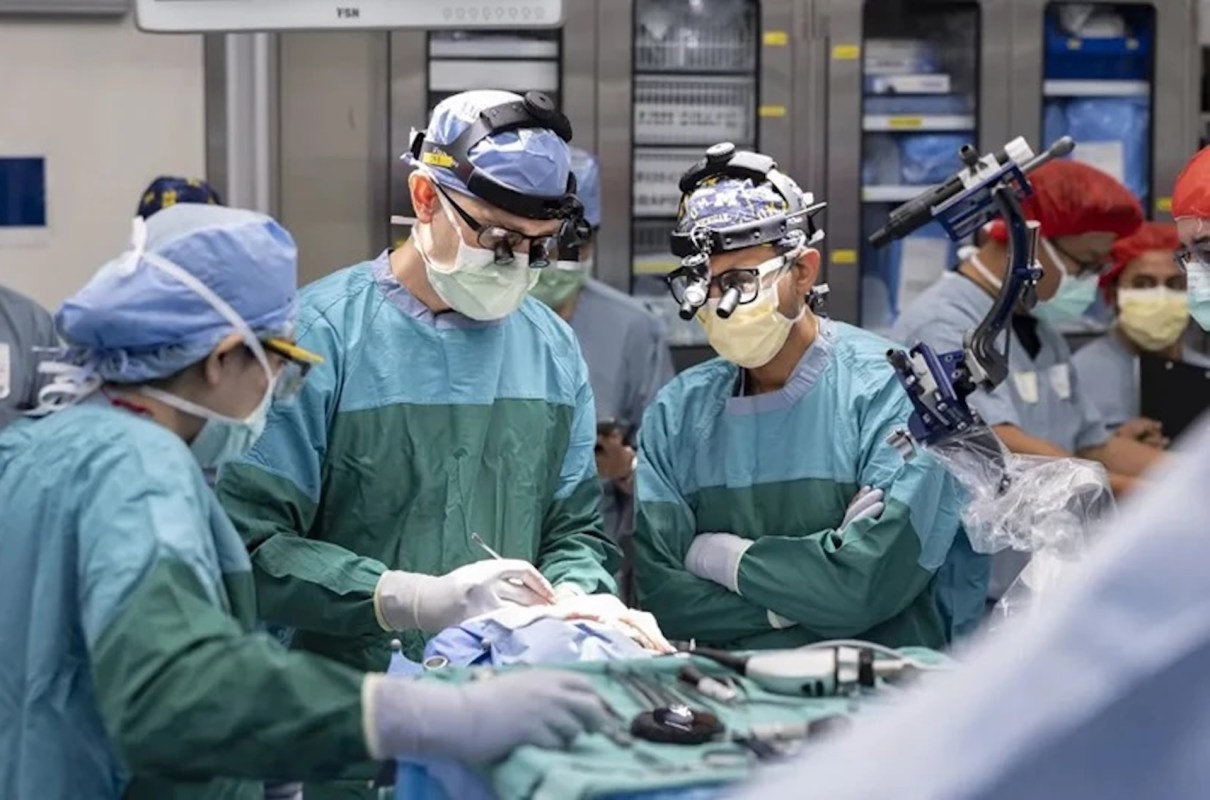
A first-in-human brain implant procedure at the University of Michigan Health is drawing attention for what it could mean for people who have lost the ability to speak.
What happened?
In the clinical trial, a U-M Health team implanted Paradromics' Connexus brain-computer interface in a participant whose motor neuron disease has made speaking difficult, according to Today's Medical Developments.
Researchers are studying the device through the national Connect-One Early Feasibility Study, which aims to assess safety and explore whether the technology can enable communication via synthesized text and speech while also allowing users to control a computer.
Matthew Willsey, M.D., Ph.D., a U-M Health neurosurgeon and biomedical engineer, carried out the implant procedure with Aditya S. Pandey, M.D., chair of the system's Department of Neurosurgery.
The device is one of a small number of fully implanted wireless BCIs now being tested in the United States.
Connexus uses 421 microelectrodes to detect signals from individual neurons. Those signals go to a small transceiver in the patient's chest, which then sends the information to an external receiver.
TCD Picks » Quince Spotlight
💡These best-sellers from Quince deliver affordable, sustainable luxury for all




The U.S. Food and Drug Administration granted the study an Investigational Device Exemption in November 2025, and Michigan Medicine is one of three sites enrolling participants.
Why does it matter?
For people living with diseases such as amyotrophic lateral sclerosis, or ALS, and primary lateral sclerosis, losing the ability to speak can profoundly affect independence, relationships, and everyday care.
Brain-computer interfaces are being developed to help bridge that gap by translating brain activity into actions such as typing, cursor control, or synthetic speech.
Early feasibility studies like this one are designed to answer practical questions about safety, monitoring, and the meaningfulness of the benefits in daily life.
The participant in this study will be followed for six years and will continue receiving specialized care through U-M Health's Stanford Morris ALS Clinic.
The procedure also builds on earlier work at Michigan Medicine. In June 2025, Willsey and Oren Sagher, M.D., who leads functional neurosurgery at U-M Health, temporarily implanted the same device during epilepsy research, helping confirm that it could be safely placed and record neural signals.
What are people saying?
Willsey called the moment a potentially transformative one, saying, "We are incredibly excited to investigate the potential of this wireless BCI to restore communication for people who have lost the ability to speak due to neurological disease or injury," according to Today's Medical Developments.
Paradromics CEO and founder Matt Angle, Ph.D., said, "Enrolling our first participant at University of Michigan is a defining moment for our company and for the field."
Stephen Goutman, M.D., M.S., director of the Stanford Morris ALS Clinic, said, "It is critical to preserve communication for all those living with motor neuron disease to keep individuals connected to their families and friends, and to preserve independence and quality of life."

Get TCD's free newsletters for easy tips, smart advice, and a chance to earn $5,000 toward home upgrades. To see more stories like this one, change your Google preferences here.






