


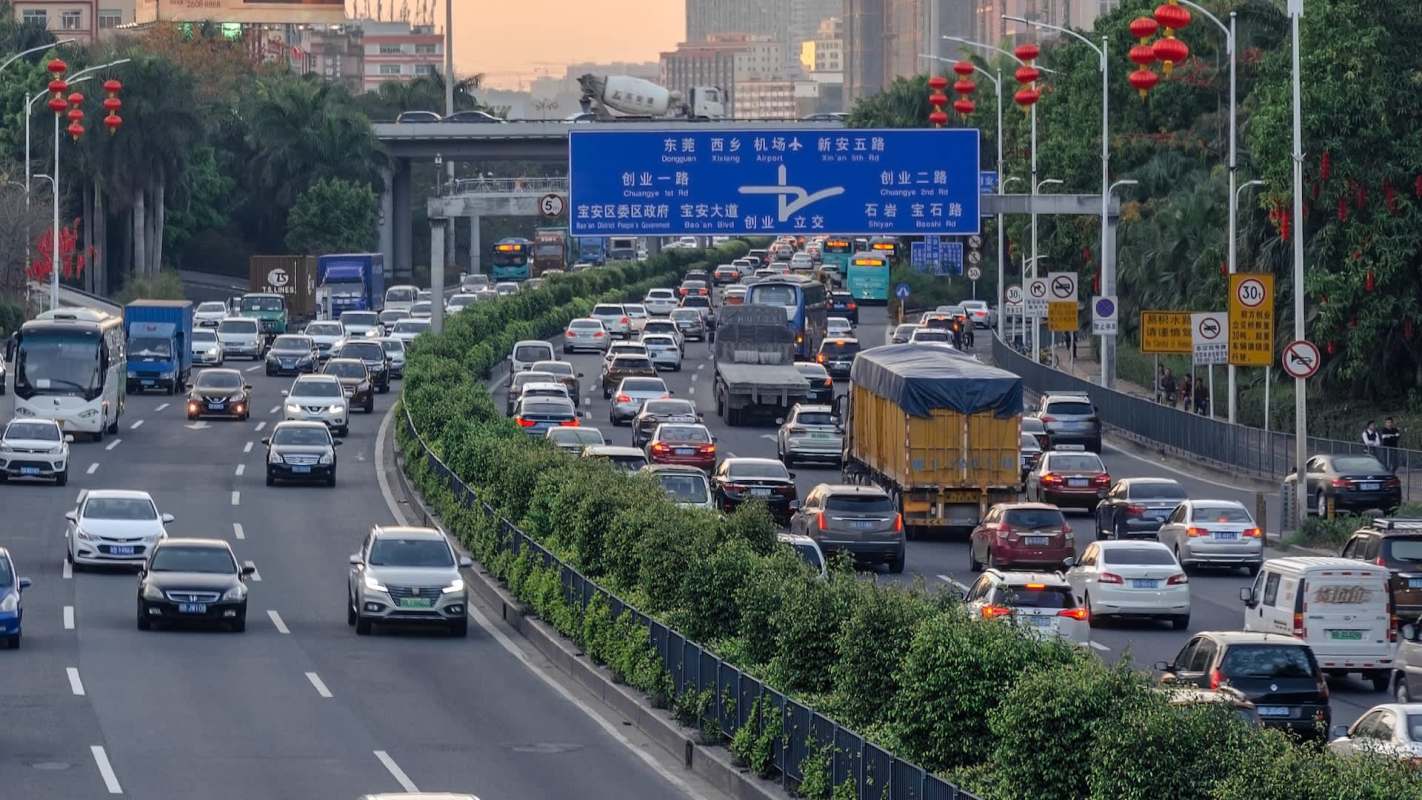
China's move away from gas-powered vehicles may already be bringing a significant public health payoff after some of the country's cities gained infamy as so smog-filled you could barely see past 300 feet on some days.
One new study, as reported by Electrek, estimates that cleaner air in China resulting from the shift to electric vehicles may have averted about 262,000 premature deaths.
The study, published in Nature Health, examined a question that has long surrounded the EV transition: whether rapidly replacing combustion-engine vehicles leads to measurable health benefits.
Researchers used machine learning alongside high-resolution satellite measurements of air quality in 150 Chinese cities, then compared those real-world conditions with a scenario where every vehicle on the road still used a combustion engine.
By 2023, cities with more new energy vehicles — including battery-electric, plug-in hybrid, and hydrogen models — were linked to lower pollution levels, with particulate matter, or PM2.5, down 23.80% and carbon monoxide down 30.67%.
Overall, the results provide real-world support for the idea that transportation electrification can improve air quality.
TCD Picks » Quince Spotlight
💡These best-sellers from Quince deliver affordable, sustainable luxury for all




Even relatively small cuts in PM2.5 can be important because it is one of the most harmful pollutants people regularly inhale.
Long-term exposure has been linked to stroke, heart disease, lung cancer, and respiratory disease, while outdoor air pollution is associated with more than 4 million premature deaths around the world each year. Roughly one-quarter of those deaths occur in China, Electrek noted.
The reductions were not uniform across all pollutants. Nitrogen dioxide declined much less, and larger particle pollution showed only modest improvement.
Researchers said a key reason is that heavy-duty diesel trucks are still difficult to electrify and remain a major pollution source. They also found that the biggest gains were concentrated in wealthier cities, where new energy vehicle adoption has moved fastest, suggesting lower-income regions could see even greater health benefits when access widens.
The authors said electrifying passenger vehicles is making a difference, but that the next major public health gains will probably require a faster move away from heavy-duty diesel trucks and broader adoption beyond China's richest cities.

Get TCD's free newsletters for easy tips, smart advice, and a chance to earn $5,000 toward home upgrades. To see more stories like this one, change your Google preferences here.






