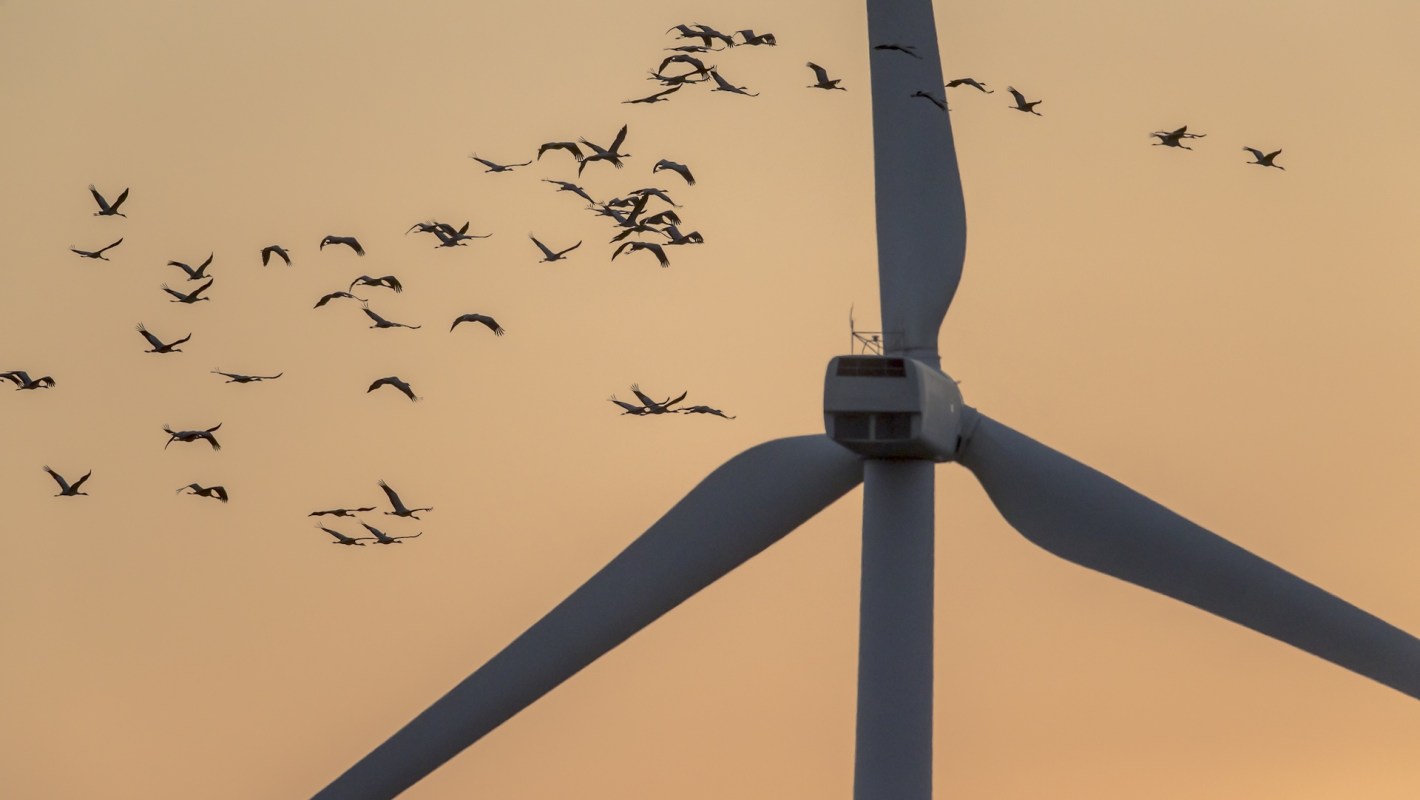
A simple paint job could make one of the world's growing clean energy technologies much safer for wildlife.
According to Popular Science, birds may be more likely to avoid wind turbines if the blades have bold warning-style colors inspired by animals such as coral snakes and poison dart frogs. The findings, published in Behavioral Ecology, suggest a relatively cheap change could cut bird collisions without slowing the shift away from non-renewable energy to clean renewables.
Wind power is one of the most important tools available for reducing the heat-trapping pollution driving extreme weather; higher energy costs; and serious health harms linked to gas, oil, and coal. However, while wind turbines are a net benefit to a cleaner future, they can still pose risks to birds and bats.
As Popular Science noted, turbines kill about two to six birds and roughly four to seven bats per megawatt annually. For widespread species, that may not sound like much, but for threatened and endangered animals, even small losses can be significant.
Scientists from the University of Helsinki and University of Exeter ran a lab test in which birds viewed videos of spinning turbine blades on a screen. The team compared a turbine with white blades, a turbine with a single black blade, one with red-striped blades, and a biomimetic black-red-yellow design.
Across almost all trials, the birds approached the white blades more often than the colored alternatives, and the black-red-yellow pattern prompted the greatest avoidance.
TCD Picks » Quince Spotlight
💡These best-sellers from Quince deliver affordable, sustainable luxury for all




"White blades, which are the most frequently used pattern around the world, turned out to be the worst option for birds," University of Helsinki environmental scientist and study co-author Johanna Mappes said in a statement, according to Popular Science. "This suggests that a relatively simple visual change could reduce bird mortality in connection with wind power."
If wind power developers can reduce bird deaths with something as simple as blade coloring, it could help communities expand clean electricity with fewer environmental tradeoffs. Bird-friendlier turbines could also strengthen public support for local wind projects, potentially making it easier to build more renewable energy installations that stabilize electric grids and reduce dependence on polluting, price-volatile fuels.
Conservation-minded design can make climate action solutions even stronger. Similar approaches could help reduce wildlife collisions with other human-made hazards, including power lines and building windows.
"By using a touchscreen especially designed for birds, we can use games to explore their behavior and ecology by simulating real-world scenarios, without putting the birds at risk," University of Exeter ecologist and study co-author George Hancock said.
"We've known for a long time that birds change how they respond to objects with warning colors," he added, "but to see such a large effect was remarkable."
There is still more research needed before the industry adopts the idea. The authors said the results should be replicated in real-world conditions to confirm how well the method works outside the lab.
Still, the early findings suggest that one small design change could help address one of wind power's most persistent wildlife concerns.
"If the results are repeated in practical conditions in different countries and with different bird species, it could be a significant change for the entire wind power industry," Mappes said, per Popular Science.

Get TCD's free newsletters for easy tips, smart advice, and a chance to earn $5,000 toward home upgrades. To see more stories like this one, change your Google preferences here.